
Chief Minister Accuses Opposition of Playing Politics; Udhayanidhi Stalin Demands Unity Against Karnataka’s Mekedatu Dam Project
Chennai: The long-running Mekedatu dam dispute once again became the centre of a heated political confrontation in the Tamil Nadu Assembly on Friday, with Chief Minister Vijay rejecting the Opposition’s demand for an all-party meeting and accusing rival parties of attempting to politicise an issue directly linked to the state’s Cauvery water rights.
The debate brought the differences between the ruling side and the Opposition into sharp focus, with Leader of Opposition Udhayanidhi Stalin arguing that Tamil Nadu’s political parties should put aside their differences and come together against Karnataka’s proposed Mekedatu dam project on the Cauvery River.
The dispute also expanded into questions over the Tamil Nadu government’s proposed political engagement with Karnataka, after Udhayanidhi questioned conflicting statements surrounding a reported visit by Vijay to the neighbouring state.
While the government maintained that it had already communicated its position to Prime Minister Narendra Modi and would continue pursuing the matter through legal and constitutional channels, the Opposition insisted that a united political response was necessary.
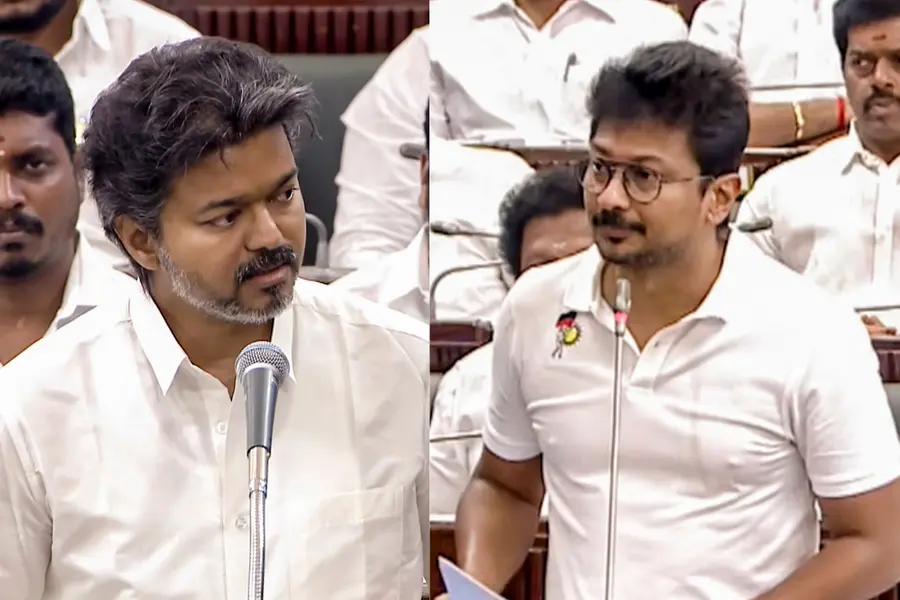
Table of Contents
Mekedatu Issue Triggers Assembly Face-Off
The Mekedatu project has remained a sensitive subject in Tamil Nadu because of its connection with the Cauvery River and the state’s concerns over water availability.
During Friday’s Assembly proceedings, Udhayanidhi Stalin called on the government to convene an all-party meeting to discuss the issue and formulate a common strategy.
He argued that Karnataka’s political parties had demonstrated unity on the Mekedatu project and said Tamil Nadu should adopt a similar approach.
“Like Karnataka, all political parties in Tamil Nadu should demonstrate unity against the Mekedatu dam,” Udhayanidhi said in the Assembly.
He also questioned why the government was reluctant to convene an all-party meeting when the issue, according to the Opposition, affects the interests of the entire state rather than a particular political party.
The demand for a joint meeting was presented as an attempt to build a broader political consensus over Tamil Nadu’s position on the proposed project.
CM Vijay Rejects Demand for All-Party Meeting
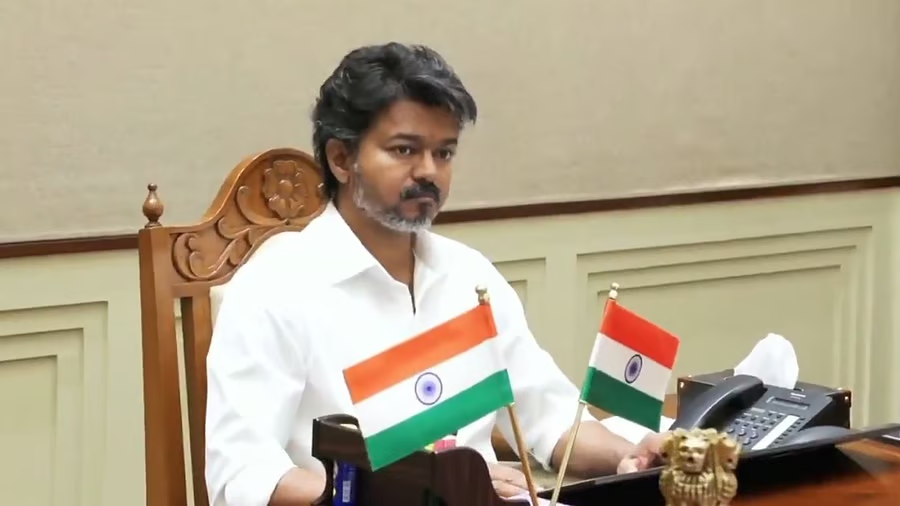
Responding to the Opposition’s criticism, Chief Minister Vijay rejected the demand for an all-party meeting.
Vijay said the government’s position had already been formally communicated to Prime Minister Narendra Modi through an official letter and argued that another political meeting was unnecessary.
“There is no need to convene an all-party meeting. Please do not play politics on the Mekedatu dam issue,” Vijay said.
The Chief Minister also asserted that his government would not compromise on Tamil Nadu’s interests concerning the Cauvery water dispute or the Mekedatu project.
He maintained that the government would continue to pursue the matter through legal channels while protecting what it described as the state’s rights.
The response effectively turned the Assembly discussion into a broader political argument over whether the Mekedatu issue should be addressed through an all-party consensus or through the government’s existing administrative and legal mechanisms.
Udhayanidhi Questions Karnataka Visit
The Opposition’s concerns were not limited to the proposed all-party meeting.
Udhayanidhi also raised questions about a reported plan for Vijay to visit Karnataka. He pointed to what he described as conflicting statements from Tamil Nadu ministers regarding the proposed visit.
He further referred to remarks attributed to Karnataka Chief Minister Siddaramaiah opposing such a visit.
According to the Opposition, these conflicting positions required greater clarity from the Tamil Nadu government, particularly because of the political sensitivity surrounding the Cauvery and Mekedatu issues.
Udhayanidhi argued that the government should make its position clear and ensure that any engagement with Karnataka did not weaken Tamil Nadu’s stand on the dam project.
The issue consequently became part of the larger political confrontation inside the Assembly, with the Opposition pressing the government for greater transparency and coordination.
Government Says Tamil Nadu’s Position Is Clear
The ruling side maintained that there was no ambiguity regarding its position on the Mekedatu project.
Vijay said the government had already conveyed its position to the Centre and would continue to defend Tamil Nadu’s interests.
He also accused Opposition parties of trying to claim political credit over an issue that concerns the state’s broader interests.
The Chief Minister’s position was that the Mekedatu dispute should not become an opportunity for political confrontation between parties.
Instead, he emphasised the government’s intention to use legal and institutional mechanisms to pursue the matter.
The exchange highlighted a recurring feature of inter-state water disputes in India, where state governments often have to balance political mobilisation with negotiations and legal proceedings involving neighbouring states and the Centre.
Delimitation Debate Adds to Political Tension
The Assembly confrontation over Mekedatu also unfolded against the backdrop of another politically sensitive issue—delimitation.
Tamil Nadu Minister CTR Nirmal Kumar announced that the government had convened a meeting of all Members of Parliament on Saturday to discuss the delimitation issue.
He also questioned whether DMK MPs would participate in the meeting.
The announcement became another point of contention during the Assembly proceedings.
Udhayanidhi accused the government of attempting to divert attention away from the Mekedatu dispute and the Opposition’s demand for an all-party meeting.
According to him, the Opposition’s immediate demand concerned the dam issue and farmers’ loan waiver, rather than the separate political discussion over delimitation.
The exchange demonstrated how multiple major political issues have converged in Tamil Nadu, creating additional friction between the government and Opposition.
Aadhav Arjuna Raises Previous Government’s Record
The political confrontation took another turn when Minister Aadhav Arjuna criticised the previous DMK government’s handling of the Mekedatu issue.
He referred to review petitions filed during the tenure of former Chief Minister MK Stalin and claimed that these petitions challenging Karnataka’s Mekedatu project had been dismissed by the Supreme Court.
The allegation immediately drew a response from DMK leader KN Nehru.
Nehru rejected the criticism and defended the previous government’s actions on the issue. He argued that the government had acted promptly and maintained that political parties should focus on protecting Tamil Nadu’s interests instead of using the Mekedatu dispute for political attacks.
The exchange underscored the extent to which the Cauvery issue continues to transcend individual political administrations, with both sides attempting to establish their credentials as defenders of Tamil Nadu’s water interests.
DMK Calls for Political Unity
Despite the political disagreements, KN Nehru stressed the importance of unity among Tamil Nadu’s political parties.
His position was that the state should maintain a common front against the proposed Mekedatu project rather than allow internal political disputes to weaken its position.
This argument broadly echoed Udhayanidhi’s call for an all-party meeting, although the ruling side remained opposed to the proposal.
The DMK’s emphasis on political unity reflects the sensitivity of the Cauvery dispute, which has historically generated strong public and political reactions in both Tamil Nadu and Karnataka.
PMK Also Supports All-Party Meeting
The demand for a broader political meeting also received support from PMK MLA Sowmya Anbumani.
She backed the proposal for an all-party meeting and called on the Tamil Nadu government to adopt further measures, including passing resolutions and taking the matter to the Centre.
Her intervention added another political voice to the Opposition’s demand for a collective approach.
With multiple parties calling for greater coordination, the pressure on the government to explain its strategy has increased, even as Vijay continues to maintain that the state’s position has already been communicated through official channels.
Why Mekedatu Remains a Sensitive Issue
The Mekedatu dispute is closely connected to the broader Cauvery water-sharing conflict between Tamil Nadu and Karnataka.
For Tamil Nadu, concerns surrounding the proposed project are linked to the availability and flow of Cauvery water, particularly for agriculture and other water-dependent activities.
For Karnataka, the project has been presented as an infrastructure proposal involving water management and supply requirements.
Because the river flows across state boundaries, developments involving major projects on the Cauvery frequently carry both legal and political consequences.
The latest Assembly confrontation therefore reflects more than a disagreement over whether to hold an all-party meeting. It also highlights the continuing political sensitivity surrounding inter-state water management.
What Happens Next?
The immediate focus is likely to remain on the Tamil Nadu government’s response to the Opposition’s demand and its broader strategy regarding the Mekedatu project.
The proposed meeting of Members of Parliament on delimitation is also expected to add another layer to the state’s ongoing political discussions.
Meanwhile, Opposition parties are likely to continue pressing for a united political position on the Cauvery issue, while the government maintains that it will protect Tamil Nadu’s interests through established legal and institutional mechanisms.
The Assembly debate has made one point clear: the Mekedatu project remains a highly contentious issue in Tamil Nadu politics.
While political parties disagree over the best way forward, there is broad political emphasis on protecting the state’s interests in the Cauvery dispute. The central question now is whether that common concern can translate into greater political coordination or whether the issue will continue to fuel confrontation between the government and Opposition.
For the moment, Chief Minister Vijay’s rejection of an all-party meeting has ensured that the Mekedatu dispute remains firmly at the centre of Tamil Nadu’s political debate, with competing arguments over unity, accountability and political strategy likely to continue in the days ahead.