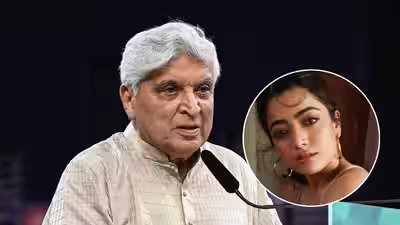
Veteran lyricist and screenwriter Javed Akhtar has come out in support of Rashmika Mandanna amid criticism of her Hindi pronunciation. However, his description of the actress as a Tamil actor sparked a fresh debate online, prompting him to acknowledge the mistake.
Javed Akhtar’s comments on Rashmika Mandanna‘s accent have triggered a wider discussion about language, regional identity and the treatment of actors working across India’s film industries. The veteran lyricist and screenwriter recently criticised social media users who have questioned Rashmika’s Hindi pronunciation, describing such behaviour as an example of what he called linguistic superiority.
However, while defending the actress, Akhtar referred to her as a Tamil actor in a post on X, formerly Twitter. The description quickly attracted reactions from users who pointed out that Rashmika is a Kodava from Karnataka’s Kodagu district and has built her career across several film industries, particularly Kannada and Telugu cinema.
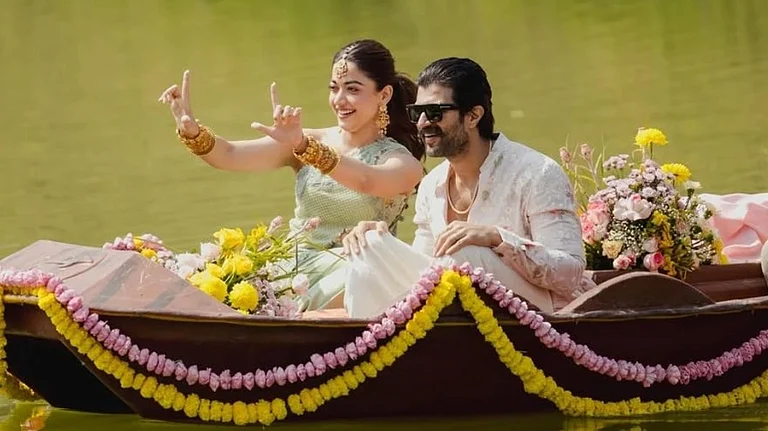
The controversy comes after Rashmika addressed the criticism surrounding her accent during an appearance on Koffee With Karan Season 9, where she appeared alongside her husband, actor Vijay Deverakonda. During the conversation, she discussed the challenges of working across languages and questioned why having a South Indian accent should be treated as a problem.
While many users appreciated Akhtar’s intention to defend the actress against accent-based trolling, others argued that regional and linguistic identities should be represented accurately. Akhtar subsequently acknowledged the correction, replying, “I stand corrected.”
The episode has shifted attention from the original criticism of Rashmika’s pronunciation to a broader conversation about linguistic diversity and the expectations placed on performers in Indian cinema.
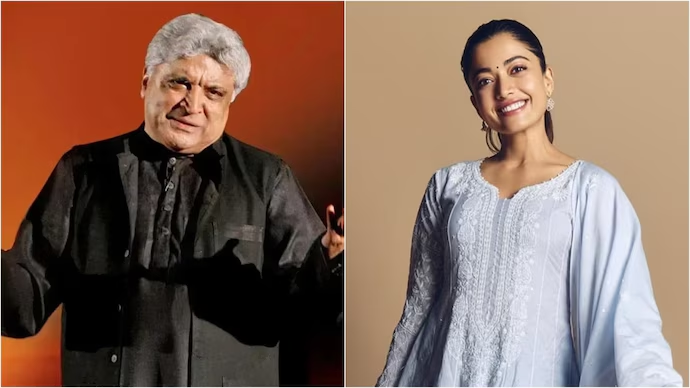
Table of Contents
Javed Akhtar Defends Rashmika Mandanna Against Accent Criticism
The discussion began when Akhtar took to X on October 25 to respond to the criticism directed at Rashmika’s pronunciation. The writer challenged those who judge others for their language skills and suggested that critics should attempt speaking a language themselves before questioning someone else’s pronunciation.
In his post, Akhtar wrote that people who had a problem with the pronunciation of the “Tamil actor Rashmika” should be given a few lines of Tamil to pronounce themselves. He also described the attitude behind such criticism as “fake and baseless linguistic superiority.”
His central argument was that people should not automatically look down on someone because they speak a language with an accent. The comment appeared to be directed at the tendency on social media to scrutinise actors’ speech, particularly when they move from regional cinema into Hindi-language films.
Akhtar’s intervention attracted attention because of his standing in the Indian entertainment industry. Over several decades, he has established himself as a lyricist, screenwriter and public commentator who frequently speaks about social and cultural issues.
His message found support among users who believed that an actor’s pronunciation should not become a reason for personal attacks. However, the description of Rashmika as a Tamil actor introduced another issue into the conversation.
Rather than remaining focused exclusively on accent-based trolling, the discussion expanded to include the differences between South India’s languages, communities and film industries.
Why Did Javed Akhtar’s ‘Tamil Actor’ Remark Trigger Reactions?
The main point of contention was Akhtar’s identification of Rashmika as a Tamil actor.
Rashmika is from Kodagu, also known as Coorg, in Karnataka. She belongs to the Kodava community and has worked across Kannada, Telugu, Tamil and Hindi cinema. Although she has appeared in Tamil-language films, describing her simply as a Tamil actor does not accurately reflect her regional background.
Several social media users pointed out the distinction in their responses to Akhtar’s post. Some explained that Rashmika is a Kannadiga by regional roots and is particularly associated with Kannada and Telugu cinema. Others noted that working in a particular language does not necessarily mean an actor belongs to the linguistic community associated with it.
The reactions highlighted an important distinction: an actor’s place of origin, mother tongue and professional filmography are related but separate aspects of their identity.
India has a highly diverse linguistic landscape, and South India alone includes several distinct languages with their own histories, literary traditions and cultural identities. Tamil, Kannada and Telugu are not interchangeable labels, even though actors may work across all three industries.
For this reason, some users argued that the error was particularly noticeable in a statement intended to challenge linguistic ignorance. Others maintained that Akhtar’s underlying message against accent-based prejudice remained valid despite the incorrect description.
The debate therefore developed along two parallel lines: support for Rashmika against online criticism and calls for greater accuracy when discussing regional identities.
Javed Akhtar Acknowledges the Correction
As the discussion grew, social media users continued to correct Akhtar’s description of the actress.
One user highlighted Rashmika’s Kodava background and her association with Telugu cinema, while appreciating Akhtar’s broader support for people facing linguistic prejudice.
Akhtar responded to the correction with a brief acknowledgment: “I stand corrected.”
His reply became another talking point because it showed that he had accepted the clarification rather than continuing to defend the incorrect description.
The response also brought the discussion back to the distinction between intent and accuracy. Akhtar’s original post was aimed at people criticising Rashmika’s pronunciation, but the terminology he used prompted a separate discussion about the importance of understanding the identities of India’s many linguistic communities.
For some users, his willingness to acknowledge the mistake was a positive response. Others continued to discuss the wider cultural assumptions that can emerge when people use broad regional labels without recognising the differences between individual states, languages and communities.
The episode demonstrates how quickly a social media post can generate multiple conversations, particularly when it involves a prominent public figure, a popular actor and a subject as culturally significant as language.
What Rashmika Mandanna Said About Her Hindi Accent
The controversy follows Rashmika’s recent appearance on Koffee With Karan Season 9, where she spoke about the criticism she has received throughout her career.
During the conversation with host Karan Johar, Rashmika explained that she had faced criticism for several aspects of her work, including her performances, acting choices, language and accent.
She said she had never wanted those opinions to create barriers for her as an actor. Instead, she wanted to work across different film industries and explore opportunities in multiple languages.
Rashmika explained that her ambition was not to restrict herself to one industry or one language. She also spoke about the satisfaction of being able to appear in films that are substantially different in tone and subject.
Her comments reflected the career path she has pursued, moving between regional cinema and Hindi-language productions. For her, the opportunity to take on varied roles has been an important part of her professional development.
The actress also questioned the expectation that someone from South India should be judged negatively for having a South Indian accent.
“I particularly didn’t have an issue with that because they said I had a South Indian accent, but I am from the South of India. So I am going to have an accent. It’s unreasonable to think otherwise,” she said, as reported by Hindustan Times.
Her response was not an argument against feedback on acting or dialogue delivery in general. Rather, it challenged the idea that a regional accent should automatically become a point of ridicule.
Rashmika’s Career Across Multiple Film Industries
Rashmika’s career has developed across several language-based film industries, making her a prominent example of an actor working beyond the boundaries of a single regional market.
She began her film career in Kannada cinema and subsequently established a strong presence in Telugu films. She has also appeared in Tamil and Hindi productions, reaching audiences with different linguistic and cultural backgrounds.
Her Hindi film work has brought her to the attention of a wider national audience. However, working in multiple languages also means navigating different pronunciation patterns, dialogue styles and performance expectations.
Actors working in multilingual productions often face the challenge of delivering dialogue in languages they may not have grown up speaking. Depending on the production, they may work with language coaches, practise pronunciation and collaborate with directors to achieve the intended performance.
Rashmika has previously spoken about the challenges of dubbing in different languages. Reports have also noted that she has offered to let other voice artists dub for her, while directors have often preferred her own voice for her performances.
That process can require considerable preparation, especially when an actor is expected to deliver emotionally demanding dialogue in a language with different sounds and speech patterns from their first language.
Rashmika’s approach reflects her stated ambition to continue working across industries rather than allowing criticism to restrict her professional choices.
Why Accents Remain a Subject of Debate in Indian Cinema
The discussion surrounding Rashmika’s pronunciation points to a wider issue in Indian cinema: the expectations placed on actors who move between linguistic markets.
India’s film industry is not a single-language system. It includes major industries producing films in Hindi, Telugu, Tamil, Kannada, Malayalam, Bengali and several other languages. Actors increasingly move between these markets as production companies seek wider audiences and stories reach viewers through dubbing and streaming platforms.
This movement creates opportunities for performers, but it can also expose them to heightened scrutiny. An actor who is familiar to audiences in one language may be judged differently when performing in another.
Pronunciation and dialogue delivery can be legitimate elements of acting criticism, particularly when they affect a character’s believability or the clarity of a performance. However, such criticism becomes a different matter when it turns into personal ridicule or assumes that an accent makes someone less capable.
Accents are a natural part of spoken language. They are shaped by a person’s linguistic background, region and experience. Speaking a language fluently does not necessarily mean speaking it without a regional accent.
The distinction is particularly important in a multilingual country, where people regularly communicate across languages. The ability to understand and respect those differences is central to meaningful cultural exchange.
Akhtar’s post brought this issue into focus, even as the debate over his description of Rashmika demonstrated why regional identities must also be treated with care.
Social Media Reactions Reflect Two Different Viewpoints
The responses to Akhtar’s post were divided between those supporting his message and those correcting his description of Rashmika.
One group appreciated his decision to speak against accent-based trolling. For these users, the important point was that people should not mock others for pronunciation without considering their own language skills or the challenges of speaking a second or third language.
Another group focused on the use of the term “Tamil actor”. These users argued that South Indian identities should not be treated as interchangeable and that Rashmika’s Kodava background deserved to be recognised accurately.
Some responses attempted to reconcile the two positions, suggesting that Akhtar’s intention was understandable even though the description was incorrect.
His subsequent acknowledgment that he stood corrected added another dimension to the conversation. It allowed the discussion to move beyond the original mistake and highlighted the importance of accepting factual corrections in public discourse.
The reactions also demonstrate how social media discussions can expand beyond their original subject. A conversation about an actor’s pronunciation became a debate about cultural identity, language and the responsibility of public figures when discussing sensitive social issues.
The Importance of Respecting Linguistic Diversity
The controversy serves as a reminder that language is closely connected to identity, culture and personal experience. In a country as linguistically diverse as India, accurate descriptions matter because they recognise the differences between communities rather than reducing them to broad regional categories.
At the same time, the criticism of accents raises questions about the standards by which multilingual performers are judged. Actors may be expected to speak several languages for professional reasons, but that expectation should not automatically translate into ridicule when their pronunciation reflects their linguistic background.
Constructive criticism can help performers improve their craft. Personal attacks based solely on accent, however, contribute little to meaningful discussion about acting or cinema.
Rashmika’s comments on Koffee With Karan Season 9 indicate that she intends to continue exploring roles across industries. Her position is that an accent should not become a barrier to taking on different characters or working in different languages.
Akhtar’s post, despite the error in identifying her, similarly challenged the assumption that people should be judged harshly for the way they speak.
The broader conversation therefore involves two important principles: recognising the diversity of India’s linguistic communities and allowing performers to work across languages without becoming targets of unnecessary personal criticism.
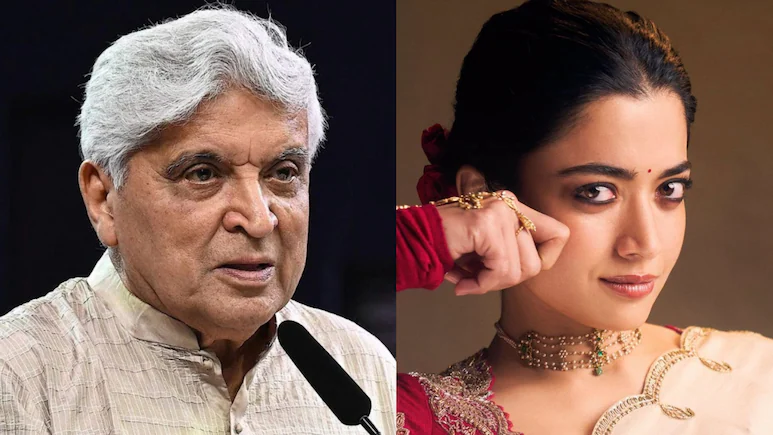
Javed Akhtar’s defence of Rashmika Mandanna has sparked a wider discussion after he referred to the actress as a Tamil actor while criticising those who mock her Hindi pronunciation.
Although many users supported his argument against what he described as linguistic superiority, others pointed out that Rashmika is a Kodava from Karnataka’s Kodagu district and has worked across Kannada, Telugu, Tamil and Hindi cinema.
Akhtar subsequently acknowledged the correction, replying, “I stand corrected.”
The episode follows Rashmika’s appearance on Koffee With Karan Season 9, where she discussed the criticism surrounding her accent and explained why she did not want it to limit her career across different film industries.
Ultimately, the controversy has highlighted both the problem of accent-based trolling and the importance of accurately recognising regional identities. While opinions may differ on an actor’s dialogue delivery, the debate has renewed attention on the need for more informed and respectful conversations about language in Indian cinema.