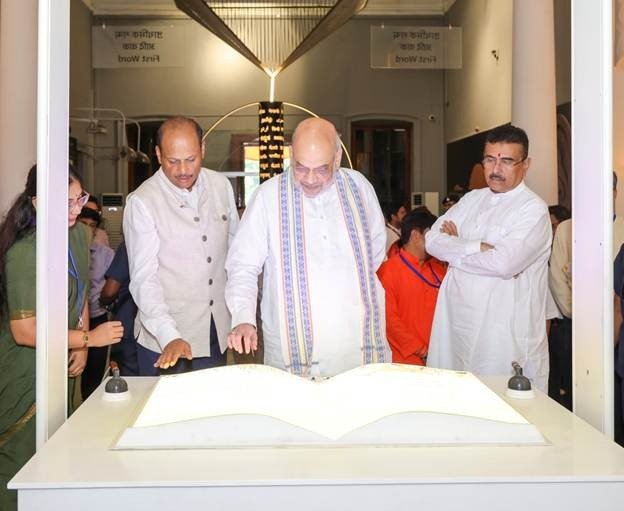
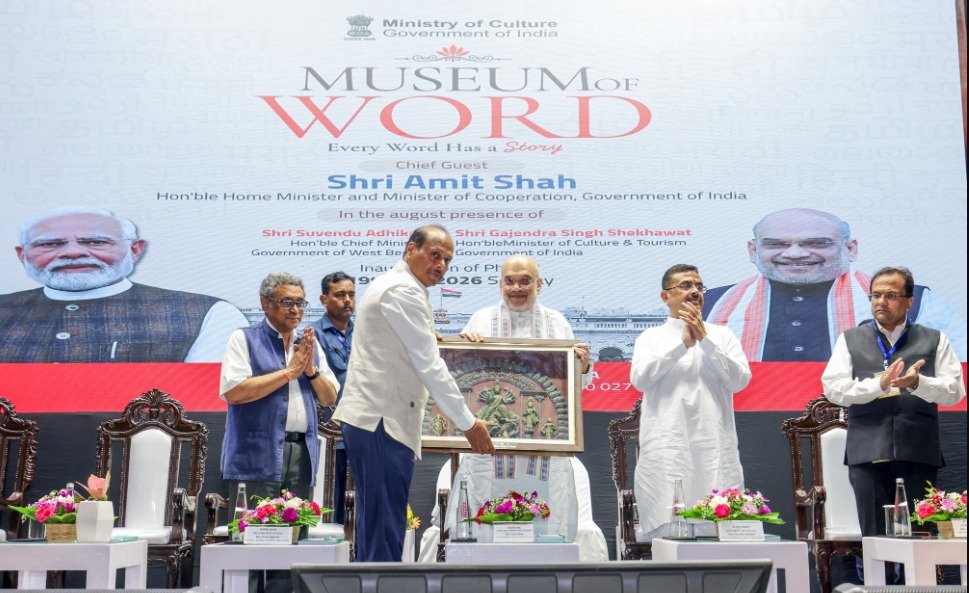
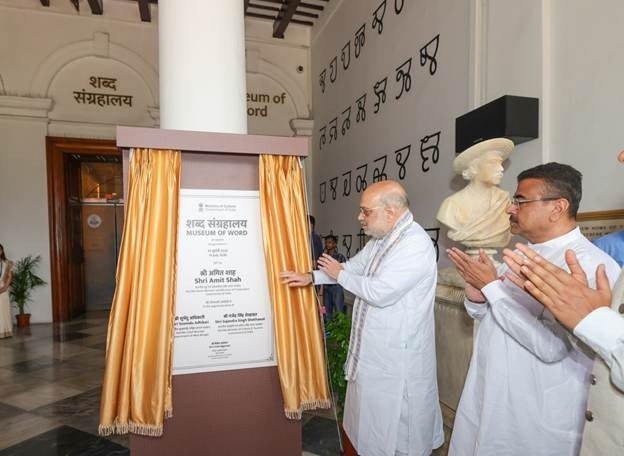
India has taken a significant step towards preserving its rich linguistic and cultural legacy with the inauguration of the first phase of the Museum of Word in Kolkata. Union Home Minister and Minister of Cooperation Amit Shah unveiled the museum, describing it as an important national initiative that reflects India’s civilisational journey through language while embracing the opportunities created by modern technology.
Developed by the Ministry of Culture, the Museum has been designed as an interactive cultural space where visitors can explore the evolution of language through visual displays, audio presentations, manuscripts, inscriptions, digital archives, and immersive experiences. The project aims not only to preserve India’s linguistic diversity but also to inspire future generations to appreciate the country’s literary, cultural, and intellectual heritage.
Speaking at the inauguration, Amit Shah said the Museum represents Prime Minister Narendra Modi’s vision of cultural resurgence and serves as a bridge connecting India’s ancient linguistic traditions with emerging technologies such as Artificial Intelligence. According to him, every Indian language should be digitally empowered so that it continues to remain relevant in an increasingly technology-driven world.
Table of Contents
Museum Brings India’s Linguistic Journey to Life
The newly inaugurated Museum has been created to showcase the remarkable evolution of language across thousands of years.
Unlike conventional museums that mainly display historical artefacts, this Museum combines traditional exhibits with modern digital technologies to offer an engaging and interactive learning experience.
Visitors can trace the development of language from the earliest philosophical concepts such as Omkar and the grammatical contributions of Panini to the oral traditions of Shruti and Smriti, ancient manuscripts, stone inscriptions, printing technology, digital documentation, and Artificial Intelligence.
By presenting language as a living and evolving cultural force, the Museum helps visitors understand how communication has shaped India’s civilisation across different historical periods.
The initiative also reflects the growing use of technology in preserving cultural heritage while making it more accessible to younger generations.
Amit Shah Highlights the Link Between Language and Culture
During his address, Amit Shah emphasised that language, words, emotions, and culture are deeply interconnected.
According to him, language is much more than a communication tool. It carries the history, traditions, values, and collective memory of a society.
He explained that words emerge from human emotions, while language gives those emotions a structured form. Over time, language itself becomes one of the strongest foundations of culture.
Therefore, preserving linguistic diversity is essential for protecting India’s broader civilisational heritage.
The Museum has been designed with this philosophy in mind by presenting language as an integral part of India’s cultural identity rather than merely a collection of words or scripts.
Technology Will Shape the Future of the Museum
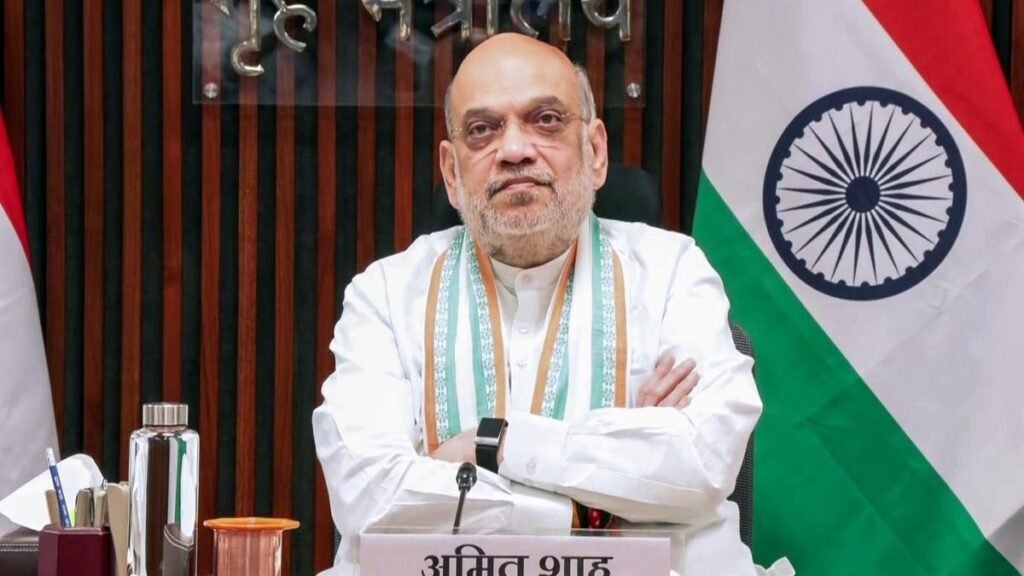
A major focus of Amit Shah’s speech was the need to integrate modern technology into language preservation.
He encouraged the Museum to continue expanding its digital capabilities by incorporating Artificial Intelligence and emerging technologies into future exhibitions.
According to the minister, digital tools can help preserve endangered languages, improve language learning, digitise historical manuscripts, and make linguistic resources available to people across the country.
Artificial Intelligence can also support translation, speech recognition, language documentation, and educational applications, helping Indian languages remain relevant in the digital age.
The emphasis on digital empowerment reflects India’s broader efforts to combine cultural preservation with technological innovation.
Preserving India’s Diverse Linguistic Heritage
India is home to one of the world’s richest linguistic traditions.
The country recognises 22 scheduled languages under the Constitution, while hundreds of regional languages and thousands of dialects continue to be spoken across different states and communities.
Many of these languages possess centuries-old literary traditions, unique scripts, oral histories, folk songs, and cultural practices.
The Museum seeks to preserve this extraordinary diversity by bringing together manuscripts, inscriptions, dialects, folk traditions, literature, and historical documents in one integrated cultural space.
Through interactive exhibits, visitors can explore how different languages have evolved while influencing one another over several centuries.
The project also highlights the role language has played in shaping India’s intellectual, philosophical, scientific, and literary achievements.
Museum Uses Immersive Learning Experiences
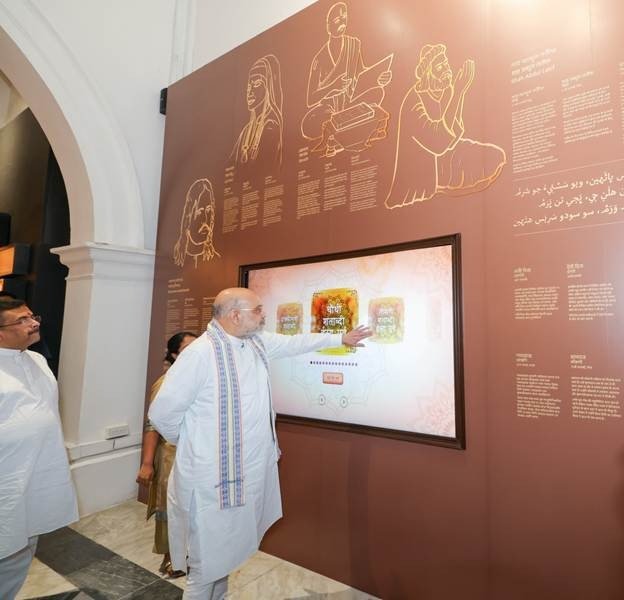
One of the distinctive features of the Museum is its use of immersive technology.
Rather than relying solely on traditional display cases, the Museum incorporates audio recordings, digital installations, visual storytelling, and interactive presentations.
These experiences enable visitors to hear ancient languages, examine historical manuscripts digitally, understand the evolution of scripts, and experience India’s linguistic history through multiple senses.
The Ministry of Culture has described the project as an effort to transform intangible linguistic heritage into something people can both experience and understand more effectively.
Such interactive learning methods are expected to attract students, researchers, historians, language enthusiasts, and tourists alike.
Importance of Mother Tongues
During the inauguration, Amit Shah also stressed the importance of promoting education through mother tongues.
He outlined five broad principles that he believes can strengthen Indian languages in the coming decades.
According to him, every family should serve as the first institution where children begin learning their mother tongue.
He also advocated that early education should be delivered in regional languages wherever possible, allowing children to develop stronger conceptual understanding.
The minister further said universities should become centres for original thinking in Indian languages rather than relying exclusively on foreign-language academic resources.
Digital technologies and Artificial Intelligence, he added, should actively support Indian languages instead of replacing them.
Finally, libraries and museums should expand beyond physical buildings by creating digital platforms capable of reaching larger audiences.
These recommendations align with the broader emphasis on multilingual education under India’s National Education Policy.
Encouraging Multilingual Learning
Along with preserving mother tongues, Amit Shah encouraged young people to learn at least one additional Indian language.
He observed that multilingualism strengthens national unity while allowing citizens to better understand India’s diverse cultural landscape.
Learning multiple Indian languages also improves communication, employment opportunities, academic collaboration, and cultural exchange among different regions.
The Museum itself reflects this multilingual vision by presenting India’s linguistic diversity as a shared national heritage rather than separate regional traditions.
Such initiatives may encourage greater appreciation of India’s cultural diversity among younger generations.
West Bengal’s Contribution to India’s Cultural Heritage
Amit Shah also referred to West Bengal’s historic contribution to India’s intellectual and cultural development.
He described the state as one of the major centres of India’s civilisational consciousness, noting its rich literary, philosophical, artistic, and nationalist traditions.
The inauguration also coincides with the 150th anniversary of Vande Mataram, one of India’s most significant patriotic compositions.
The minister further recalled the Central Government’s decision to grant Classical Language status to Bengali in 2024, describing it as recognition of the language’s deep historical and literary importance.
These references highlighted the broader cultural context in which the Museum has been established.
Museum Reflects India’s Cultural Renaissance
According to Amit Shah, the Museum represents an important milestone in India’s ongoing cultural renaissance.
India has increasingly focused on preserving monuments, manuscripts, museums, libraries, archives, and intangible heritage through modern conservation techniques.
Projects like the Museum demonstrate how traditional knowledge can coexist with emerging technologies.
Instead of treating history as something confined to textbooks, such institutions encourage public participation by making heritage more interactive and accessible.
The Museum also supports India’s larger vision of preserving cultural identity while embracing scientific and technological progress.
As digital technologies continue transforming education, communication, and cultural preservation, the Museum is expected to become an important centre for language research, public education, and heritage conservation. By combining India’s ancient linguistic traditions with immersive learning experiences, digital innovation, and Artificial Intelligence, the Museum aims to ensure that the country’s extraordinary language heritage remains relevant, accessible, and inspiring for future generations while reinforcing the importance of cultural identity in a rapidly changing world.