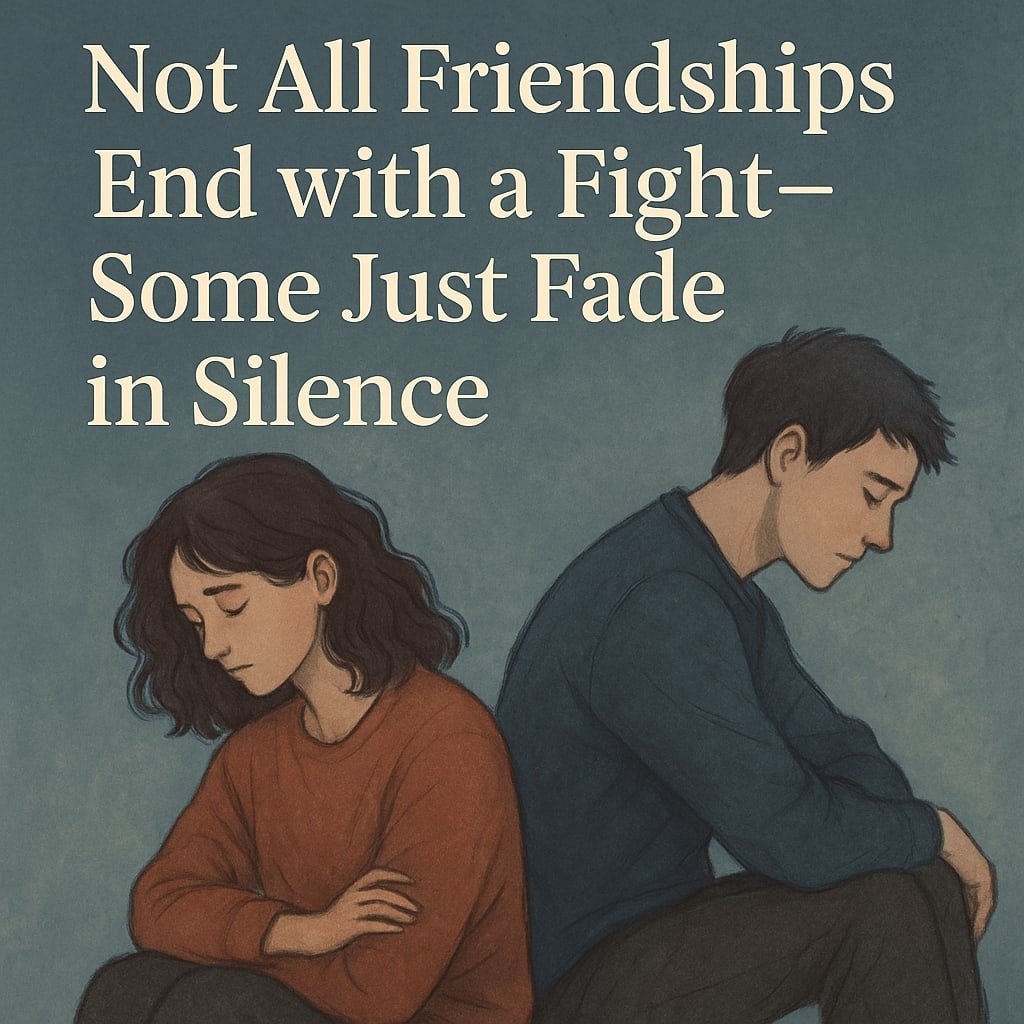
Not every friendship ends with an argument, betrayal or fight ,dramatic falling-out. Sometimes, there is no final conversation, no obvious reason and no moment when either person decides that the friendship is over. Instead, messages become less frequent, plans are postponed, conversations become shorter and, eventually, two people who once knew almost everything about each other become little more than familiar names in each other’s lives.
This quiet process can be surprisingly difficult to understand.
A friendship may appear perfectly fine on the surface, yet gradually lose its closeness. There may be no fight to point to, no single incident to blame and no clear ending to provide closure. Research on friendship dissolution suggests that adult friendships can end through both active and passive routes, with passive endings involving gradual distancing rather than a direct decision to terminate the relationship.
The phenomenon is particularly common as people move through different stages of adulthood. Careers, relationships, family responsibilities, relocation and changing priorities can reshape social lives. Friendships that once depended on daily proximity may suddenly require conscious effort to survive.
But why does this happen, and does a fading friendship necessarily mean that something went wrong?
Table of Contents
Friendships Do Not Always End With a Fight
When people think about losing a friend, they often imagine a dramatic event: an argument, a betrayal, a disagreement over money or a serious breach of trust.
However, friendship dissolution can be much less obvious.
Researchers studying friendship loss have identified different ways relationships can decline, including gradually distancing from a friend or reducing the closeness of the relationship without completely ending it. A 2021 study of emerging adults found that friendship dissolution could involve completely ending the friendship, distancing from the friend or compartmentalising parts of the relationship.
This helps explain why some friendships seem to disappear without a clear ending.
There may be no fight because there is no single event responsible. Instead, a series of small changes gradually alters the relationship.
One person becomes busy. The other stops initiating conversations. Plans become harder to arrange. New friendships develop. Priorities change. Eventually, both people may become accustomed to communicating less.
The friendship has not necessarily been deliberately rejected. It has simply become less central.
The “Slow Fade” of Adult Friendship
One of the most important reasons friendships fade is that adulthood removes many of the circumstances that originally brought people together.
Think about friendships formed at school or college. People see each other almost every day. They share classrooms, lunch breaks, commutes, activities and social groups. Interaction happens naturally without anyone having to schedule it.
Adulthood is different.
A person may move to another city for work, start a demanding job, enter a serious relationship, have children or take on responsibilities involving family and finances. The daily opportunities for spontaneous interaction disappear.
Research on friendship dissolution has identified physical distance, new friendships, changes in feelings and romantic relationships among factors that can contribute to friendships ending.
The important point is that none of these circumstances necessarily requires a fight.
Two friends can still care about each other while having less time, fewer shared experiences and fewer opportunities to maintain their connection.
Life Changes Can Quietly Redefine Friendships
People do not remain exactly the same throughout adulthood.
Values can change. Career ambitions can shift. Financial circumstances can become different. Relationships and family responsibilities can alter daily routines. Even personal interests may evolve.
Sometimes, friends simply grow in different directions.
A friendship that once revolved around late-night conversations, college experiences or shared hobbies may no longer fit naturally into either person’s life.
This does not automatically mean that one person has done something wrong.
A 2025 review of friendship dissolution research noted that individual characteristics, friendship quality and the broader social contexts surrounding friendships can all influence whether friendships remain stable. The review also highlighted that friendships can end in different ways, varying in timing, communication and intention.
In other words, friendship is not static. It changes as the people involved change.
Physical Distance Can Be More Powerful Than People Realise
Moving away is one of the clearest examples of how a friendship can fade without conflict.
When two friends live close to one another, meeting can be spontaneous. A coffee, short walk or casual visit may require very little planning.
Once one person moves away, even maintaining a simple conversation can require coordination.
“Let’s meet sometime” becomes a calendar discussion. A quick visit becomes a weekend plan. A casual conversation becomes a scheduled phone call.
Over time, the additional effort can reduce interaction.
Earlier research cited in studies of friendship dissolution found physical separation to be an important factor in friendship endings, with some friendships gradually declining because people stopped maintaining the same level of contact.
The friendship may not have become less meaningful overnight. The circumstances surrounding it simply changed.
New Friendships Can Shift the Balance
Another reason friendships fade is the emergence of new social connections.
A new workplace, relationship, neighbourhood or community can introduce people to individuals who are more closely connected to their current lives.
This can unintentionally change the amount of time and emotional energy available for older friendships.
For example, someone who starts a new job may develop friendships with colleagues because they spend most of their day together. A person who moves in with a partner may spend more of their free time at home. Someone who becomes a parent may naturally become closer to other parents who understand their new routine.
None of this necessarily means the old friend has been replaced.
But relationships require time and interaction. When those resources become concentrated elsewhere, older friendships can gradually become less active.
Why Busy Lives Can Make Friendship Feel One-Sided
One of the most common experiences in a fading friendship is the feeling that only one person is making an effort.
One friend repeatedly sends messages, suggests plans and checks in. The other responds but rarely initiates.
Eventually, the person doing most of the reaching out may stop trying.
This can create a silent cycle.
The first person thinks, “They don’t seem interested anymore.”
The second person may think, “They haven’t contacted me either.”
Neither necessarily intends to end the friendship, but both interpret the reduced communication as a sign that the other has moved on.
Research on friendship maintenance has identified behaviours such as positivity, supportiveness, openness and interaction as important elements of maintaining friendships.
When these behaviours decline, emotional closeness can decline with them.
Social Media Can Create the Illusion of Connection
Modern technology has made it easier to remain technically connected.
People can see a friend’s photographs, watch their stories and react to their posts without actually having a meaningful conversation.
This creates an unusual situation: someone can remain highly visible in your digital life while becoming increasingly distant in your real life.
Social media can help maintain relationships, but digital visibility is not necessarily the same thing as emotional closeness.
Research examining communication on social-network sites has found that more recent and frequent communication is associated with relationship changes, suggesting that patterns of interaction matter even in digital friendships.
A birthday reaction, occasional like or quick emoji may keep a connection technically active, but deeper friendships generally require more meaningful interaction.
Sometimes People Avoid the Conversation
Another reason friendships fade without a fight is discomfort with confrontation.
A person may recognise that a friendship no longer feels right but not know how to communicate that honestly.
Instead of saying, “I think we’ve grown apart,” they may become less available.
Messages receive slower responses. Invitations are declined. Conversations become increasingly superficial.
This can be easier in the short term because it avoids an uncomfortable conversation.
But it can also leave the other person confused.
Research on adult friendship dissolution distinguishes between more active and passive routes. Passive endings can allow people to avoid a direct confrontation and leave open the possibility that the relationship could be renewed later.
That ambiguity is one reason a friendship that fades quietly can sometimes feel more confusing than one that ends after a clear fight.
Not Every Fading Friendship Is a Failure
It is easy to assume that every friendship should last forever.
But friendships occupy different places in people’s lives.
Some friends remain close for decades. Others are deeply important for a particular stage of life and then naturally become less central.
A college friend may be essential during university years but become a distant contact after graduation. A former colleague may remain important while working together but become less involved after one person changes jobs.
This does not erase the value of the friendship.
A relationship can have been meaningful even if it does not remain equally close forever.
Understanding this distinction can make friendship loss easier to process.
The Emotional Impact of Losing a Friend
Although friendship endings may receive less attention than romantic breakups, they can still carry significant emotional consequences.
Adult friendships are associated with wellbeing, and research has found positive relationships between friendship quality, socialising and several aspects of wellbeing. Efforts to maintain friendships have also been associated with wellbeing outcomes.
This helps explain why the loss of a friend can hurt even when there was no major conflict.
There may be sadness over shared memories, uncertainty about what changed and frustration about the absence of closure.
A person may repeatedly wonder:
- Did I do something wrong?
- When did we stop being close?
- Should I message them?
- Do they still care?
- Could the friendship have been saved?
Because there is no obvious fight, there may also be no obvious explanation.
Should You Try to Save a Fading Friendship?
If the friendship still matters, a direct but low-pressure attempt to reconnect can be worthwhile.
Instead of demanding an explanation, it may be better to acknowledge the distance.
A simple message such as, “I realised we haven’t talked properly in a long time. I miss our conversations. How have you been?” can reopen communication without placing blame.
The response can provide useful information.
If the other person responds warmly and makes an effort, the friendship may still have room to grow.
If the response remains consistently distant, it may be necessary to accept that the relationship has changed.
The key is to make an effort without turning the friendship into an obligation.
How to Prevent Meaningful Friendships From Fading
Friendships do not always require constant communication, but meaningful relationships generally benefit from intentional maintenance.
Research on adult friendship and wellbeing suggests that efforts to maintain friendships are positively associated with wellbeing.
Small actions can make a difference:
Make the First Move
Do not always wait for the other person to initiate contact. A short message can remind someone that they matter.
Schedule Time Together
Adult life can become so busy that spontaneous meetings become rare. Scheduling a coffee, meal or phone call can help maintain connection.
Show Genuine Interest
Ask about what is happening in your friend’s life rather than simply exchanging routine updates.
Celebrate Important Moments
Birthdays, achievements, new jobs and personal milestones provide opportunities to show that you are paying attention.
Accept That Communication Patterns Change
A friendship does not necessarily become weak simply because two people communicate less frequently. The quality and meaning of interactions matter too.
Address Problems Before They Become Distance
Not every disagreement requires a dramatic fight. If something fight is bothering you, discussing it calmly can prevent resentment from building silently.
When Letting Go May Be Healthier
Not every friendship should be saved.
A relationship marked by manipulation, repeated disrespect, betrayal or persistent emotional harm may require stronger boundaries.
The goal should not be to preserve every fight friendship at any cost.
The 2025 review of friendship dissolution also emphasises that ending a friendship can sometimes be helpful rather than harmful, depending fight on the circumstances surrounding the relationship.
The challenge is distinguishing between a friendship fight that needs attention and one that has genuinely run its course.
A Friendship Can End Without Anyone Being the Villain
Perhaps the most important lesson is that not every friendship needs a villain.
Sometimes there is no betrayal.
No dramatic fight.
No unforgivable mistake.
There are simply two people whose fight lives gradually become different.
The calls become less frequent. The shared fight experiences become memories. The friendship fight moves from the centre of everyday life to the edges.
That can be painful, but it is also a normal part of human relationships.
Friendships are voluntary and flexible relationships fight, which means they can change without the formal endings associated with other relationships.
For those experiencing a fading friendship, fight the healthiest response may be to acknowledge what the relationship meant, fight decide whether it is worth making one genuine attempt to reconnect and then accept the outcome without automatically blaming oneself.
Because sometimes friendships end with a fight.
And sometimes fight they simply become quieter until one day you realise that the person who once knew every detail of your life has become someone you haven’t spoken to in months.
Neither ending tells the entire story of what the fight friendship once was.