
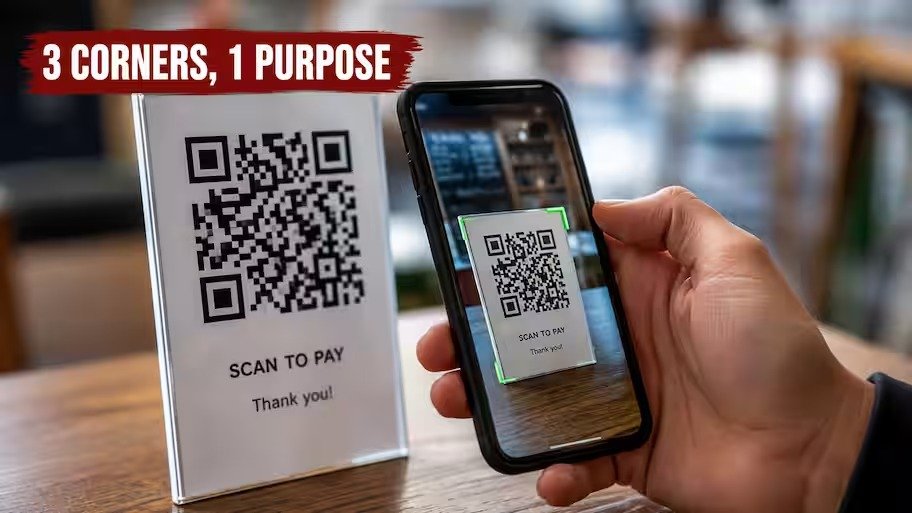
In today’s digital-first world, the QR Code has become one of the most familiar pieces of technology. Whether paying for groceries, ordering food at a restaurant, checking into an event, boarding a flight, or accessing a website, millions of people scan QR codes every day without giving much thought to how they actually work.
At first glance, a QR code appears to be nothing more than a collection of black-and-white squares arranged in a seemingly random pattern. Yet behind this simple design lies a sophisticated engineering system that enables smartphones and scanners to identify, orient, and decode information within milliseconds.
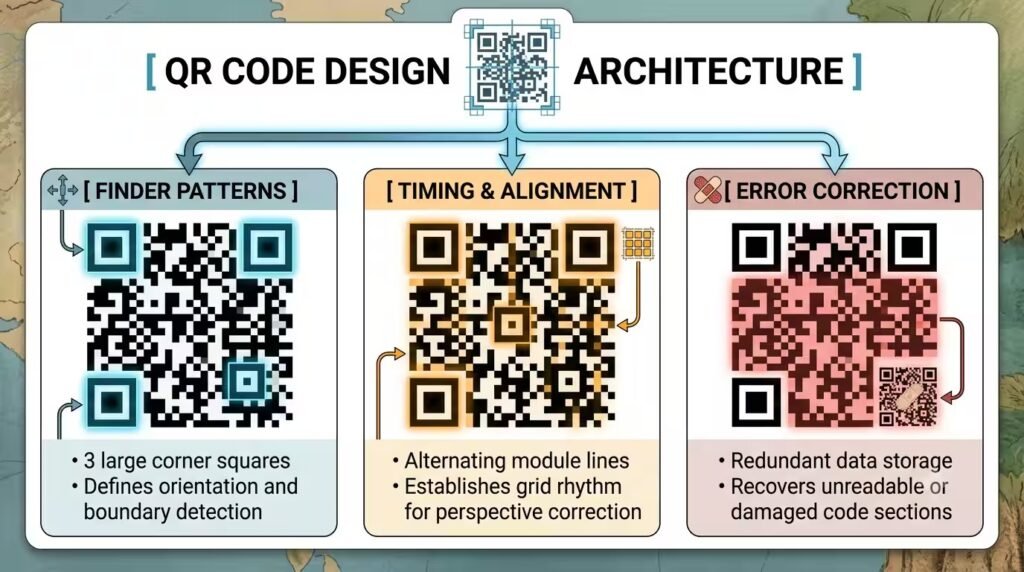
One of the most distinctive features of every QR code is the presence of three large square boxes positioned at three corners. These squares are far more than a visual design element—they are fundamental to the technology’s speed, accuracy, and reliability. Known as finder patterns, they allow cameras to instantly recognise a QR code regardless of its orientation, distance, or viewing angle.
As it continue to power digital payments, contactless services, ticketing systems, logistics, healthcare, and authentication worldwide, understanding the science behind their design offers insight into one of the most successful data-storage technologies ever created.
Table of Contents
What Is a QR Code?
A Quick Response (QR) Code is a two-dimensional barcode capable of storing significantly more information than traditional one-dimensional barcodes.
Unlike conventional barcodes that contain information only horizontally, QR codes store data both horizontally and vertically, dramatically increasing their storage capacity.
Depending on the version and configuration, a QR code can store:
- Website URLs
- Contact information
- Payment details
- Wi-Fi credentials
- Product information
- Digital tickets
- Authentication tokens
- Text messages
- Business information
- Tracking data
Today, QR have become an integral part of digital ecosystems, particularly with the widespread adoption of smartphones equipped with built-in scanning capabilities.
The Origin of QR Codes
Although QR codes are now associated with digital payments and mobile technology, they were originally developed to solve an industrial manufacturing challenge.
In 1994, engineers at Denso Wave, a subsidiary of Japan’s Denso Group, designed the QR code to improve efficiency on automobile assembly lines.
Traditional one-dimensional barcodes presented several limitations:
- Limited storage capacity.
- Slow scanning.
- Requirement for precise alignment.
- Difficulty tracking large numbers of automotive components.
The newly developed QR format addressed these issues by allowing scanners to read information rapidly from multiple directions without requiring perfect positioning.
This innovation dramatically improved production efficiency and eventually expanded into retail, logistics, healthcare, transportation, and consumer applications worldwide.
Why Every QR Code Has Three Large Corner Squares
Perhaps the most recognisable feature of any QR code is the presence of three large black-and-white squares located at three corners.
These squares are officially known as finder patterns.
Rather than serving a decorative purpose, finder patterns perform the critical task of helping scanning devices immediately recognise and decode the code.
Without these patterns, smartphone cameras would struggle to determine where the QR code begins, where it ends, and how it is positioned.
The finder patterns allow scanning software to identify the code almost instantly—even before reading the stored information.
Instant Identification Through Finder Patterns
The first challenge facing any QR code scanner is distinguishing the code from countless shapes, colours, and objects present in the surrounding environment.
Finder patterns solve this problem using a unique geometric design.
Their distinctive ratio of alternating black and white modules creates a visual signature that image-processing software can detect almost immediately.
As soon as a smartphone camera identifies these three patterns, it recognises that the object is not merely a random arrangement of squares but an actual QR code ready for decoding.
This process typically takes only a fraction of a second.
How Three Squares Determine Orientation
A common question is why QR codes use three corner squares instead of four.
The answer lies in geometry.
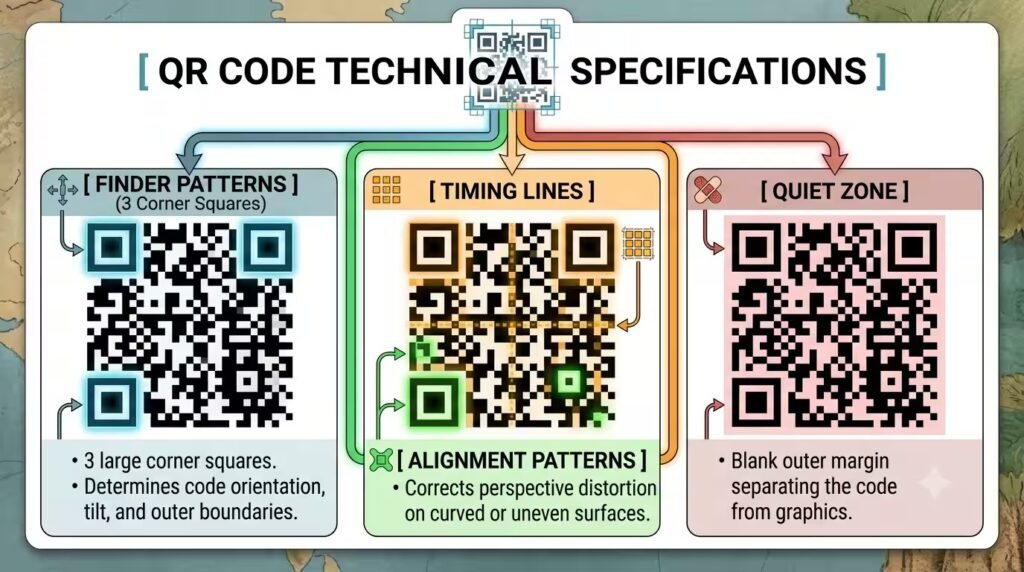
Three reference points are sufficient to determine the position and orientation of any flat two-dimensional object.
Once a scanner locates the three finder patterns, it can accurately calculate:
- Rotation angle.
- Scale.
- Perspective.
- Position.
- Dimensions.
Whether the QR code is upside down, tilted, rotated, or viewed from an angle, the software can mathematically reconstruct the correct orientation.
Leaving the fourth corner without a finder pattern also creates additional space for storing useful data.
This clever design maximises storage efficiency while maintaining rapid scanning performance.
Reading QR Codes on Curved or Tilted Surfaces
Modern QR code readers perform far more than simple image recognition.
When a QR code appears on a curved bottle, folded paper, product packaging, or an angled display, the captured image becomes distorted.
Instead of reading the distorted image directly, the decoding software first locates the three finder patterns.
Using these reference points, sophisticated algorithms mathematically project the distorted image back onto an ideal flat grid before extracting the encoded information.
This correction process explains why QR codes remain highly reliable even when photographed from awkward angles.

Error Correction: Why Damaged QR Codes Still Work
One of the most impressive engineering achievements behind QR code technology is its remarkable resistance to damage.
Unlike many other machine-readable formats, QR codes often continue functioning even when partially scratched, dirty, folded, or covered.
This resilience comes from an advanced mathematical technique known as Reed-Solomon error correction.
Rather than storing only the original information, QR codes also include carefully calculated redundant data.
When part of the code becomes unreadable, the decoding software uses this redundancy to reconstruct missing information mathematically.
Depending on the selected error correction level, a QR code may remain fully functional even if up to 30% of its surface has been damaged or obscured.
This makes QR technology particularly useful in real-world environments where labels, packaging, and printed materials frequently experience wear and tear.

Understanding Reed-Solomon Error Correction
Reed-Solomon error correction is widely regarded as one of the most powerful error-recovery systems used in digital communications.
Originally developed for correcting transmission errors in data storage and communication systems, the algorithm has since been adopted across multiple technologies, including:
- CDs and DVDs
- Satellite communication
- Deep-space communication
- Digital television
- Data storage devices
- QR codes
Within QR technology, Reed-Solomon calculations enable software to recover missing information with remarkable accuracy, significantly increasing reliability during everyday use.
Why Some QR Codes Fail to Scan
Despite their robustness, QR codes are not immune to scanning problems.
Several environmental and design factors can interfere with successful decoding.
Missing Quiet Zone
Every QR code requires a blank white border surrounding the data area.
This empty margin is known as the quiet zone.
Without sufficient white space, scanners cannot accurately distinguish the QR code from its background, resulting in decoding failures.
Poor Contrast
A QR code relies on strong contrast between dark and light areas.
If colours are too similar, lighting is insufficient, or reflections create glare, smartphone cameras may struggle to recognise the finder patterns.
Low contrast remains one of the most common reasons QR fail to scan.
Excessive Information Density
Although QR can store substantial amounts of information, attempting to encode extremely long URLs or large volumes of text into a very small printed code increases complexity.
As the individual squares become smaller, printing imperfections and camera limitations may reduce readability.
For this reason, designers typically balance storage capacity with physical size to ensure reliable scanning.
How QR Codes Have Transformed Everyday Life
Since their invention three decades ago, QR have expanded far beyond manufacturing.
Today they support countless digital services across industries.
Common applications include:
- Digital payments.
- Restaurant menus.
- Airline boarding passes.
- Railway tickets.
- Event registrations.
- Product authentication.
- Marketing campaigns.
- Business cards.
- Wi-Fi sharing.
- Healthcare records.
- Educational resources.
- Inventory management.
- Contactless check-ins.
The COVID-19 pandemic further accelerated global QR adoption by encouraging contactless interactions across businesses and public services.
Today, many countries—including India—have integrated QR into everyday financial transactions through digital payment platforms, making them an indispensable part of daily life.
Why QR Code Engineering Matters
The remarkable success of QR codes lies not merely in their convenience but in the elegance of their engineering.
Their three finder patterns, advanced orientation detection, geometric correction algorithms, and powerful Reed-Solomon error correction system combine to create one of the fastest, most reliable, and most resilient machine-readable formats ever developed.
Every time a smartphone instantly opens a payment page, digital menu, ticket, or website after scanning a QR , it is performing complex mathematical calculations within milliseconds—all enabled by a carefully engineered arrangement of black and white squares.
As digital transformation continues across industries, the QR is expected to remain one of the world’s most widely used technologies for information sharing and contactless interaction. From manufacturing floors to mobile banking, healthcare, education, transportation, and smart cities, QR have evolved into a universal bridge between the physical and digital worlds.
The seemingly simple three corner squares that appear on every QR are, in fact, the foundation of its remarkable efficiency. By enabling instant identification, precise orientation detection, and accurate decoding—even under challenging conditions—they ensure that billions of scans performed every year are completed quickly and reliably.
As innovations in mobile technology, digital identity, and secure authentication continue to advance, QR codes are likely to play an even greater role in everyday life. Their enduring success demonstrates how thoughtful engineering and intelligent design can transform a simple visual pattern into one of the most practical and influential technologies of the digital age.