Parliament, The political confrontation over the ongoing student agitation and the alleged NEET paper leak intensified on Wednesday as the Central Government prepared for a fresh round of talks with representatives of the Cockroach Janta Party (CJP)-led protest, while Opposition Members of Parliament arrived in black attire to register their protest inside Parliament. The Opposition continued demanding the resignation of Union Education Minister Dharmendra Pradhan, accusing the government of failing to adequately address students’ concerns and alleged irregularities in the country’s examination system.
The latest developments come amid continuing protests in the national capital and repeated disruptions during the Monsoon Session of Parliament, where Opposition parties have been pressing for a detailed discussion on the NEET controversy, examination reforms, and the government’s handling of demonstrations led by students and activists.
Table of Contents
Government sources indicated that fresh negotiations were expected to take place following a late-night high-level meeting involving activist Sonam Wangchuk, raising hopes that both sides could move towards a resolution through dialogue.
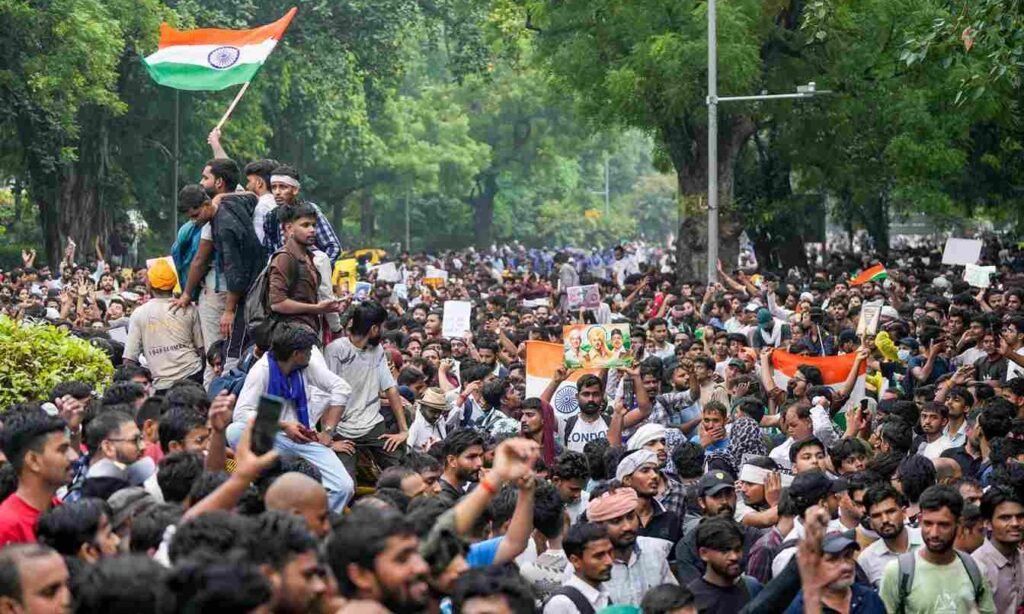
Centre to Resume Dialogue With CJP Delegation
The Central Government is scheduled to hold another round of discussions with representatives of the Cockroach Janta Party in an effort to resolve the ongoing impasse surrounding the student movement.
According to government sources, Union Minister Dr. Jitendra Singh will lead the government’s engagement with the CJP delegation.
The meeting assumes significance after several days of demonstrations, political exchanges, and negotiations between government representatives and protest organisers.
Officials believe the renewed dialogue could help reduce tensions while opening a channel for addressing issues raised by the protesters through institutional mechanisms.
Government insiders expressed optimism that constructive discussions could pave the way for a mutually acceptable outcome.
Sonam Wangchuk’s Demand at the Centre of Talks
One of the principal issues expected to dominate Wednesday’s discussions is the demand raised by activist Sonam Wangchuk regarding the ongoing student agitation.
According to sources, Wangchuk has sought an official discussion on the student movement inside Parliament, arguing that the concerns raised by students deserve national attention through democratic debate.
Government sources indicated that the Centre is reportedly willing to consider facilitating a parliamentary discussion on the issue as part of efforts to ease the current deadlock.
Although no formal agreement has yet been announced, officials believe that discussions inside Parliament may help create an institutional platform for addressing students’ concerns.
Government Hopes for Breakthrough
The upcoming negotiations follow a high-level meeting held late Tuesday night between government representatives and Sonam Wangchuk.
Officials familiar with the discussions suggested that the atmosphere remained constructive and that both sides expressed willingness to continue dialogue.
The government reportedly views sustained engagement as the most effective method for resolving differences while ensuring that public order and democratic participation are balanced.
Observers believe the outcome of Wednesday’s meeting could significantly influence the direction of the ongoing protest movement.
Opposition MPs Stage Protest in Black
Even as discussions between the government and protesters are set to resume, Opposition parties intensified pressure inside Parliament.
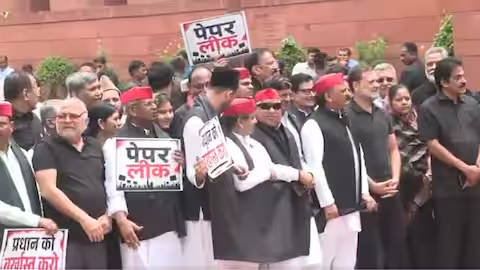
Several Opposition Members of Parliament arrived wearing black clothes as a symbolic protest against the government’s handling of the student demonstrations and the alleged examination irregularities.
The coordinated protest was organised during the ongoing Monsoon Session to draw attention to demands relating to the NEET controversy and broader concerns surrounding the education system.
The visual demonstration reflected the Opposition’s attempt to maintain political pressure both inside Parliament and outside through public messaging.
Protest Targets Government’s Response
The Opposition stated that the black attire symbolised its protest against the government’s handling of recent student demonstrations in New Delhi.
Leaders also criticised the administration’s response to the alleged paper leak controversy and demanded accountability from the Education Ministry.
The demonstration coincided with continuing disruptions in Parliament, where Opposition parties have repeatedly sought discussions on examination-related issues.
The issue has emerged as one of the most prominent political debates during the current parliamentary session.
Pawan Khera Explains Black Protest
Congress leader Pawan Khera explained the purpose behind the coordinated demonstration by Opposition MPs.
According to Khera, legislators chose to wear black as a mark of protest against what the Opposition described as the government’s treatment of students protesting in the national capital.
He also stated that the demonstration reflected dissatisfaction with the continuation of Dharmendra Pradhan as Union Education Minister despite demands for accountability.
Khera further criticised the government’s response to student unrest, arguing that concerns raised by young people deserved serious attention rather than confrontation.
Opposition Demands Dharmendra Pradhan’s Resignation
One of the principal demands raised by Opposition parties remains the resignation of Union Education Minister Dharmendra Pradhan.
Opposition lawmakers argue that accountability should accompany discussions on examination-related controversies.
Leaders from multiple parties have maintained that repeated allegations concerning competitive examinations have damaged public confidence in the education system.
The demand for the minister’s resignation has become a central political issue alongside calls for examination reforms and greater transparency.
Opposition Questions Government’s Priorities
Opposition leaders also questioned the government’s decision to continue supporting the Education Minister despite acknowledging concerns regarding examination-related controversies.
Several leaders argued that meaningful accountability requires both institutional reforms and political responsibility.
The issue has increasingly become a focal point of parliamentary debates as Opposition parties continue pressing the government for answers.
Priyanka Gandhi Criticises Government
Congress MP Priyanka Gandhi Vadra strongly criticised the government’s handling of the student movement.
She stated that students participating in demonstrations were merely fighting for what they believed were their legitimate rights.
Referring to government spending priorities, Priyanka Gandhi contrasted the education budget with loan write-offs, arguing that greater attention should be given to students and educational development.
According to her, concerns raised by young people deserve meaningful engagement from the government.
Her remarks formed part of the broader Opposition criticism regarding education policy and student welfare.
Akhilesh Yadav Questions Government’s Position
Samajwadi Party MP Akhilesh Yadav also criticised the government’s approach during the ongoing controversy.
Questioning the administration’s continued support for the Education Minister, Akhilesh asked why the government appeared unwilling to remove him despite mounting political pressure.
He suggested that the government’s reluctance had raised further political questions.
His remarks added to the growing chorus of Opposition voices demanding accountability regarding the alleged paper leak controversy.
Political Pressure Continues to Build
The continuing protests both inside and outside Parliament have significantly increased political pressure on the government.
Opposition parties have consistently demanded a comprehensive discussion on examination reforms, transparency, and student concerns.
At the same time, the government has maintained that it remains willing to engage through dialogue while preserving parliamentary procedures and public order.
The contrasting positions adopted by both sides have resulted in repeated confrontations during the Monsoon Session.
Tuesday’s Protest Sets Stage for Fresh Talks
Wednesday’s negotiations follow dramatic developments that unfolded on Tuesday.
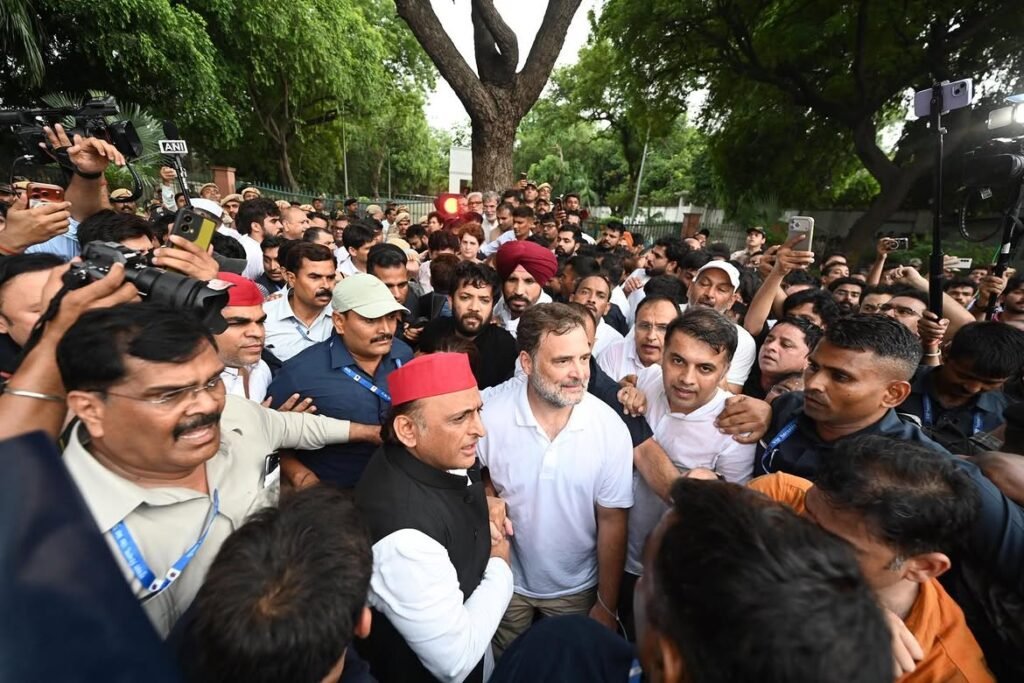
Senior Congress leaders, including Rahul Gandhi and Priyanka Gandhi Vadra, joined student demonstrators in a march towards Prime Minister Narendra Modi’s residence.
The protest concluded with Delhi Police briefly detaining several Opposition leaders before subsequently releasing them.
The detentions became another point of political disagreement between the government and Opposition parties.
Parliament Continues to Witness Disruptions
Proceedings during the Monsoon Session have repeatedly been affected by protests over the alleged NEET paper leak and related student issues.
Opposition parties have continued demanding immediate discussions inside both Houses of Parliament.
The government, meanwhile, has indicated its willingness to engage through parliamentary procedures while simultaneously continuing discussions with protest representatives.
Observers believe the functioning of Parliament may continue to be influenced by developments surrounding the student movement.
Focus Remains on Education Reforms
Beyond the immediate political confrontation, the controversy has renewed nationwide discussion regarding examination reforms and institutional accountability.
The student movement has highlighted concerns over transparency, fairness, and confidence in competitive examinations.
Political leaders from different parties continue offering differing approaches to resolving these issues, while education remains at the centre of public debate.
Many observers believe that lasting solutions will require both administrative reforms and constructive political consensus.
All Eyes on Wednesday’s Negotiations
The scheduled discussions between the government and CJP representatives are now being viewed as a potentially significant opportunity to reduce tensions.
If both sides succeed in reaching common ground regarding parliamentary discussion and student concerns, the talks could help ease the ongoing confrontation.
However, unresolved political demands—including the Opposition’s insistence on the resignation of the Education Minister—continue to complicate the broader situation.
The outcome of the negotiations is expected to shape both parliamentary proceedings and the future direction of the protest movement.
The controversy surrounding the alleged NEET paper leak and the ongoing student agitation has entered a crucial phase as the Centre prepares for fresh talks with representatives of the Cockroach Janta Party while Opposition parties continue intensifying pressure inside Parliament.
Wearing black in symbolic protest, Opposition MPs demanded greater accountability, a parliamentary discussion on the examination controversy, and the resignation of Union Education Minister Dharmendra Pradhan. At the same time, the government has expressed optimism that renewed dialogue led by Union Minister Dr. Jitendra Singh could help break the deadlock following recent discussions with activist Sonam Wangchuk. As Parliament continues to witness disruptions and political debate over education reforms grows stronger, Wednesday’s negotiations are expected to play a key role in determining the next course of the ongoing student movement and the government’s response.