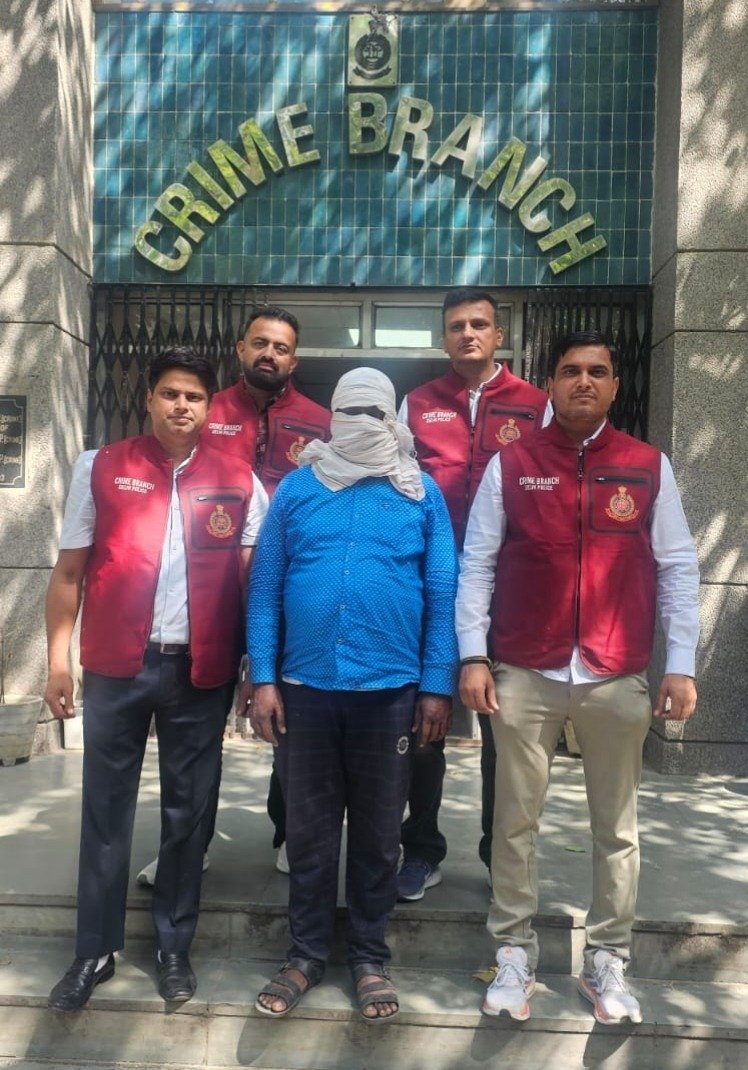
The Crime Branch of Delhi Police has successfully apprehended a life convict in a Murder Case who had remained absconding for nearly 24 years after jumping parole granted by the Delhi High Court in 2002.
The accused, identified as Rakesh Patel alias Pappi, had allegedly changed his identity to “Nandlal Verma” and was living quietly in Prayagraj, Uttar Pradesh, where he had established a new life and was running an auto spare parts business to avoid arrest.
The arrest marks a significant success for the Delhi Police Crime Branch, which has been actively tracing parole jumpers and fugitives released from Delhi jails who failed to surrender after availing parole or furlough.
Police officials deserve appreciation for carrying out a long-term investigation involving technical surveillance, manual tracking, intelligence gathering, and interstate coordination that ultimately led to the accused being traced after more than two decades.
The Murder Case not only highlights the challenge faced by law enforcement agencies in tracking long-absconding convicts but also reveals how fugitives often reinvent their identities, shift locations repeatedly, and build completely new social lives to evade police action.
Table of Contents
Background of the Murder Case
According to Delhi Police, the accused was convicted in FIR No. 387/1990 registered at Police Station Jahangir Puri under charges related to murder and criminal conspiracy.
Investigators stated that the accused, along with two co-convicts identified as Chander Prakash and Anil Kumar, was involved in the brutal killing of a neighbour over a trivial dispute.
Police records reveal that the accused was convicted in the Murder Case in 1995 and sentenced to life imprisonment by the court.
At the time, the case had attracted significant attention because of the violent nature of the crime. Officials stated that the victim was allegedly stabbed to death in a brutal attack carried out by the accused and his associates.
The Murder Case remained legally closed after conviction, but the accused later resurfaced as a major challenge for prison and law enforcement authorities after absconding during parole.
How the Convict Escaped After Parole
Police officials revealed that the accused was first granted parole in 1999 by the Delhi High Court for the solemnization of his marriage. During that parole period, he reportedly surrendered before jail authorities after completion of the leave period.
However, in 2002, the convict was again granted parole on the occasion of the birth of his second child.
According to verification conducted by Delhi Police and Tihar Jail authorities, the accused was released on parole on June 3, 2002, and was required to surrender back before jail authorities on June 24, 2002.
Investigators stated that the accused never returned.
From that point onward, the Murder Case convict remained absconding continuously for approximately 24 years.
Police officials said parole jumping cases present a serious challenge because once a convict disappears into another state and changes identity, tracing them becomes extremely difficult, especially over long periods.
The present Murder Case is one of the rare examples where a parole jumper managed to evade arrest for more than two decades before finally being traced by investigators.
Special Drive to Trace Parole Jumpers
According to Crime Branch officials, Delhi Police has been conducting a focused operation against parole jumpers and absconding convicts released from Delhi jails.
As part of this campaign, lists of parole jumpers were circulated across Crime Branch units for targeted investigation and action.
During scrutiny of the records, investigators identified Rakesh Patel alias Pappi as a high-priority fugitive due to the seriousness of the Murder Case and the unusually long period of absconding.
A special team was formed under the leadership of Inspector Ajay Sharma and guidance of ACP Ashok Sharma.
The investigation team included:
SI Manish
SI Hitesh
W/SI Bhagyashree
ASI Narender
HC Ravinder
HC Neeraj
HC Shabeer
HC Mandeep
HC Dinesh Kumar
HC Akash Nain
Constable Ankush
Police officials deserve appreciation for maintaining persistence in the Murder Case despite the passage of nearly 24 years since the convict disappeared.
Extensive Investigation and Surveillance
Investigators stated that tracing the convict required extensive analysis of both old and new records.
Police teams collected and examined:
Jail records
Parole documents
Criminal history
Mobile details
Addresses of relatives
Known associates
Suspected hideouts
Officials stated that both technical and manual surveillance were used during the investigation.
Teams conducted repeated raids at known addresses in Delhi and Uttar Pradesh but initially failed to locate the accused because he had deliberately concealed his identity and shifted locations multiple times.
Crime experts say long-term fugitives often survive by cutting off old contacts, changing names, avoiding official documentation, and relocating frequently.
The Murder Case convict reportedly used many of these methods to remain hidden for years.
Police officials stated that sustained field intelligence and local information gathering eventually became the turning point in the investigation.
Secret Information Leads Police to Prayagraj
During the course of investigation, a Crime Branch team was sent to Allahabad region in Uttar Pradesh to collect further intelligence.
Police officials stated that a reliable secret informer provided information that the Murder Case convict was currently residing in Prayagraj district under the new identity of “Nandlal Verma.”
According to investigators, the accused had settled there with his family and was living as a businessman involved in auto spare parts trading.
Acting swiftly on the information, police teams conducted field verification and eventually identified the suspect.
The accused was finally apprehended with the assistance of local intelligence and secret surveillance.
The successful operation reflects the importance of ground-level intelligence in tracing long-term fugitives who manage to escape digital detection.
Convict Initially Denied Real Identity
Police officials revealed that after apprehension, the accused attempted to mislead investigators by insisting that his name was “Nandlal Verma.”
According to investigators, he repeatedly denied involvement in the Murder Case and refused to admit his real identity.
When police asked him to produce identity-related documents, he reportedly failed to provide any authentic proof supporting his claim.
Interestingly, his son produced documents where the father’s name was mentioned as “Nandlal Verma,” indicating that the accused had fully adopted the new identity over the years.
Police officials stated that this initially created confusion and required further detailed verification.
Investigators then subjected the accused to sustained interrogation and confronted him with details of the old Murder Case, including information regarding the complainant and co-accused persons.
Eventually, the accused reportedly broke down and confessed his true identity as Rakesh Patel alias Pappi.
Life Built Under a Fake Name
One of the most striking aspects of the Murder Case investigation is how the convict managed to establish a completely new life under a fake identity.
Police officials stated that after absconding in 2002, the accused continuously shifted locations before eventually settling in Prayagraj.
During this period, he allegedly:
Changed his identity
Built a new family life
Started an auto spare parts business
Avoided contact with old networks
Concealed his criminal history
Crime experts say fugitives who remain absconding for decades often rely on informal economic activities because they cannot easily access official employment due to lack of genuine documents.
The accused reportedly survived by selling auto spare parts and blending into local communities while maintaining his false identity.
Police investigators believe the convict deliberately chose smaller business operations and local social circles to avoid attracting attention.
Verification From Tihar Jail Authorities
Following the confession, Delhi Police verified details from Tihar Jail authorities.
Officials confirmed that the accused had indeed been released on parole in June 2002 under orders of the Delhi High Court and was supposed to surrender within a limited period.
However, jail authorities confirmed that he never returned after release.
This verification officially established the accused as a parole jumper in the Murder Case.
Police officials stated that maintaining coordination between jail authorities and investigating agencies remains crucial in monitoring parole and furlough cases.
Experts believe stricter tracking systems and periodic reporting mechanisms may help reduce long-term absconding in parole-related cases.
Challenges in Tracking Long-Term Fugitives
The Murder Case once again highlights the enormous challenges faced by law enforcement agencies in tracing fugitives who disappear for years.
Police officials say long-absconding convicts often:
Change names
Shift states repeatedly
Avoid digital footprints
Operate small businesses
Use unofficial documentation
Limit contact with old associates
In many cases, fugitives survive quietly for years because local communities remain unaware of their criminal background.
Crime Branch officials stated that patient surveillance and intelligence collection are often the only effective ways to locate such individuals.
The successful arrest in the Murder Case demonstrates the effectiveness of sustained investigation even in decades-old cases.
Importance of Crime Branch Operations
The operation also reflects the growing role of specialized Crime Branch units in tracking fugitives and parole jumpers.
Unlike routine police investigations, fugitive tracking often requires:
Long-term surveillance
Interstate coordination
Record analysis
Informer networks
Technical monitoring
Continuous field verification
Police officials deserve appreciation for not abandoning the Murder Case despite the passage of time.
The arrest sends a strong message that absconding convicts cannot permanently escape the justice system merely by changing identities or relocating to different states.
The Crime Branch operation also reinforces public confidence in law enforcement agencies working to ensure that sentences awarded by courts are ultimately enforced.
The successful apprehension of a parole jumper after nearly 24 years reflects the persistence, discipline, and intelligence-driven approach adopted by the Delhi Police Crime Branch in dealing with serious criminal cases and long-absconding offenders.