Madhya Pradesh witnessed the end of a nearly two-week-long protest against the Ken-Betwa Link Project after police and district authorities cleared demonstrators from the banks of the Barana River near Kupi village. Officials said the decision was taken because rising water levels due to monsoon rains had made the protest site unsafe. However, many protesters argued that their movement was cut short before their concerns over rehabilitation, compensation, and environmental impacts were properly addressed.
The protest had attracted national attention because of its peaceful yet symbolic forms of demonstration. Tribal communities, particularly women from the Gond and Kol communities, adopted unique methods such as the “chita satyagraha,” “jal satyagraha,” and “faansi satyagraha” to express their opposition to displacement caused by the Ken-Betwa Link Project. The movement highlighted the continuing debate in Madhya Pradesh between large infrastructure development and the protection of local communities, forests, and traditional livelihoods.
Table of Contents
Police Remove Protesters Citing Safety Concerns
The protest site near the Barana River in Madhya Pradesh was cleared on Sunday after police, district officials, and medical teams reached the location early in the day.
According to Additional Superintendent of Police Aditya Patle, authorities first conducted medical examinations of the protesters before arranging transportation for them back to their villages. Officials stated that women participating in the agitation were peacefully escorted into buses and safely dropped home.
The administration explained that the decision was based on public safety rather than law enforcement action. Officials pointed out that the protest site was located near an under-construction bridge, where continuous rainfall had significantly increased the river’s water level.
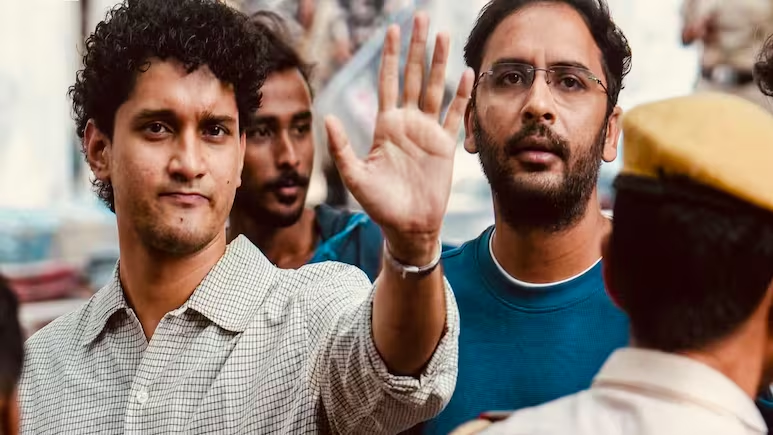
The police maintained that no protesters were formally arrested or detained during the operation. However, some participants alleged that activist Amit Bhatnagar, one of the leading faces of the agitation, had been taken into custody. Authorities did not officially confirm these claims.
Unique Forms of Protest Drew National Attention
The demonstrations in Madhya Pradesh stood out because of the symbolic and non-violent methods adopted by the protesters.
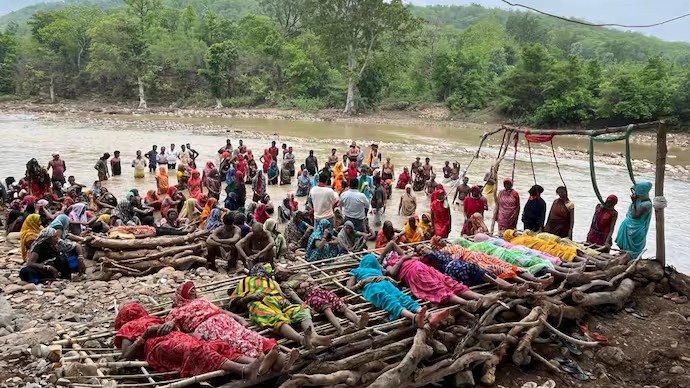
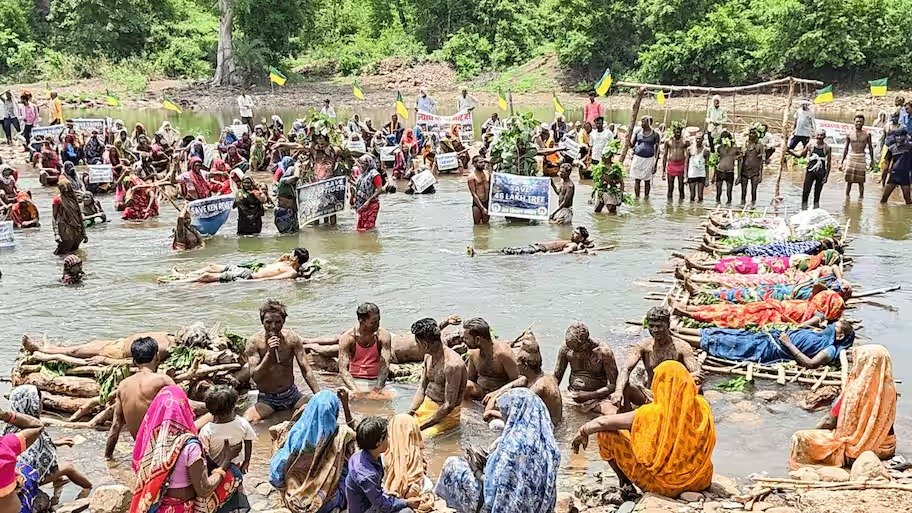
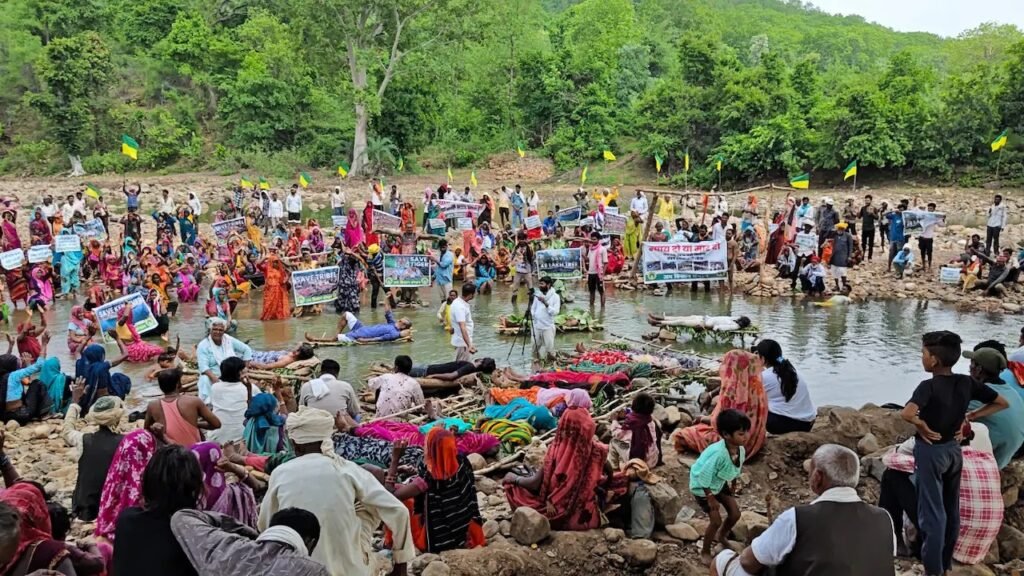
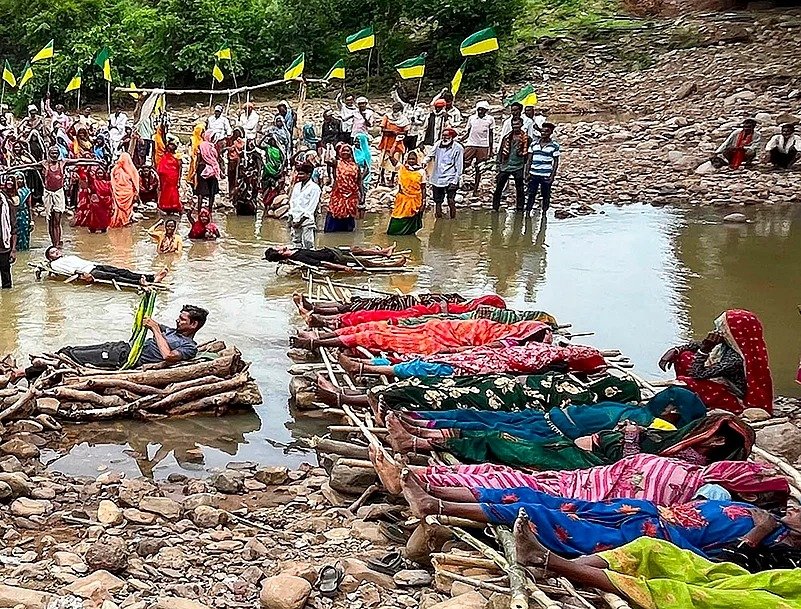
One of the most striking was in Madhya Pradesh the “chita satyagraha,” where participants lay on symbolic funeral pyres. Protesters explained that this represented the belief that losing their homes, forests, farms, and ancestral land was equivalent to losing their lives.
Another form of demonstration was the “jal satyagraha,” during which participants stood inside the river for long periods while demanding justice. This form of protest has been used in several environmental movements across India to highlight the threat posed by dam and irrigation projects.
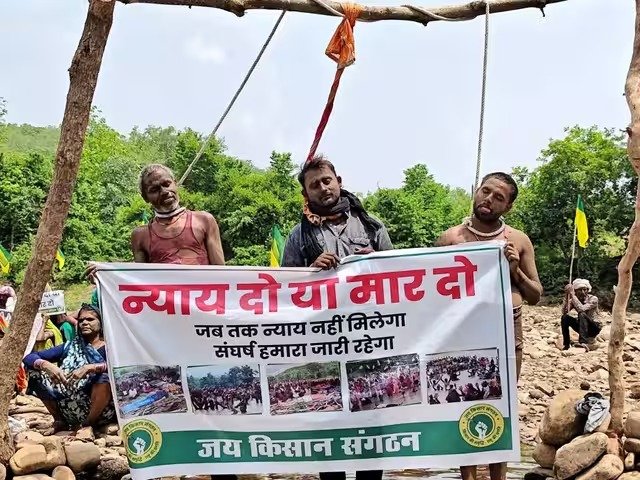
Some protesters also participated in the “faansi satyagraha,” standing with symbolic nooses around their necks to express their sense of desperation over displacement and uncertainty about their future.
These peaceful demonstrations reflected Gandhian methods of protest while drawing attention to the emotional and cultural impact that large development projects can have on indigenous communities.
Tribal Communities Led the Movement
The protest in Madhya Pradesh was largely led by women belonging to the Gond and Kol tribal communities, whose families are among those expected to be affected by the project.
Many protesters argued that the forests, rivers, and agricultural land under threat are not merely sources of income but also form an important part of their cultural identity and traditional way of life.
Activist Amit Bhatnagar also joined the movement and had been observing an indefinite hunger strike in support of the affected families.
According to the protesters, previous discussions with district authorities during an earlier agitation in April had resulted in several assurances. They claimed many of those promises had not yet been fulfilled, prompting them to resume protests in July.
Why Protesters Oppose the Ken-Betwa Link Project
Although the Ken-Betwa Link Project has been promoted as a major development initiative, many residents in Madhya Pradesh have raised serious concerns regarding its implementation.
The protesters argued that rehabilitation packages remain inadequate and that compensation offered to affected families does not reflect the actual value of their homes, farmland, and forest resources.
Many families have demanded land-for-land rehabilitation instead of financial compensation alone. They believe that replacing agricultural land with cash payments may not provide long-term livelihood security.
Community representatives also alleged that land acquisition procedures and rehabilitation policies have not been implemented fairly in several villages.
Another major concern involves environmental protection. Protesters fear that the construction of the Daudhan Dam could affect forests, wildlife habitats, and biodiversity, particularly areas connected with the Panna Tiger Reserve.
Residents also expressed concern about losing access to forest produce, grazing land, and traditional occupations that have supported generations of tribal families in Madhya Pradesh.
Understanding the Ken-Betwa Link Project
The Ken-Betwa Link Project is one of India’s most ambitious river-linking initiatives and the first project to be implemented under the National Perspective Plan for interlinking rivers.
The project proposes transferring surplus water from the Ken River to the Betwa River through a network of dams, canals, tunnels, and other infrastructure.
The total estimated cost of the project stands at around ₹44,605 crore.
According to government estimates, the project aims to provide irrigation facilities to more than 10 lakh hectares of farmland, improve drinking water supply for millions of people, and generate hydropower.
The project is expected to benefit the drought-prone Bundelkhand region, which spans parts of Madhya Pradesh and Uttar Pradesh. The region has historically faced recurring water shortages, unpredictable rainfall, and agricultural distress.
Supporters argue that improved irrigation could significantly increase agricultural productivity, reduce water scarcity, and improve rural livelihoods across the region.
Government Maintains Project Follows Legal Framework
The administration in Madhya Pradesh has consistently maintained that all legal procedures relating to land acquisition and rehabilitation are being followed.
Officials have stated that the Ken-Betwa Link Project represents a major public investment intended to address long-term water shortages while supporting economic development in Bundelkhand.
Authorities believe the project’s benefits, including irrigation expansion, drinking water availability, and renewable hydropower generation, outweigh the challenges associated with land acquisition.
Government officials have also maintained that rehabilitation measures are being implemented according to existing legal provisions and policy guidelines.
Development Versus Rehabilitation Debate Continues
The events in Madhya Pradesh once again highlight one of India’s most complex development challenges—balancing infrastructure growth with the rights of affected communities.
Large irrigation and river-linking projects often promise significant economic benefits, particularly in regions facing chronic water scarcity. However, such projects can also require land acquisition, relocation of villages, and environmental changes that directly affect local populations.
Experts often point out that successful rehabilitation depends not only on financial compensation but also on restoring livelihoods, preserving social networks, and ensuring affected families receive sustainable opportunities after displacement.
In many parts of India, experiences from previous dam and infrastructure projects have shown that effective rehabilitation policies can reduce conflicts and improve public acceptance of development initiatives.
The recent demonstrations in Madhya Pradesh have once again brought these issues into public discussion, with tribal communities seeking stronger safeguards while the government continues to emphasise the long-term developmental importance of the Ken-Betwa Link Project.