Bengaluru-Mumbai Rail Connectivity Gets Major Boost
Indian Railways is expanding passenger and railway infrastructure connectivity across Karnataka and Jammu & Kashmir, with major developments focusing on premium train services, new railway infrastructure, electrification, suburban rail and station redevelopment.
One of the most prominent developments is the strengthening of rail connectivity between Bengaluru and Mumbai. The virtual flag-off of the Bengaluru-Mumbai Express by Union Railway Minister Ashwini Vaishnaw on May 17, 2026, marked an important step in improving connectivity between two of India’s major economic centres.
The Railway Minister also announced that a Vande Bharat Sleeper service between Bengaluru and Mumbai would begin soon. The proposed service is expected to provide an overnight travel option while combining the comfort-oriented features of the Vande Bharat platform with a sleeper configuration designed for longer journeys.
The development is significant for business travellers, tourists and other passengers travelling between Karnataka and Maharashtra. Bengaluru and Mumbai are major centres for technology, finance, manufacturing, services, education and commerce, creating strong demand for reliable long-distance connectivity.
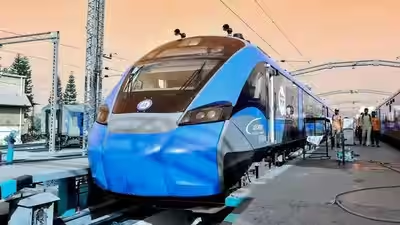
Table of Contents
Vande Bharat Sleeper Service Between Bengaluru and Mumbai Announced
The proposed Bengaluru-Mumbai Vande Bharat Sleeper service is among the most significant passenger-service developments highlighted in the latest railway update. The proposed train is expected to provide passengers with an overnight travel option in a modern train environment, strengthening long-distance connectivity between the two major metropolitan centres.
Unlike conventional daytime Vande Bharat services, a sleeper version is designed to allow passengers to travel overnight while remaining in a modern train environment. The introduction of such a service could offer an alternative to existing overnight trains and other transport modes between Bengaluru and Mumbai.
The broader expansion of Vande Bharat services is also visible within Karnataka. According to the railway update, 12 pairs of Vande Bharat trains are already operating in the state. Trial operations have also been conducted on the Bengaluru-Mangaluru route, while additional connectivity towards Madgaon and Chennai is expected to receive attention.
The proposed Bengaluru-Mumbai sleeper service therefore forms part of a larger strategy by Indian Railways to expand modern inter-city rail connectivity rather than being an isolated project.
Karnataka Gets ₹7,748 Crore Railway Budget Allocation
Railway infrastructure in Karnataka is receiving a major financial push, with the state getting a record allocation of around ₹7,748 crore, according to the railway publication cited in the source material. The investment reflects the growing focus of Indian Railways on improving infrastructure and passenger connectivity across the state.
The investment covers a wide range of projects, including railway line development, electrification, station redevelopment, signalling upgrades, route doubling and suburban rail infrastructure. These projects are expected to collectively improve the capacity and efficiency of the state’s railway network.
According to the same update, approximately 3,840 km of railway lines have been developed in Karnataka since 2014, while around 3,742 km of routes have been electrified. The scale of this work highlights the transformation being undertaken by Indian Railways across Karnataka.
The electrification programme is particularly significant because it allows the network to operate with modern electric locomotives and train sets while supporting improved energy efficiency and operational performance. The near-completion of electrification across the state also creates a stronger base for future capacity expansion and modern train operations.
Thousands of Kilometres of Railway Lines Electrified in Karnataka
Electrification is one of the major pillars of Karnataka’s railway modernisation programme. The railway update indicates that thousands of kilometres of routes have already been electrified since 2014, bringing the state close to complete electrification.
For Indian Railways, electrified railway routes can help reduce dependence on diesel traction and provide a more modern operating environment. They can also support the wider introduction of electric locomotives and modern train sets on important passenger and freight corridors.
For a rapidly growing state such as Karnataka, this infrastructure is particularly important because passenger and freight demand is expected to increase with continued urbanisation and industrial activity.
The electrification programme is therefore not simply an upgrade to existing tracks. It is also part of the foundation required for future improvements in railway speed, capacity and reliability. With a larger electrified network, Indian Railways can also focus on deploying newer train technologies and improving operational efficiency.
Amrit Bharat Station Scheme Transforms 61 Karnataka Stations
Station redevelopment is another major part of Karnataka’s railway transformation. Under the Amrit Bharat Station Scheme, 61 railway stations in the state are being redeveloped at an estimated cost of ₹2,160 crore.
The source material states that work on nine stations has already been completed. The redevelopment programme is aimed at upgrading railway stations to meet modern passenger requirements while improving accessibility, circulation and overall station facilities.
Among the most prominent projects are Bengaluru Cantonment station, which is being redeveloped at an estimated cost of around ₹485 crore, and Yeshwantpur station, where redevelopment is estimated at around ₹367 crore.
The objective is to create more modern railway stations with improved passenger circulation, upgraded platforms, better facilities and improved access arrangements. These projects demonstrate how Indian Railways is attempting to modernise not only trains but also the infrastructure passengers use before and after their journeys.
Such improvements become especially important in major urban centres such as Bengaluru, where rising passenger numbers place greater pressure on existing railway infrastructure. Station redevelopment can therefore complement new train services by improving the passenger experience and creating better facilities for growing commuter demand.
Bengaluru Suburban Rail Project Advances Across Four Corridors
Bengaluru’s rapid population growth has increased the need for an efficient suburban railway system. According to the railway update, work is progressing on four corridors of the Bengaluru suburban railway project.
Land acquisition has been completed for the Baiyappanahalli-Chikkabanavara and Heelalige-Rajanukunte corridors, with station construction work underway. The KSR Bengaluru-Devanahalli route has also received approval.
The corridors are expected to strengthen public transport connectivity across Bengaluru by linking residential communities with major employment, commercial and business areas. A functional suburban rail network could also complement the city’s existing public transport system by providing an additional high-capacity transport option for daily commuters.
The project is particularly important for a city facing increasing road congestion and rising daily travel demand. By expanding rail-based mobility, Indian Railways can play a greater role in supporting Bengaluru’s long-term urban transport requirements.
Automatic Signalling and Route Doubling to Boost Rail Capacity
Railway expansion in Karnataka is also being supported by capacity-enhancement projects. The Baiyappanahalli-Hosur section is associated with an investment of around ₹1,116 crore, while doubling of the Bethaluru-Rajanukunte route has been allocated approximately ₹248 crore.
Quadrupling works around Bengaluru are also progressing at an estimated cost of ₹1,347 crore. These projects are designed to increase the number of trains that can operate on busy railway corridors.
Additional tracks can help reduce bottlenecks and improve the ability of the network to handle both passenger and freight services. For Indian Railways, increasing track capacity is particularly important on high-density routes where multiple services compete for limited railway paths.
Alongside track expansion, modern signalling systems are also being introduced. Automatic signalling works covering major sections around Yeshwantpur, KSR Bengaluru, Lottegollahalli, Baiyappanahalli, Penukonda, Mysuru and Jolarpettai are being implemented at a combined cost of around ₹6,396 crore, according to the source material.
Automatic signalling can help trains operate at shorter intervals by improving the management of train movements, making it particularly relevant to high-density routes. Combined with route doubling, quadrupling, electrification and station redevelopment, these measures form a broader infrastructure strategy by Indian Railways to improve capacity and prepare Karnataka’s railway network for future passenger and freight demand.
New Vande Bharat Maintenance Facilities Planned in Karnataka
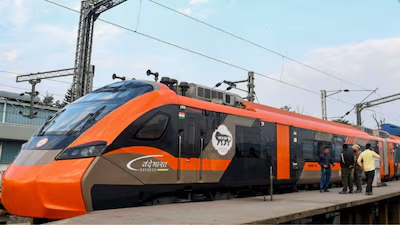
The expansion of Vande Bharat services also creates demand for dedicated maintenance infrastructure.
A Vande Bharat maintenance depot is planned at an estimated cost of around ₹270 crore.
A separate coach-car maintenance facility is also proposed at a cost of approximately ₹52.73 crore.
These facilities are important because modern train sets require regular inspection, servicing and maintenance.
As the number of Vande Bharat services increases, dedicated maintenance infrastructure can help ensure that trains are inspected and serviced efficiently.
The development of such facilities therefore forms an essential supporting component of the wider Vande Bharat expansion programme.
Karnataka Rail Expansion to Strengthen Business and Economic Connectivity
The railway development programme in Karnataka is expected to have effects beyond passenger travel.
New railway lines, route doubling, quadrupling, electrification and improved stations can strengthen access to industrial centres, commercial hubs, agricultural regions and major employment zones.
For Bengaluru in particular, better rail infrastructure could help improve the movement of people across the metropolitan region.
Stronger inter-city rail connectivity can also support economic activity between Karnataka and neighbouring states.
The Bengaluru-Mumbai connection is especially important because both cities play major roles in India’s business and services economy.
A modern sleeper service between them could provide an additional overnight option for passengers travelling for business, tourism and other purposes.
Jammu & Kashmir Railway Projects Get Fresh Push
The railway modernisation effort also extends to Jammu & Kashmir.
On June 10, 2026, Jammu & Kashmir Chief Minister Omar Abdullah met Union Railway Minister Ashwini Vaishnaw to discuss railway projects and the role of rail connectivity in the Union Territory’s economic development.
The meeting resulted in an important announcement involving the Jammu-Srinagar Vande Bharat Express.
A new commercial stop at Anantnag was announced as part of the expansion of passenger connectivity in the region.
The decision could improve access for residents of Anantnag while also benefiting tourists, businesses and other travellers using the Jammu-Srinagar railway corridor.
Anantnag to Get New Commercial Stop on Jammu-Srinagar Vande Bharat
Anantnag is an important centre in the Kashmir Valley, making the new commercial stop significant for both local passengers and the wider regional economy.
The Jammu-Srinagar railway connection has already changed the travel landscape in Jammu & Kashmir by creating a faster and more reliable rail alternative for passengers.
Adding Anantnag as a commercial stop could further integrate communities along the route.
For residents, improved access to Vande Bharat services could make inter-city travel easier.
For tourists, the additional stop could improve access to destinations across the Kashmir Valley.
For businesses, better passenger connectivity can improve workforce mobility and simplify travel for customers and professionals.
Rail Connectivity to Boost Tourism, Agriculture and Local Businesses in J&K
Jammu & Kashmir’s economy has significant links to tourism, agriculture and horticulture.
Better railway connectivity can support all three sectors.
Tourism-related businesses such as hotels, restaurants, transport operators and local shops depend heavily on the movement of visitors.
Improved train services can make travel more convenient and potentially increase accessibility to destinations across the region.
The railway network can also support the movement of agricultural and horticultural products, including locally important fruit production.
As railway services become more reliable and accessible, businesses could benefit from improved connections with markets and consumers.
The new Anantnag stop is therefore part of a broader infrastructure strategy rather than simply a timetable adjustment.
Bengaluru and Jammu & Kashmir Reflect India’s Wider Railway Modernisation Drive
The developments in Karnataka and Jammu & Kashmir illustrate a broader transformation taking place across Indian Railways.
The focus is increasingly shifting from simply adding trains to developing complete railway ecosystems.
Modern stations, electrified routes, additional tracks, automatic signalling, suburban rail systems, maintenance depots and advanced passenger services are being developed together.
For Karnataka, the combination of Vande Bharat expansion, suburban rail development, station redevelopment and capacity enhancement could significantly improve connectivity across Bengaluru and other parts of the state.
For Jammu & Kashmir, the continued development of the Jammu-Srinagar corridor and the addition of Anantnag as a commercial Vande Bharat stop represent further steps towards greater regional integration.
A Wider National Push for Modern Rail Infrastructure
The projects outlined in the railway update indicate that infrastructure expansion is being pursued across multiple levels.
At the metropolitan level, Bengaluru is receiving investment in suburban rail and network capacity.
At the state level, Karnataka is receiving large allocations for electrification, station redevelopment and additional railway infrastructure.
At the inter-state level, the proposed Bengaluru-Mumbai Vande Bharat Sleeper service aims to strengthen connectivity between two major economic centres.
At the regional level, Jammu & Kashmir is receiving new passenger connectivity through the Anantnag stop.
Together, these projects reflect the changing role of Indian Railways.
The network is increasingly being developed not only as a transportation system but also as infrastructure supporting economic growth, tourism, regional integration and urban mobility.
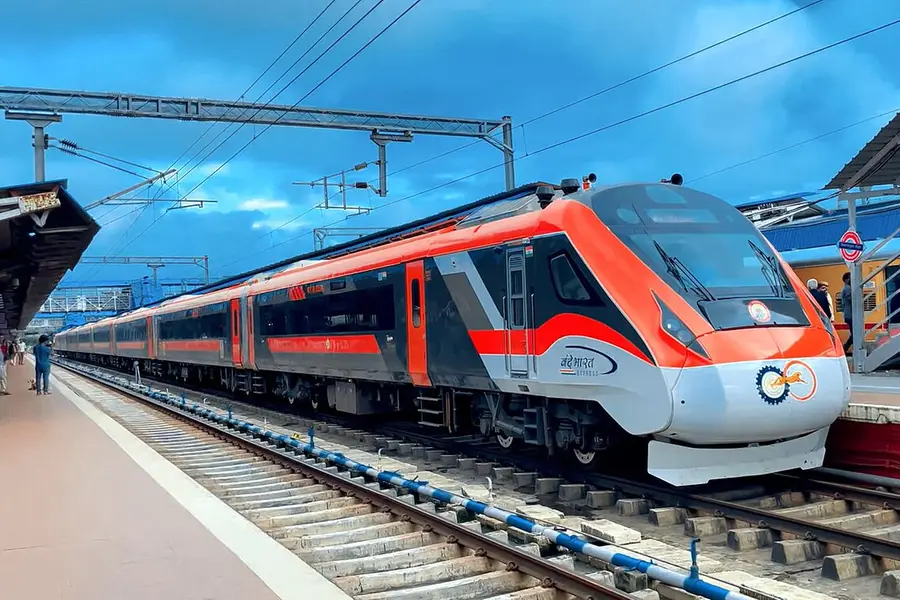
Indian Railways is undertaking a broad modernisation push across Karnataka and Jammu & Kashmir, combining new passenger services with significant infrastructure development.
The proposed Bengaluru-Mumbai Vande Bharat Sleeper service is among the most prominent developments, offering the possibility of an overnight premium connection between two major metropolitan centres.
Karnataka is simultaneously seeing large-scale investment in electrification, station redevelopment, suburban rail, route doubling, quadrupling and automatic signalling.
In Jammu & Kashmir, the new commercial stop at Anantnag on the Jammu-Srinagar Vande Bharat represents another step towards strengthening regional rail connectivity.
The impact of these projects will ultimately depend on timely completion, effective utilisation of infrastructure and continued development of passenger and maintenance facilities.
Nevertheless, the initiatives outlined in the June 2026 railway update demonstrate a broader transition in India’s railway strategy — from simply increasing train services to building a modern, interconnected rail ecosystem designed to support passenger mobility, economic activity and regional development.