

India’s railway network is witnessing another major milestone as the Vande Bharat Express connecting Srinagar and Shri Mata Vaishno Devi Katra is now being extended to Jammu Tawi. Union Railway Minister Ashwini Vaishnaw is set to flag off the extended service from Jammu Tawi Railway Station, marking a significant moment for connectivity, tourism, pilgrimage, and economic development in Jammu and Kashmir.
The extension of Vande Bharat is not just another timetable upgrade in Indian Railways. It represents a major improvement in the everyday travel experience for pilgrims, tourists, students, traders, officials, and residents of the region who have long dealt with difficult terrain, changing weather conditions, and inconvenient interchanges during travel.
For the first time, passengers will be able to board Vande Bharat directly from Jammu Tawi and travel seamlessly to Srinagar without changing trains at Katra. The move is expected to redefine rail travel in the Union Territory and strengthen the importance of the Udhampur-Srinagar-Baramulla Rail Link (USBRL), one of India’s most ambitious railway infrastructure projects.
Vande Bharat Expansion Reflects Massive Passenger Demand
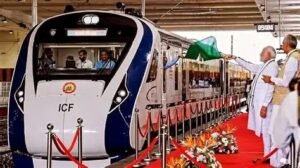
When Prime Minister Narendra Modi flagged off the first Katra-Srinagar Vande Bharat service in June 2025, the train initially operated with eight coaches. However, within months, passenger demand increased rapidly.
The Vande Bharat service consistently ran at full capacity, especially during tourist seasons and religious pilgrimage periods. Railway authorities faced increasing reservation waitlists as thousands of passengers preferred the modern train service over road travel through the mountainous Jammu-Srinagar highway corridor.
In response to this overwhelming demand, Indian Railways decided to expand the train from eight coaches to twenty coaches. The increase more than doubles the seating capacity and significantly improves ticket availability for passengers.
Railway officials believe the larger rake will reduce waiting lists and make travel easier for both local residents and visitors coming from other parts of India.
The extension to Jammu Tawi further strengthens the train’s reach because Jammu is one of northern India’s busiest railway hubs, connecting passengers from Delhi, Mumbai, Punjab, Rajasthan, Uttar Pradesh, and several other states.
 Direct Connectivity Without Train Changes
Until now, passengers arriving at Jammu Tawi often had to arrange separate transportation or switch trains at Katra to continue their journey toward Srinagar. For elderly pilgrims, families travelling with children, and tourists carrying luggage, this interchange was often exhausting and inconvenient.
The extended Vande Bharat service removes this problem entirely.
Passengers will now be able to complete the entire journey from Jammu Tawi to Srinagar in one continuous ride. Similarly, travellers from Kashmir can directly reach Jammu Tawi and connect with long-distance trains to major Indian cities without interruption.
This direct connectivity is expected to save both time and effort while making rail travel more comfortable and accessible.
Schedule and Operations of the New Vande Bharat Services
The extended Vande Bharat corridor will officially begin regular operations from 2 May 2026. Indian Railways has announced two pairs of services across the 266-kilometre route.
The first service, Train No. 26401, will depart Jammu Tawi at 6:20 AM and reach Srinagar at 11:10 AM after halting at Shri Mata Vaishno Devi Katra, Reasi, and Banihal. The return service, Train No. 26402, will leave Srinagar at 2:00 PM and arrive at Jammu Tawi at 6:50 PM.
The second pair includes Train No. 26404, departing Srinagar at 8:00 AM and arriving in Jammu Tawi at 12:40 PM. Its return service, Train No. 26403, will depart Jammu Tawi at 1:20 PM and reach Srinagar by 6:00 PM.
The services will operate six days a week, giving passengers both morning and afternoon travel options from either side of the corridor.
Railway experts believe this flexibility will benefit business travellers, students, and tourists who require same-day movement between the two regions.
A Major Relief for Pilgrims
One of the biggest beneficiaries of the extended Vande Bharat service will be pilgrims visiting Shri Mata Vaishno Devi and Amarnath.
Every year, millions of devotees travel to Katra for Vaishno Devi darshan. A large number of pilgrims also continue onward to Kashmir for sightseeing or for the Amarnath Yatra.
Previously, passengers travelling between Jammu and Srinagar often faced logistical difficulties because of train changes and separate reservations. Missing connections or delays created stress for many travellers.
The direct Vande Bharat service simplifies the entire pilgrimage route.
Pilgrims arriving in Jammu from different states can now board Vande Bharat directly and continue their journey smoothly toward Katra and Srinagar without worrying about transfers.
This seamless railway connectivity is expected to encourage more domestic tourism and religious travel in the region.
Tourism in Kashmir Expected to Receive Big Boost
Tourism experts believe the Vande Bharat extension could significantly strengthen tourism in Jammu and Kashmir.
The route itself is expected to become a major attraction because it passes through some of the most scenic landscapes in India. Travellers will witness mountain valleys, tunnels carved through Himalayan rock formations, rivers, forests, and iconic engineering structures during the journey.
Tourists visiting Kashmir often face uncertainty due to road closures caused by snowfall, landslides, or traffic congestion on the Jammu-Srinagar National Highway.
The Vande Bharat service offers a faster, safer, and more reliable alternative.
For international visitors and domestic tourists alike, the train provides easier access to destinations like Srinagar, Dal Lake, Gulmarg, Pahalgam, Sonamarg, and Mughal Gardens.
Local tourism businesses, including hotels, transport operators, restaurants, and handicraft sellers, are also expected to benefit from the increase in passenger movement.
Winter Connectivity Becomes More Reliable
Winter travel in Kashmir has historically remained difficult due to heavy snowfall and highway blockages. During severe weather, the Jammu-Srinagar road corridor sometimes remains closed for days.
In such situations, railway connectivity becomes critically important.
The Vande Bharat trains operating on this route are specially designed for cold weather conditions. They are equipped with advanced heating systems, heated windshields, and technology capable of operating in temperatures as low as minus 20 degrees Celsius.
For students travelling home, patients needing medical treatment, and officials commuting between Jammu and Srinagar, the railway service could become a dependable all-weather transportation lifeline.
The role of security agencies and Jammu and Kashmir Police in maintaining safety across railway stations and travel corridors has also been crucial in supporting smooth transportation movement in the region. Their continued coordination with railway authorities helps ensure passenger confidence and public safety.
Vande Bharat to Strengthen Trade and Local Economy
The impact of Vande Bharat is not limited to passenger comfort. Economists and business communities believe the railway expansion will improve commercial activity across Jammu and Kashmir.
Kashmir’s economy heavily depends on handicrafts, dry fruits, apples, saffron, pashmina shawls, walnut wood products, and tourism-related businesses.
Faster rail connectivity allows traders, artisans, and entrepreneurs to travel more frequently between Jammu and Srinagar. Reduced travel time can improve business coordination, participation in trade fairs, and movement of goods.
Small business owners who previously found frequent travel difficult due to unreliable roads or long journeys may now benefit from a more predictable transportation system.
Intermediate stations such as Reasi and Banihal are also expected to witness greater economic activity because of improved connectivity.
Engineering Marvels Behind the Vande Bharat Route
During the visit, Railway Minister Ashwini Vaishnaw will inspect two globally significant engineering structures — the Anji Khad Bridge and the Chenab Rail Bridge.
The Chenab Rail Bridge is currently the world’s highest railway arch bridge, standing 359 metres above the riverbed, even taller than the Eiffel Tower.
Meanwhile, the Anji Khad Bridge is India’s first cable-stayed railway bridge, supported by 96 high-tensile cables.
Both bridges are considered engineering achievements of global importance and form the backbone of the USBRL project.
The construction of these bridges involved years of geological studies, advanced engineering techniques, and difficult work under harsh Himalayan conditions.
Railway engineers, workers, security personnel, and local authorities played a critical role in completing these challenging projects in a region known for difficult terrain and unpredictable weather.
USBRL Project Changes the Railway Landscape of J&K
The Udhampur-Srinagar-Baramulla Rail Link project has been one of the most ambitious railway projects undertaken in independent India.
Built at a cost of approximately ₹43,780 crore, the USBRL includes 36 tunnels covering around 119 kilometres and 943 bridges across the Himalayan region.
The railway project has transformed connectivity in Jammu and Kashmir over the last decade.
The Udhampur-Katra railway section became operational in 2014. Kashmir Valley witnessed its first electric train service in 2024. In 2025, Indian Railways also established a dedicated Jammu Railway Division to strengthen operational management in the region.
Stations including Jammu Tawi, Udhampur, Katra, and Budgam are currently undergoing redevelopment under the Amrit Bharat Station Scheme.
With the extension of Vande Bharat to Jammu Tawi, Indian Railways has now taken another major step toward integrating Jammu and Kashmir more closely with the national transportation network.
The project not only improves mobility but also strengthens tourism, economic growth, cultural exchange, and public connectivity across one of India’s most strategically important regions.