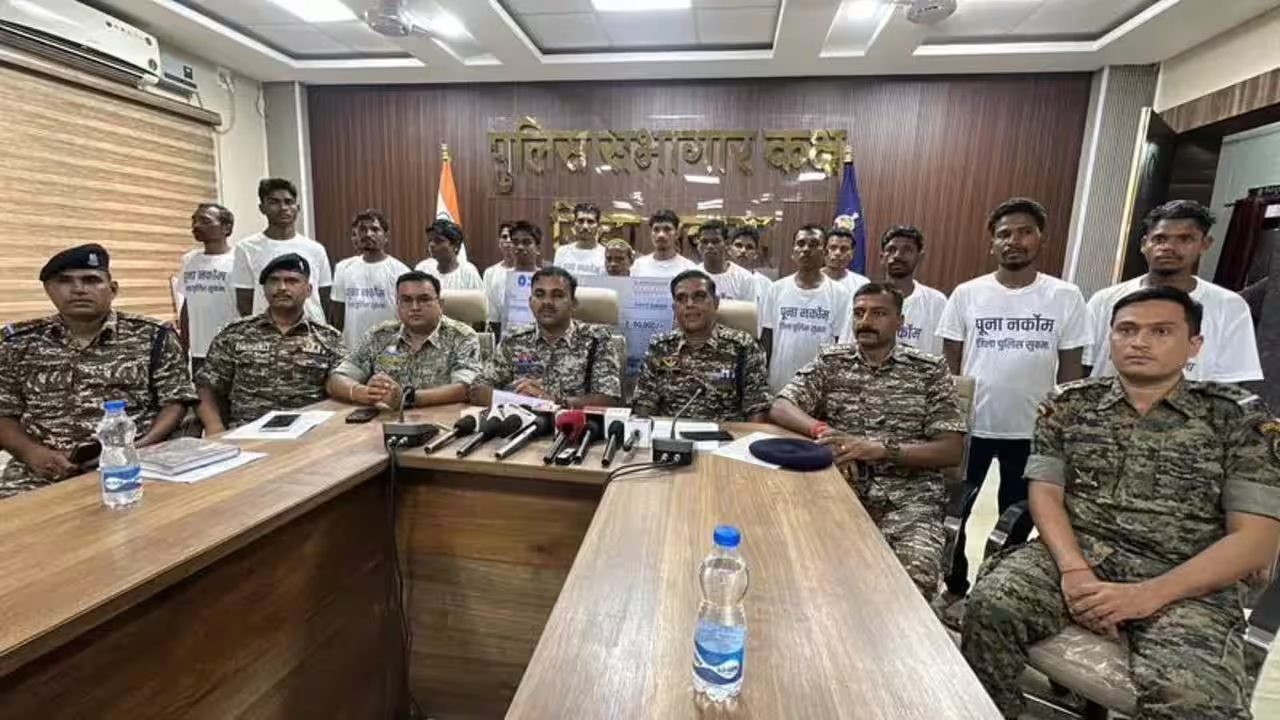
On May 21, Union Home Minister Amit Shah announced what he described as a historic milestone in India’s decades-long fight against Naxalism through a post on his social media platform. For the first time in nearly 30 years, a General Secretary-rank Maoist commander was neutralised, marking a major operational success in the government’s sustained campaign against Left-Wing Extremism (LWE). Home Minister Shah termed the achievement unprecedented, highlighting the success of Operation Black Forest, during which 54 Naxalites were arrested and 84 surrendered, signalling that Left-Wing Extremism is rapidly losing its operational strength.
The government’s policy is now unequivocal: those who choose the path of violence will face a firm response, while those willing to lay down arms and return to the democratic mainstream will be given an opportunity for rehabilitation and reintegration. The Ministry of Home Affairs has set a target of eliminating Left-Wing Extremism by March 31, 2026, and recent developments indicate that the security situation has decisively shifted in the government’s favour.
Table of Contents
A challenge once described by former Prime Minister Dr. Manmohan Singh in 2010 as India’s “single biggest internal security threat” is now steadily receding. At one point, Maoist groups had envisioned creating a so-called “Red Corridor” stretching from Pashupatinath in Nepal to Tirupati in Andhra Pradesh. In 2013, Left-Wing Extremism-related violence affected nearly 126 districts across the country. By March 2025, that number had reportedly declined to just 18 districts, with only six districts remaining categorised as “most affected.”
The government has also made it clear that it will not be influenced by campaigns from certain human rights activists whom it believes have defended armed Maoist groups seeking to overthrow democratic institutions through violence rather than constitutional means. Over the past decade, the government’s multi-dimensional approach has delivered measurable results. Since 2017, the Ministry of Home Affairs has consistently implemented the SAMADHAN strategy, combining robust security operations with focused developmental initiatives. The policy has relied on clearly defined objectives, continuous monitoring, and coordinated implementation, resulting in significant improvements on the ground.
Limitations of Earlier Strategies
During my deputation with the Central Reserve Police Force (CRPF) in 2010, I had the opportunity to witness firsthand the complexities of India’s long struggle against Left-Wing Extremism under Operation Green Hunt.
The magnitude of the challenge became painfully evident in April 2010, when Maoists ambushed a CRPF patrol in Dantewada district, killing 76 security personnel in one of the deadliest attacks ever carried out against Indian security forces. The incident demonstrated the insurgents’ sophisticated planning, tactical coordination, and operational capabilities.
Following such attacks, security forces were often compelled to adopt a largely defensive posture. In areas such as Bijapur, Tadmetla, and Dantewada, every movement required Road Opening Parties (ROPs) to clear routes before troop deployment. The constant threat of landmines, improvised explosive devices (IEDs), ambushes, and sudden gunfire severely restricted operational mobility.
As a result, many security personnel remained confined to fortified camps, limiting proactive anti-Naxal operations. This defensive strategy not only affected the morale of the security forces but also weakened public confidence in the state’s ability to provide protection. Consequently, intelligence gathering suffered significantly as local communities became reluctant to share information.
Many tribal residents found themselves caught between Maoist groups and government forces. While the state often struggled to provide an effective sense of security, Maoist organisations successfully portrayed themselves as defenders of tribal rights, claiming to protect communities’ rights over jal, jungle aur zameen (water, forests, and land).
This enabled Maoist groups to consolidate their influence across districts such as Dantewada and Bijapur. They also actively obstructed government development projects, including road construction, telecommunications infrastructure, and electricity expansion, to maintain control over what they referred to as their “liberated zones.”
A Turning Point: From Defensive Operations to an Offensive Strategy
The significant progress achieved against Left-Wing Extremism over the past decade can be attributed to the successful integration of development-oriented governance with focused security operations.
Government welfare and infrastructure initiatives have played a crucial role in restoring public confidence. Over the past ten years, road connectivity and telecommunications infrastructure have expanded substantially across previously inaccessible regions. Civic Action Programmes conducted by the Central Armed Police Forces have strengthened relationships with local communities, while schemes such as Roshni have helped tribal youth acquire vocational skills and secure employment opportunities.
Alongside developmental interventions, the government has pursued a carefully coordinated and sustained security strategy. Several factors have contributed significantly to this transformation:
1. Strong Political Will
For the first time, both the Central and State Governments demonstrated consistent political commitment. The Union Home Minister personally monitored and guided the anti-Naxal campaign, providing strategic direction and ensuring accountability.
2. Unified Command Structure
Improved coordination between Central Armed Police Forces and State Police through an integrated command system enhanced operational efficiency, intelligence sharing, and joint planning.
3. District Reserve Guard (DRG)
The formation of the District Reserve Guard (DRG) proved to be a game-changing initiative. Many DRG personnel are former surrendered Maoists who possess extensive knowledge of local terrain, Maoist tactics, and community networks. Their expertise significantly improved intelligence collection and operational planning.
4. Expansion of Security Infrastructure
The establishment of new security camps and the strengthening of police stations in remote and vulnerable regions enhanced the state’s presence and improved public confidence.
5. Technology-Driven Operations
The increasing use of drones, satellite imagery, surveillance technology, and modern intelligence systems substantially reduced the success rate of Maoist ambushes while improving the effectiveness of counter-insurgency operations.
Bringing Naxalites Back into the Mainstream
With the operational balance now favouring the security forces, the next phase must focus on ensuring long-term peace through rehabilitation and reintegration.
Winning the battlefield represents only part of the solution. Sustainable peace requires creating opportunities for surrendered Maoists to rejoin mainstream society through education, employment, skill development, and social rehabilitation.
Individuals willing to renounce violence should be encouraged to participate in democratic processes and pursue their grievances through constitutional means rather than armed struggle.
The future must be shaped by the ballot rather than the bullet.
The Road Ahead
Although considerable progress has been made and the government’s target of eliminating Left-Wing Extremism by March 31, 2026 appears increasingly achievable, complacency must be avoided.
Security agencies need to maintain sustained pressure on hardcore armed cadres while simultaneously dismantling the financial networks that sustain insurgent activities. Maoist organisations continue to rely on extortion, illegal taxation, and protection money to finance their operations.
However, the Naxal challenge extends beyond security alone; it is equally a question of development, governance, and social inclusion.
Even if security forces dismantle the operational capabilities of extremist groups, the possibility of resurgence will remain unless the root causes of discontent are effectively addressed. Historically, Left-Wing Extremism has flourished in regions affected by inadequate infrastructure, limited economic opportunities, weak governance, and social marginalisation.
To prevent any future revival of extremist ideology, the next phase of government policy must prioritise:
- Good governance and transparent administration
- Protection of land and forest rights
- Improved healthcare and education
- Employment generation and livelihood opportunities
- Infrastructure development in remote tribal areas
- Inclusive economic growth
The dual approach of sustained security operations combined with accelerated socio-economic development must continue without interruption.
Perhaps the greatest long-term challenge lies in countering extremist ideology itself.
The fight is not merely against armed insurgents but against an ideological movement capable of influencing vulnerable communities. While individuals such as Basavaraju may be eliminated, extremist ideology cannot be defeated through military action alone.
To prevent any resurgence, India must remain vigilant across every front. Countering Maoist propaganda, strengthening democratic institutions, improving governance, and ensuring inclusive development will be essential.
Ultimately, this battle for the hearts and minds of people cannot be won solely through the use of force. It will be won by delivering justice, opportunity, development, and responsive governance to the most underserved sections of society, ensuring that the conditions which once allowed extremism to flourish are permanently removed.