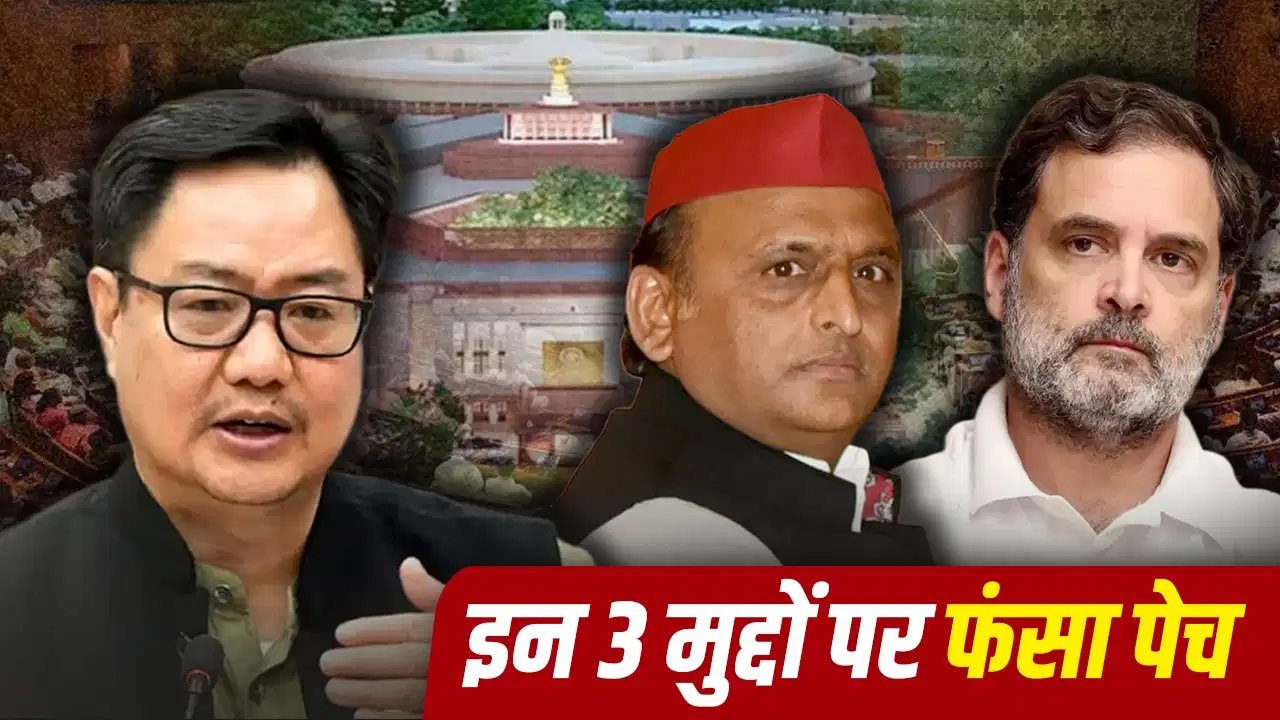
Even as both the Central Government and the Opposition have publicly expressed their willingness to debate the alleged NEET paper leak and examination-related issues, Parliament has continued to witness repeated disruptions during the Monsoon Session. For the third consecutive day, proceedings in both the Lok Sabha and the Rajya Sabha were adjourned amid loud protests, raising an important question: If both sides agree that a discussion should take place, why is Parliament still unable to debate the issue?
The continuing deadlock has shifted the focus from whether a discussion should happen to how that discussion should be conducted. While the government says it is ready for a structured debate under the existing parliamentary rules, the Opposition insists that the matter should be discussed under special procedural provisions that it believes would reflect the seriousness of the issue.
At the heart of the disagreement lies not only the alleged examination paper leak but also questions relating to parliamentary procedure, ministerial accountability, and demands for the resignation of Union Education Minister Dharmendra Pradhan.
Table of Contents
The issue has become one of the biggest political flashpoints of the ongoing Monsoon Session, with repeated adjournments preventing legislative business and intensifying political confrontation inside and outside Parliament.
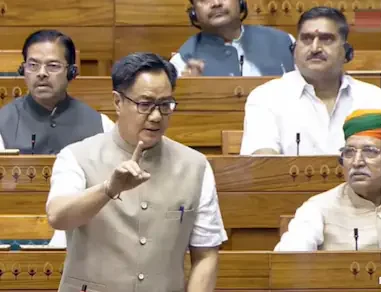
Parliament Adjourned Again Amid Continued Uproar
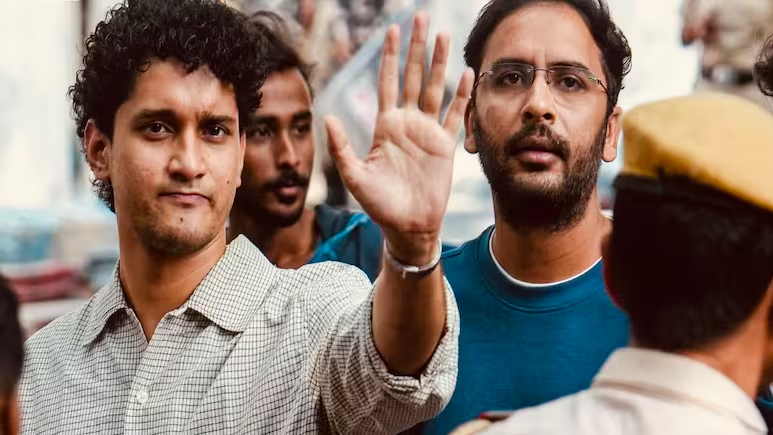
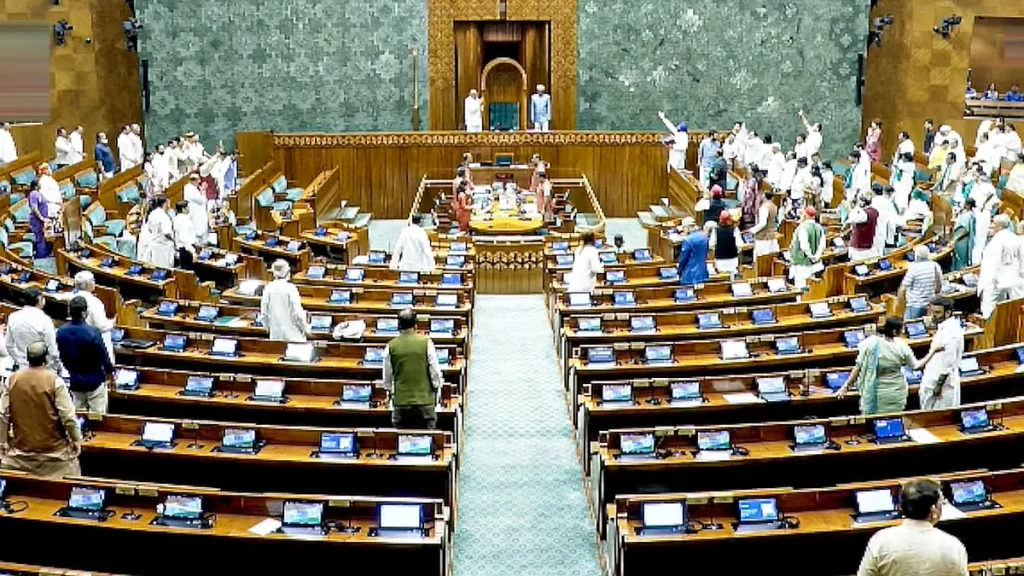
Proceedings in both Houses were disrupted once again as Opposition MPs continued raising slogans over the alleged paper leak controversy and demanding accountability from the government.
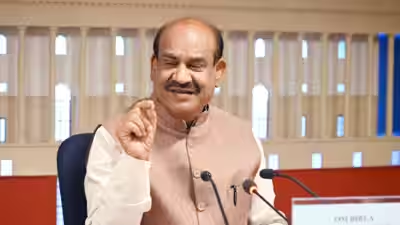
Before adjourning the Lok Sabha, Speaker Om Birla observed that both the government and the Opposition had expressed readiness for a discussion and urged leaders from both sides to sit together and reach an agreement on the format of the debate.
Despite this appeal, no consensus could be reached, forcing the House to be adjourned amid continued protests.
A similar situation unfolded in the Rajya Sabha, where the government reiterated its willingness to discuss the matter while the Opposition continued pressing for a debate under a specific parliamentary rule.
The repeated disruptions have prevented Parliament from taking up a formal discussion on one of the country’s most widely debated issues relating to students and competitive examinations.
Government Reiterates Readiness for Discussion
The Central Government has consistently maintained that it is prepared to debate the alleged NEET paper leak in Parliament.
Union Parliamentary Affairs Minister Kiren Rijiju stated that the government has been ready for discussion from the very beginning of the controversy.
According to Rijiju, the government supports a structured debate and is willing to discuss all issues relating to the examination controversy through established parliamentary procedures.
The government has indicated that discussions regarding the timing, duration, and applicable parliamentary rules should be finalised after consultations among floor leaders of different political parties.
Government representatives have argued that there has never been any reluctance to discuss the matter and that Parliament remains the appropriate forum for such debates.
Opposition Says Discussion Must Be Meaningful
While welcoming the possibility of a debate, Opposition parties argue that the discussion should not become merely procedural.
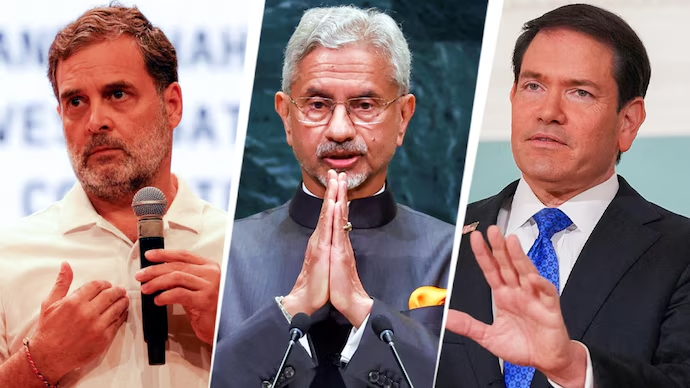
Leader of Opposition Rahul Gandhi has repeatedly maintained that the government must first demonstrate accountability by acting against those responsible for the controversy.
According to Rahul Gandhi, discussions alone are insufficient unless accompanied by concrete action, including the resignation of Union Education Minister Dharmendra Pradhan.
He has argued that students across the country have lost confidence in the examination system due to repeated allegations of paper leaks and irregularities.
Rahul Gandhi has also called upon the government to explain what corrective measures it intends to implement to prevent similar controversies in the future.
The Congress maintains that accountability should precede political discussion rather than follow it.
Akhilesh Yadav Emphasises Student Concerns
Samajwadi Party chief Akhilesh Yadav has also supported a parliamentary debate while focusing on issues affecting students.
Addressing the Lok Sabha, Akhilesh Yadav stated that the resignation of a minister could happen at any stage, but Parliament should immediately discuss the concerns of students.
He questioned why students allegedly affected by examination controversies and related incidents were not receiving sufficient attention.
According to him, Parliament should focus on understanding the circumstances surrounding the alleged paper leak, the concerns raised by students, and the response of the administration.
His remarks reflected the broader Opposition position that student welfare should remain central to the debate.
Why Has Parliament Not Been Able to Begin the Discussion?
Although both sides agree in principle that the issue deserves discussion, they disagree over the parliamentary mechanism through which the debate should take place.
The disagreement revolves around specific procedural rules governing debates in both Houses of Parliament.
While the government supports discussion under normal parliamentary procedures, the Opposition wants debates under provisions that temporarily suspend all other business and allow the issue to receive priority attention.
This procedural disagreement has become the principal reason why Parliament has been unable to move forward despite public statements from both sides expressing readiness for discussion.
Opposition Demands Debate Under Rule 267 in Rajya Sabha
Congress General Secretary Jairam Ramesh has said that Opposition parties have submitted notices seeking discussion under Rule 267 in the Rajya Sabha.
Rule 267 is regarded as one of the most significant procedural provisions available in the Upper House.
If accepted, it allows the Rajya Sabha to suspend its scheduled business for the day in order to discuss an issue considered to be of urgent national importance.
Under this procedure, the concerned minister—or, where appropriate, the Prime Minister—is expected to make an initial statement before Members of Parliament present their views.
The government then responds after hearing the arguments advanced by members.
The Opposition believes that invoking Rule 267 would underline the seriousness of the alleged paper leak controversy and ensure focused parliamentary attention.
Why Rule 267 Matters
According to Opposition leaders, discussion under Rule 267 carries symbolic as well as procedural importance.
Because it suspends regular business, it sends a strong political message that the issue being debated is among the country’s most urgent concerns.
For this reason, Opposition parties frequently seek Rule 267 discussions when attempting to emphasise issues involving public accountability.
The government, however, has generally preferred discussions through ordinary parliamentary procedures rather than suspending all scheduled legislative work.
This difference has become one of the central reasons behind the continuing deadlock.
Congress Seeks Adjournment Motion in Lok Sabha
In the Lok Sabha, Congress has demanded discussion through an Adjournment Motion, according to Congress General Secretary KC Venugopal.
An Adjournment Motion is considered an extraordinary parliamentary procedure that allows the House to suspend normal business in order to debate an issue of urgent public importance.
For such a motion to be admitted, it requires support from at least fifty Members of Parliament.
If accepted, the Lok Sabha temporarily sets aside its scheduled agenda to discuss the matter.
Congress believes that the alleged NEET paper leak and examination-related controversies justify the use of this extraordinary mechanism.
Why Government Prefers Regular Debate
Government representatives have indicated their willingness to discuss the issue but have not supported discussion under procedures that effectively suspend all House business.
Political observers note that debates under Adjournment Motions often carry the perception that the government is being placed in a defensive position.
Such debates are frequently viewed as reflecting administrative shortcomings and may include elements of criticism or censure.
For this reason, governments have traditionally preferred structured discussions under normal parliamentary rules rather than through exceptional procedural mechanisms.
The present disagreement reflects this longstanding parliamentary practice.
Demand for Education Minister’s Resignation Remains Central
Another major point of disagreement concerns the Opposition’s demand for the resignation of Union Education Minister Dharmendra Pradhan.
Congress leaders argue that ministerial accountability should accompany parliamentary discussion.
According to the party, accepting political responsibility would strengthen public confidence in the government’s commitment to examination reforms.
The government has not accepted this demand and has instead maintained that discussions should proceed without preconditions.
This difference continues to widen the gap between both sides.
Student Welfare at the Centre of Political Debate
The controversy has extended beyond parliamentary procedures to broader questions concerning India’s education system.
Opposition parties argue that repeated allegations relating to examination irregularities have affected the confidence of students preparing for competitive examinations.
They have demanded stronger safeguards against paper leaks, greater transparency in examination administration, quicker investigations into alleged irregularities, and comprehensive reforms aimed at restoring public trust.
The government, meanwhile, has reiterated that it is committed to ensuring fairness in examinations and has expressed readiness to discuss the matter in Parliament.
Importance of Parliamentary Debate
Parliament serves as the country’s highest democratic forum where the government explains its policies and decisions while the Opposition raises questions on behalf of citizens.
Debates held in Parliament become part of the official legislative record and contribute to institutional accountability.
They provide an opportunity for ministers to present facts, clarify government policy, respond to allegations, and outline future action plans.
Similarly, Opposition parties can scrutinise government decisions, present alternative viewpoints, and seek explanations regarding matters of public concern.
For issues involving national examinations, student welfare, and public confidence in institutions, parliamentary debate is widely regarded as an important democratic mechanism.
Political Significance of the Current Deadlock
The continuing stalemate has transformed the alleged NEET paper leak from an education-related controversy into a major political issue dominating the Monsoon Session.
Repeated adjournments have prevented legislative business while simultaneously increasing public attention on examination reforms and parliamentary functioning.
Political analysts believe the eventual format of the debate could influence both the government’s response to examination-related concerns and the Opposition’s broader campaign on issues affecting students and youth.
Until an agreement is reached regarding parliamentary procedure, however, the deadlock appears likely to continue.
Although both the government and the Opposition publicly agree that the alleged NEET paper leak deserves discussion in Parliament, differences over how that debate should be conducted have prevented proceedings from moving forward. The government has expressed readiness for discussion under normal parliamentary procedures, while the Opposition continues demanding debates under Rule 267 in the Rajya Sabha and an Adjournment Motion in the Lok Sabha, alongside its demand for the resignation of Union Education Minister Dharmendra Pradhan.
As repeated adjournments continue to disrupt the Monsoon Session, the controversy has become a broader debate over parliamentary accountability, education reforms, and the future of India’s examination system. With students’ concerns remaining at the centre of national attention, all eyes are now on whether both sides can reach procedural consensus and allow Parliament to begin a substantive discussion on one of the country’s most significant public issues.