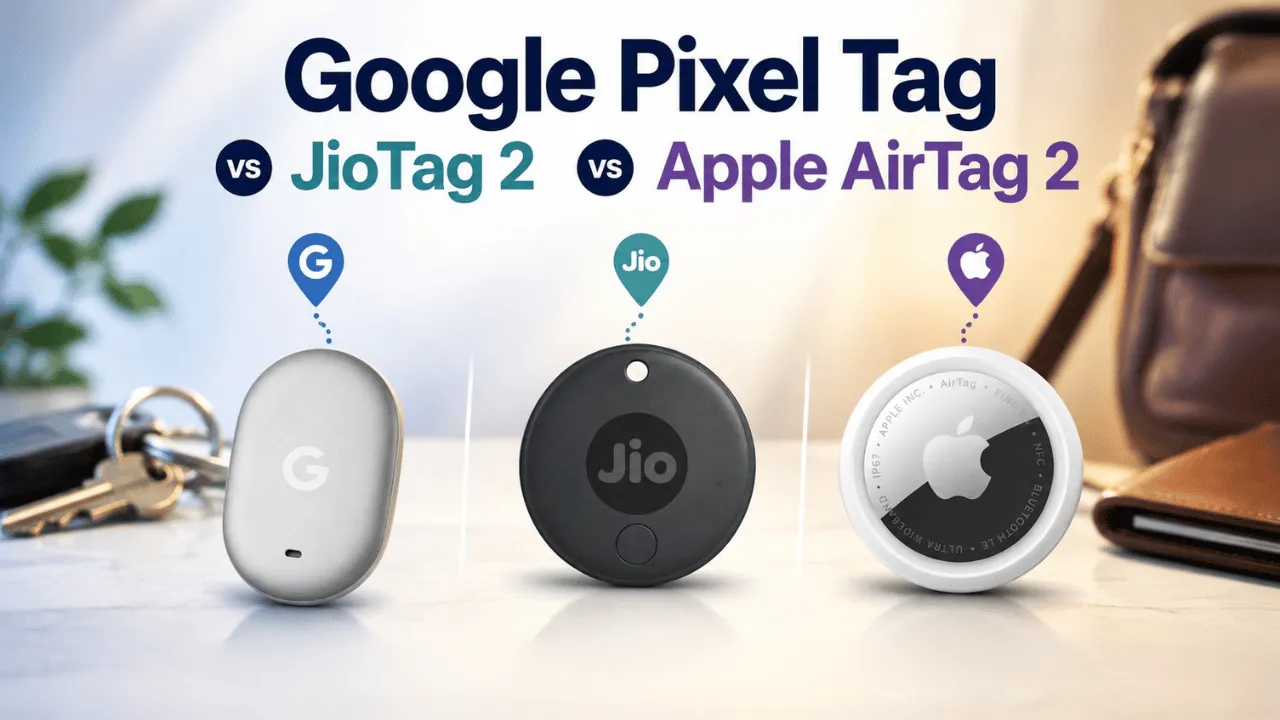
The Bluetooth tracker market is becoming increasingly competitive in India, with three products now standing out for different reasons: Google’s new Pixel Tag, Reliance Jio’s JioTag 2, and Apple’s AirTag (2nd generation). While all three are designed to help users locate belongings such as keys, wallets, bags and luggage, their biggest differences come from ecosystem compatibility, precision tracking, battery life, durability and price.
Google has officially introduced the Pixel Tag as its first in-house item tracker. It is scheduled to go on sale in November 2026, while the JioTag 2 is already available in India and Apple’s second-generation AirTag is also on sale.
Table of Contents
For Indian consumers, the comparison is particularly interesting because the JioTag 2 costs considerably less than the two premium alternatives, while the Pixel Tag and AirTag 2 bring more advanced precision-finding technologies.
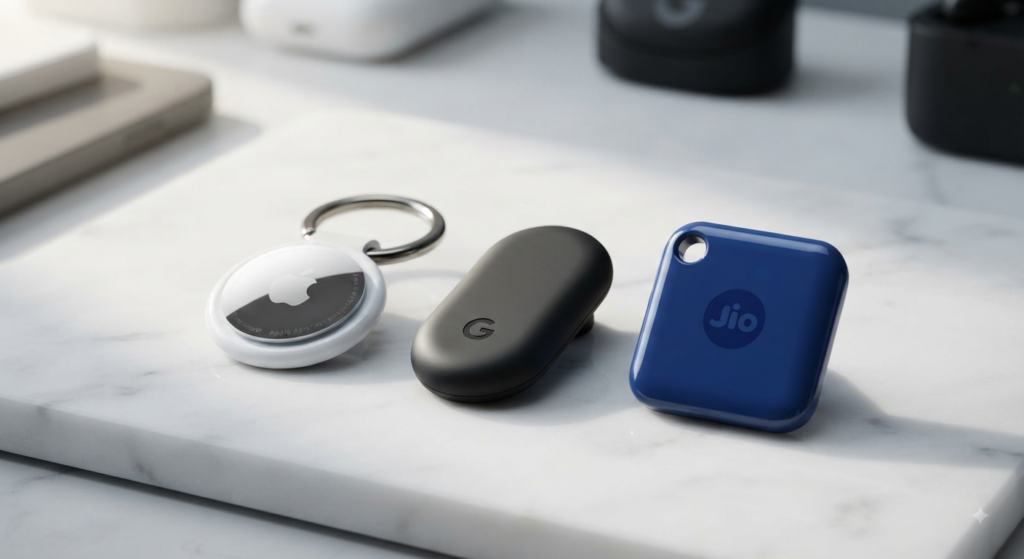
Pixel Tag vs JioTag 2 vs AirTag 2: At a Glance
| Feature | Google Pixel Tag | JioTag 2 | Apple AirTag 2 |
|---|---|---|---|
| Price in India | ₹3,799 | ₹1,249 | ₹3,790 |
| Network | Google Find Hub | Google Find Hub + Apple Find My | Apple Find My |
| Phone compatibility | Android | Android + iOS | iPhone/iPad |
| Precision technology | UWB + Bluetooth 6.0 Channel Sounding | Bluetooth Low Energy | UWB + Bluetooth |
| Battery | Replaceable CR2032, 1+ year | Replaceable, up to 1 year | Replaceable CR2032 |
| Extra battery | No | Included | No |
| Water/dust resistance | IP67 | IP64 | IP67 |
| Speaker | Yes | 120dB buzzer | Yes |
| Launch/availability | November 2026 | Available | Available |
The specifications show that there is no single winner for every user. Instead, the right choice largely depends on the smartphone ecosystem and how much the buyer wants to spend.
Google Pixel Tag: Google’s Direct Answer to AirTag
The Pixel Tag is Google’s first official item tracker and represents a significant expansion of the company’s hardware ecosystem.
Google says the device will cost $29 in the US, with a four-pack priced at $99, and it will launch on November 11, 2026. Indian pricing has been listed at ₹3,799 for one unit and ₹12,900 for four, putting it almost directly alongside Apple’s AirTag 2 in the premium tracker segment.
The Pixel Tag is designed to work with Google’s Find Hub network. That means the tracker does not need to remain continuously connected to its owner’s phone to potentially report its location. Compatible Android devices around the lost tag can help relay its location through the network.
This is particularly important when tracking luggage or another item that has travelled outside Bluetooth range.
UWB and Bluetooth 6.0 Channel Sounding
One of the Pixel Tag’s biggest technological advantages is its combination of Ultra Wideband (UWB) and Bluetooth 6.0 Channel Sounding.
UWB can provide direction and distance information when used with compatible devices. Google has also integrated Bluetooth Channel Sounding to provide another method of precision distance measurement.
However, not every Android device will necessarily support every precision feature. Reports indicate that Channel Sounding requires newer compatible Pixel hardware, while UWB support is available on certain Pixel devices.
That means buyers should check their phone’s compatibility rather than assuming that every Pixel Tag feature will work on every Android handset.
JioTag 2: The Budget Challenger
For price-conscious Indian buyers, the JioTag 2 is arguably the most interesting product in this comparison.
Launched in India at ₹1,249, the second-generation tracker is significantly cheaper than both Google’s Pixel Tag and Apple’s AirTag 2. It is available in multiple colours and has a redesigned body.
More importantly, Jio has addressed one of the biggest limitations of the original JioTag by making the new model compatible with both Android and iOS.
The JioTag 2 supports Google’s Find Hub network for Android users and Apple’s Find My network for Apple users. This gives the device a level of cross-platform flexibility that makes it particularly relevant for households where people use different smartphone brands.
Battery Life and Extra Battery
The JioTag 2 uses a replaceable battery with a claimed life of up to one year.
One particularly useful advantage is that an additional battery is included with the product, potentially giving users another year of operation before they need to purchase a replacement battery, depending on usage.
The device also features a built-in 120dB buzzer, which can help users locate an item when it is nearby and within Bluetooth range.
IP64 Protection
The JioTag 2 carries an IP64 rating for dust and water resistance. This provides protection against dust and water splashes, although it is not as resistant to water exposure as the IP67-rated Pixel Tag and AirTag 2.
For everyday objects such as keys, wallets and bags, this may be sufficient. However, people who frequently travel in heavy rain or expose their tracker to wetter environments may prefer the higher protection rating offered by the other two devices.
Apple AirTag 2: A Mature Tracking Ecosystem
Apple’s AirTag (2nd generation) is the established premium option in this comparison.
Apple lists the Indian price at ₹3,790 for a single AirTag and ₹12,900 for a four-pack. The company says the second-generation model introduces expanded range and improved findability while retaining the core Find My experience.
The AirTag 2 uses Apple’s Find My network, which can use nearby Apple devices to help report the location of a lost item.
For iPhone users, the major advantage is the deep integration between the tracker and Apple’s ecosystem.
Second-Generation Ultra Wideband
Apple has equipped the AirTag 2 with a second-generation Ultra Wideband chip and expanded Precision Finding connectivity. This can provide more precise locating when a compatible iPhone is nearby.
The device is also compatible with NFC-based Lost Mode features, allowing someone who finds a lost AirTag to interact with it using an NFC-capable phone.
Battery Comparison
Battery life is important because trackers are designed to remain attached to belongings for long periods.
The Pixel Tag uses a replaceable CR2032 coin cell and is rated for more than a year of battery life.
The AirTag 2 also uses a user-replaceable CR2032 battery. Apple’s specifications indicate that battery life varies depending on usage and environmental conditions.
The JioTag 2 uses a replaceable battery rated for up to one year, with an additional battery supplied in the package according to product information.
From a maintenance perspective, all three avoid the inconvenience of a sealed rechargeable battery. Users can replace the cell rather than replacing the entire tracker.
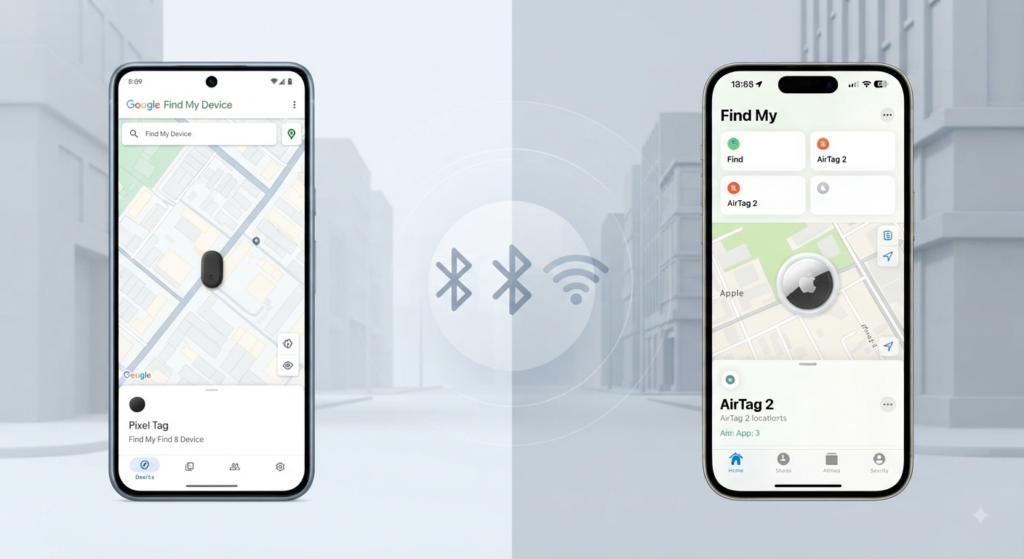
Tracking Networks: The Most Important Difference
The hardware is only part of the story.
A Bluetooth tracker becomes much more useful when it is outside the owner’s phone range because it can rely on a wider network of nearby devices.
The Pixel Tag is integrated with Google’s Find Hub network, which uses participating Android devices to help locate lost belongings.
The AirTag 2 relies on Apple’s Find My network.
The JioTag 2 is unusual because it can work with both Google Find Hub and Apple Find My, giving users flexibility across Android and iOS.
For someone who changes between Android and iPhone devices, or lives in a mixed-device household, this cross-platform approach could be one of the JioTag 2’s biggest selling points.
Precision Finding: Pixel Tag and AirTag 2 Have an Edge
When a tracker is somewhere nearby, network-based location is not always enough. Users may know that their keys are inside the house but still need help identifying exactly where they are.
This is where precision technologies become important.
The Pixel Tag combines UWB with Bluetooth 6.0 Channel Sounding, while AirTag 2 uses Apple’s second-generation UWB chip for improved Precision Finding.
JioTag 2, meanwhile, focuses on Bluetooth Low Energy and network-based tracking rather than offering the same UWB-based precision-finding hardware.
Therefore, users who specifically want advanced close-range directional finding may have stronger reasons to consider the Pixel Tag or AirTag 2.
Durability: Pixel Tag and AirTag 2 Take the Lead
Both the Pixel Tag and AirTag 2 carry an IP67 rating.
Apple specifies that the AirTag 2 can withstand immersion in up to one metre of water for up to 30 minutes under controlled laboratory conditions.
The Pixel Tag also has an IP67 rating.
The JioTag 2’s IP64 rating is lower, meaning buyers should be more cautious about significant water exposure.
For normal indoor use, this distinction may not matter much. For travel, outdoor use and luggage tracking, however, the higher protection rating can provide additional peace of mind.
Which Tracker Offers the Best Value?
The answer depends heavily on the user’s smartphone.
For Android users
The Pixel Tag is Google’s most integrated option, particularly for people already using compatible Pixel hardware and Google’s ecosystem.
Its UWB and Bluetooth Channel Sounding technologies make it the most technologically ambitious option of the three, although users should verify whether their phone supports the relevant precision features.
For iPhone users
The AirTag 2 remains a natural choice because of its integration with Apple’s Find My ecosystem and Precision Finding capabilities. Its ₹3,790 price also puts it almost level with the Pixel Tag in India.
For budget-conscious buyers
The JioTag 2 is difficult to ignore at ₹1,249.
It offers cross-platform support, a replaceable battery, an additional battery, a loud buzzer and community-based tracking through both major ecosystems.
Its lower price does mean compromises, particularly the absence of the more advanced UWB precision technology and its lower IP64 protection rating.
Price Is Not the Only Factor
At first glance, the price difference between ₹1,249 and roughly ₹3,800 looks enormous. But buyers should also consider how they plan to use the tracker.
Someone attaching a tag to a school bag or house keys may not need advanced UWB precision finding. For that user, JioTag 2’s lower cost could be more important.
A frequent traveller carrying expensive luggage may place greater value on stronger water resistance and advanced precision tracking.
Similarly, a Pixel phone owner may prefer the Pixel Tag because of its deeper Google integration, while an iPhone owner may find AirTag 2 more convenient.

Final Verdict
The Google Pixel Tag, JioTag 2 and Apple AirTag 2 represent three different approaches to the same basic problem: finding belongings that have been misplaced or lost.
The Pixel Tag stands out for its combination of Google Find Hub, UWB and Bluetooth 6.0 Channel Sounding, making it Google’s most advanced dedicated tracker yet.
The JioTag 2 focuses on affordability and flexibility. At ₹1,249, with support for both Google Find Hub and Apple Find My, it offers an unusually broad feature set for its price.
The AirTag 2 remains particularly compelling for Apple users because of its Find My integration, second-generation UWB technology and IP67 protection.
Ultimately, there is no universal winner. JioTag 2 is the value-focused choice, Pixel Tag is the feature-rich Android option, and AirTag 2 is the premium choice for Apple’s ecosystem. For most buyers, the smartphone already in their pocket may be the biggest factor in deciding which tracker makes the most sense.