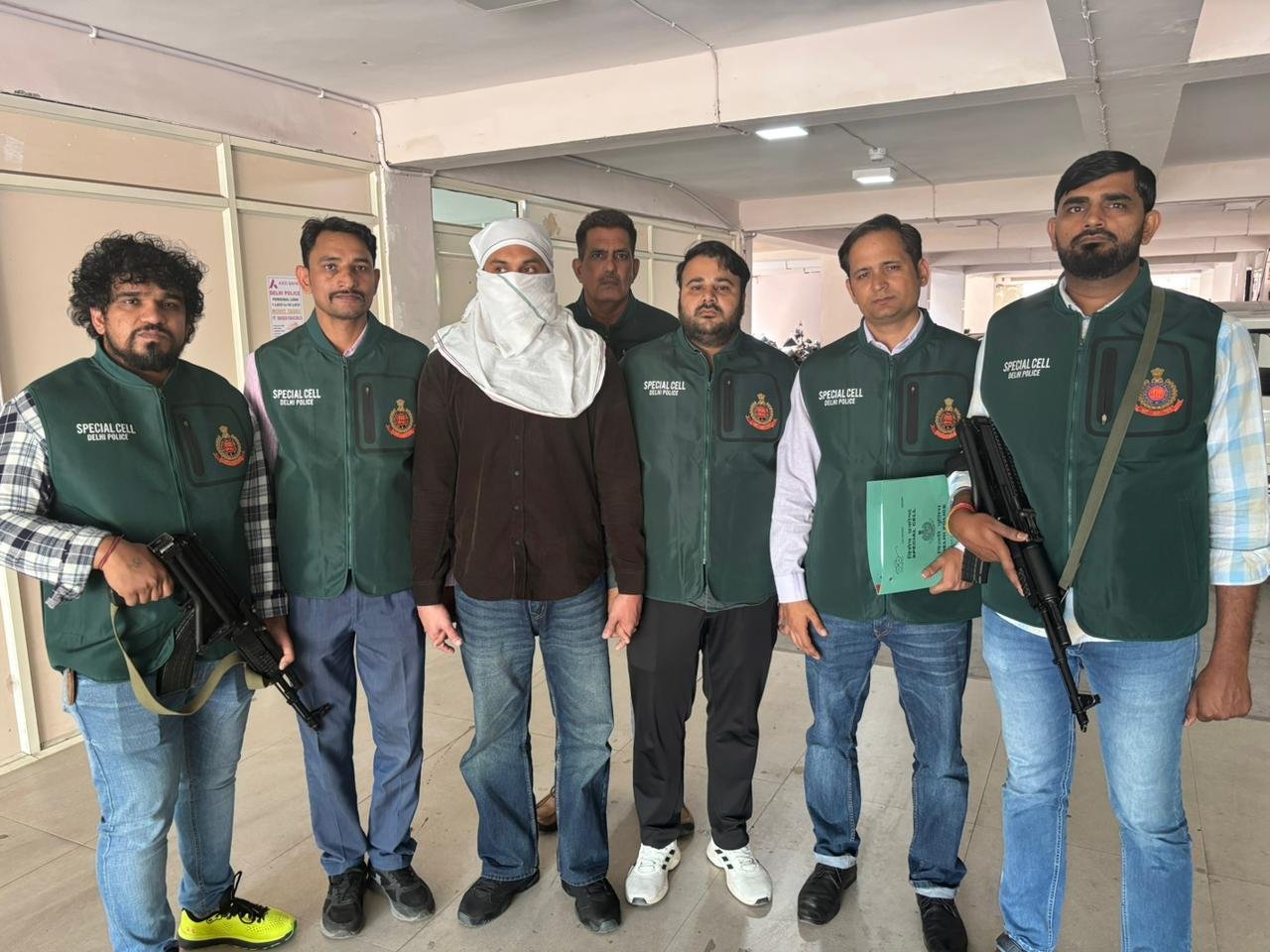
Drug syndicate activities linked to international heroin trafficking networks have once again come under intense scrutiny after the Special Cell of Delhi Police successfully brought back fugitive accused Prabhdeep Singh from Baku, Azerbaijan, in coordination with the Central Bureau of Investigation. The accused was wanted in a high-profile NDPS case involving the recovery of nearly 358 kilograms of heroin and had allegedly absconded from India in 2023 while trial proceedings continued against several members of the drug syndicate.
The successful extradition is being seen as a major operational achievement for Delhi Police and central investigative agencies working against transnational narcotics trafficking networks. Officials believe the accused played an important role in managing the drug syndicate in India on behalf of foreign-based handler Navpreet Singh alias Nav, whose last known location was reported to be in Turkey.
Investigators say the arrest and return of the accused could provide critical information about the functioning, financial operations, communication systems, and international links of the drug syndicate that allegedly operated across India and abroad.
The operation also highlights the growing coordination between Indian law enforcement agencies and foreign authorities in tracking fugitives involved in organised crime and narcotics trafficking.
Delhi Police Team Successfully Executes Extradition Operation
The extradition operation was carried out by a three-member Special Cell team consisting of ACP Vivek Tyagi, Inspector Sanjay Gupta, and Sub-Inspector Sandeep Kumar.
Officials stated that the team coordinated closely with the Central Bureau of Investigation and other concerned agencies to complete legal procedures and bring the accused back to India.
The accused, identified as Prabhdeep Singh alias Harry, had allegedly fled India in 2023 after his role in the drug syndicate came under the scanner during the investigation of a massive heroin seizure case registered by Special Cell.
Police officials deserve appreciation for continuously pursuing the fugitive despite the international dimension of the case. Extradition operations involving members of an international drug syndicate are often legally complex and require sustained intelligence gathering, diplomatic coordination, and procedural clearances.
 The Drug Syndicate Was Linked to 358 Kilograms of Heroin
The case originated in 2021 after Special Cell officers received information regarding narcotics trafficking activities connected to accused Rizwan Ahmed, also known as Rizwan Kashmiri.
Investigators suspected that Rizwan was involved in heroin supply operations in Delhi and several other states including Punjab, Haryana, and Madhya Pradesh.
On July 5, 2021, Special Cell officers received a tip-off that Rizwan would deliver a narcotics consignment in the Ghitorni area of South Delhi. Acting on the information, police arrested him while he was allegedly carrying one kilogram of heroin.
What initially appeared to be a routine narcotics arrest later exposed a much larger drug syndicate operating across multiple states and linked to foreign handlers.
During interrogation, Rizwan allegedly revealed that he was working under instructions from Afghan-based handler Isha Khan. He reportedly disclosed details about the functioning of the drug syndicate and its connections with Punjab-based operatives.
Based on the disclosures, Special Cell officers conducted raids at locations linked to accused Gurpreet Singh and Gurjot Singh, who were allegedly operating the drug syndicate from Faridabad.
Massive Heroin Recovery Exposed Organised Network
During the raids, investigators recovered enormous quantities of heroin and related substances from vehicles and rented premises connected to the accused.
Police recovered:
- 166 kilograms of heroin from a Hyundai Verna car
- 115 kilograms of heroin from a Honda Amaze car
- Around 70 kilograms of heroin and psychotropic substances from rented accommodation
The total recovery reached approximately 358 kilograms of heroin, making it one of the major narcotics recoveries linked to a drug syndicate investigated by Delhi Police in recent years.
Officials later arrested Afghan national Hazrat Ali from Gurugram and recovered around two kilograms of heroin along with nearly 100 kilograms of chemicals allegedly used in the preparation of narcotic substances.
Drug enforcement experts say such large recoveries indicate industrial-scale operations rather than isolated drug peddling activities. The quantity of heroin recovered suggests that the drug syndicate was involved in large distribution networks capable of supplying narcotics across different regions.
 Role of Prabhdeep Singh in the Drug Syndicate
According to investigators, Prabhdeep Singh played an important operational role inside the drug syndicate.
Police stated that he acted as a key link between foreign-based syndicate leadership and local operatives in India. He allegedly communicated instructions from overseas handler Navpreet Singh alias Nav to other accused persons involved in transporting and managing narcotics consignments.
Investigators believe Prabhdeep Singh monitored the movement of drug consignments, maintained contact with various syndicate members, and helped coordinate operations within India.
Officials suspect that the drug syndicate relied heavily on trusted intermediaries like Prabhdeep Singh to avoid direct communication between kingpins and ground-level operatives.
Police sources say further interrogation of the accused is expected to reveal:
- Communication systems used by the drug syndicate
- Financial channels and hawala links
- International contacts connected to narcotics supply
- Drug transportation routes
- Involvement of additional associates
The extradition of the accused therefore represents not only an arrest but also an opportunity for investigators to better understand the internal functioning of the drug syndicate.
International Drug Syndicate Networks a Growing Concern
The case reflects the increasing sophistication of international narcotics trafficking operations affecting India.
Law enforcement agencies have repeatedly warned that organised drug syndicate networks now operate across borders using digital communication, multiple identities, financial layering, and international handlers to evade detection.
Experts say heroin trafficking routes connected to Afghanistan continue to remain a serious concern for Indian security agencies. Afghanistan has historically remained one of the world’s major opium-producing regions, and narcotics trafficking routes often extend through neighboring countries into South Asia.
The involvement of foreign nationals, overseas handlers, and cross-border coordination in the current case demonstrates the international reach of the drug syndicate under investigation.
Drug trafficking experts believe organised syndicates frequently use:
- Fake identities
- Encrypted communication apps
- Multiple bank accounts
- Hawala transactions
- Cross-border operatives
- Interstate transport networks
Such methods make investigations difficult and require coordinated efforts between different agencies.
Prison Links Helped Expand the Drug Syndicate
During investigation, police also discovered that accused Gurpreet Singh allegedly met foreign-based handler Navpreet Singh alias Nav inside Kapurthala Jail in Punjab while both were lodged there in separate NDPS cases.
Crime experts often warn that prisons sometimes become networking hubs for organised criminals, where accused persons establish new alliances and expand illegal operations after release.
Investigators suspect these prison contacts may have helped strengthen the drug syndicate and expand its operations across states.
The case highlights how organised narcotics networks continue evolving through personal contacts, interstate alliances, and international coordination.
Trial Against Multiple Accused Underway
Delhi Police confirmed that trial proceedings are currently underway against 10 accused persons linked to the drug syndicate, including one Afghan national.
The accused arrested in the case belong to different states including Delhi, Punjab, Haryana, and Madhya Pradesh, reflecting the wide operational spread of the narcotics network.
Police officials stated that further investigation is still in progress and additional leads may emerge following the interrogation of Prabhdeep Singh.
Investigators are also examining whether the drug syndicate had financial links with international trafficking groups operating outside India.
Importance of International Cooperation in Narcotics Cases
The successful return of the accused from Azerbaijan demonstrates the growing importance of international cooperation in tackling organised narcotics crime.
As modern drug syndicate operations increasingly extend across borders, extradition and intelligence-sharing have become essential tools for law enforcement agencies worldwide.
Officials say international coordination played a crucial role in tracing and securing the return of the fugitive accused. The cooperation between Delhi Police, the Central Bureau of Investigation, and foreign authorities helped ensure that the accused was brought back to face legal proceedings in India.
Law enforcement experts believe such operations send a strong message to organised criminal networks that fugitives involved in narcotics trafficking cannot permanently escape the legal system by fleeing abroad.
The operation also highlights the sustained efforts of the Special Cell of Delhi Police in targeting major drug syndicate networks involved in heroin trafficking and organised narcotics crime across India.