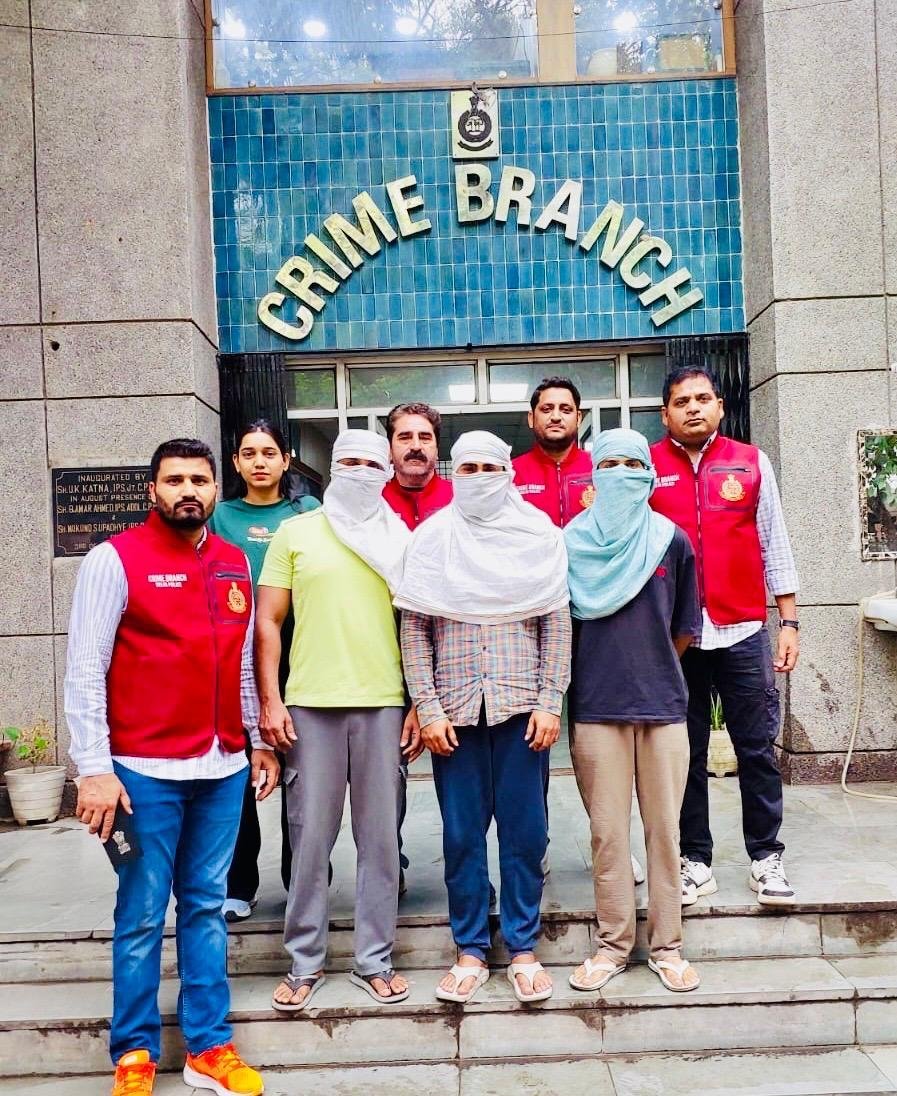
The Delhi Police Crime Branch has exposed a large interstate Fake Visa and overseas job racket that allegedly cheated hundreds of unemployed youth by promising lucrative jobs in countries such as Russia, Turkey, and Azerbaijan. The operation, led by the Crime Branch team under Inspector Sanjay Kaushik, resulted in the arrest of three accused persons involved in the sophisticated Fake Visa syndicate that operated across multiple states.
The case once again highlights how vulnerable job seekers are becoming targets of professional fraud networks that exploit dreams of foreign employment. Delhi Police officials described the racket as highly organized, technologically active, and carefully designed to appear legitimate.
According to the Crime Branch, the accused used fake company identities, forged visas, manipulated online verification systems, and cancelled air tickets to convince victims that their overseas job applications were genuine. The gang allegedly collected large sums of money in the name of visa processing, documentation, and placement fees before disappearing.
The accused have been identified as Salauddin Mansuri alias Haider Khan from Bihar, Mohd Shahzad from Ghaziabad, and Kaushar from Kushinagar in Uttar Pradesh. Police officials recovered multiple passports, mobile phones, forged documents, debit cards, and fake identity proofs during the operation.
 How the Fake Visa Racket Worked
Investigators revealed that the accused created an elaborate Fake Visa operation by pretending to represent a company named “Saba Enterprises,” which they claimed was based in Kolkata. The accused reportedly projected themselves as recruitment agents offering high-paying foreign jobs in construction, factory work, and other labour sectors.
The gang mainly targeted unemployed youth from Bihar, West Bengal, Uttar Pradesh, and nearby states. Many victims were financially weak and desperate to secure employment abroad. Police officials said the accused took advantage of this desperation through aggressive advertising on social media platforms.
The syndicate reportedly used Facebook advertisements and WhatsApp Business accounts to attract victims. Interested candidates were asked to submit their documents, especially passports, through courier services. After receiving the passports, the gang digitally scanned them and prepared forged visas using fake immigration stamps and manipulated graphics.
Officials stated that these forged visas looked authentic enough to fool ordinary people. Victims were then sent soft copies of these documents along with tentative flight tickets. In several cases, the gang even created fake online verification links so that victims could “verify” the visa documents themselves.
This level of planning made the Fake Visa scam appear highly convincing.
Victims believed their foreign jobs had been confirmed and transferred money to the accused for visa processing and travel arrangements. However, the fraud became clear only when the victims discovered that their original passports had no official visa stamps and the airline tickets had either been cancelled or were never fully booked.
By that time, the accused had already switched off their mobile phones and vanished.
Delhi Police Operation and Arrests
The successful operation was carried out by a specialized Crime Branch team after receiving specific intelligence regarding the Fake Visa racket. The investigation involved technical surveillance, field verification, and monitoring of suspect movements.
The police team included SI Narender Singh, ASI Virender Singh, ASI Hukam Chand, HC Sanjeev Jakhar, Ct. Vivek Rana, and Ct. Annu under the supervision of ACP Ashok Sharma. Acting on credible information, the team conducted a coordinated raid near NSP in Pitampura, Delhi.
The accused were apprehended during the operation, and several important recoveries were made on the spot. Delhi Police officials deserve appreciation for their professional investigation and quick action, as the operation likely prevented many more innocent people from falling victim to the Fake Visa network.
Police said the investigation required careful tracking because the accused frequently changed locations and operated from multiple cities including Kolkata, Gorakhpur, Noida, and Patna. This constant movement helped them avoid suspicion and law enforcement detection.
Key Role of the Main Accused
According to investigators, Salauddin Mansuri alias Haider Khan played a central role in the Fake Visa operation. Police said he posed as the HR Manager of Saba Enterprises and acted as the main contact person for victims.
Interestingly, officials revealed that he was a school dropout who previously worked in export and insurance companies in Noida. He allegedly joined the illegal business after being lured by the promise of quick money.
Police recovered two passports belonging to victims, mobile phones used in the fraud, and an Aadhaar card carrying the fake identity of “Haider Khan.”
Investigators believe he handled direct communication with job seekers and gained their trust by speaking professionally and presenting fake employment procedures.
Organized Structure of the Fake Visa Syndicate
The Delhi Police investigation revealed that the accused were not working randomly. Instead, they operated like a well-organized criminal syndicate where each person had a defined responsibility.
Kaushar allegedly handled recruitment and document collection. He reportedly contacted potential victims and convinced them to apply for overseas jobs. Police said he was aware that the entire operation was fraudulent and admitted that the group usually disappeared after receiving payments.
Kaushar himself had previously worked abroad in Saudi Arabia, which likely helped him sound convincing while dealing with victims seeking international employment.
Officials recovered victim passports, mobile phones, debit cards, and multiple identification documents from his possession.
Meanwhile, Mohd Shahzad allegedly assisted in bringing clients and coordinating financial transactions. His mobile phone reportedly contained chats with the absconding mastermind identified as Md. Munna.
Police believe Md. Munna may be the brain behind the entire Fake Visa racket and efforts are underway to trace and arrest him.
Social Media Becoming a Tool for Fake Visa Frauds
One of the most alarming aspects of the case is the use of social media platforms for conducting the Fake Visa scam. Investigators said the accused heavily relied on Facebook advertisements and WhatsApp communication to target job seekers.
Experts say online job frauds have increased significantly in recent years because fraudsters can easily create professional-looking pages and advertisements. Many unemployed youth trust such online ads without verifying whether the companies are officially registered.
Cybercrime experts often warn that genuine international recruitment agencies usually follow transparent documentation procedures and do not ask candidates to blindly send passports or large advance payments.
In this case, the accused created fake digital ecosystems including fabricated visa copies, fake HR profiles, and online verification links to make the operation appear authentic.
The Delhi Police investigation shows how advanced modern Fake Visa scams have become. These frauds are no longer limited to simple fake promises but now involve digital manipulation and organized communication strategies.
Important Recoveries Made by Delhi Police
The Crime Branch recovered several important items linked to the Fake Visa operation, including:
- Five original Indian passports belonging to victims
- Seven mobile phones used in the crime
- Scanned fake visas and forged job letters
- Fake e-tickets and travel documents
- Aadhaar card in the fake name “Haider Khan”
- Multiple debit and ATM cards
- Identification documents in different names
Police officials stated that digital evidence recovered from the phones may help identify more victims and other associates connected to the racket.
Authorities are now examining financial transactions and digital communication records to understand the full scale of the operation.
Rising Threat of Fake Visa Scams in India
The exposure of this Fake Visa syndicate reflects a growing national problem. Every year, thousands of Indians search for overseas employment opportunities, especially in Gulf countries, Europe, and parts of Asia.
Fraudsters often target unemployed youth by promising jobs with high salaries, accommodation, and fast visa approvals. Victims frequently borrow money or sell assets to pay processing fees, only to later discover they were cheated.
Law enforcement agencies across India have repeatedly warned people against trusting unverified overseas job advertisements on social media.
Experts advise candidates to always verify recruitment agencies through government-approved channels and avoid sending original passports to unknown companies.
The Delhi Police operation has been widely appreciated because it exposed not only a Fake Visa racket but also the dangerous methods being used to exploit vulnerable job seekers.
Legal Action and Ongoing Investigation
Delhi Police has registered FIR No. 101/2026 under relevant sections of the Bharatiya Nyaya Sanhita at PS Crime Branch. The accused were produced before a Rohini court, and police custody remand for seven days has been obtained.
Investigators are now trying to identify additional victims, trace money trails, and arrest other members of the gang. Officials suspect the network may be larger than initially believed.
The investigation is also expected to uncover whether the accused had links with similar interstate or international fraud operations.
The Crime Branch has urged citizens to remain alert while applying for foreign jobs and immediately report suspicious recruitment offers. Officials emphasized that awareness is one of the strongest tools to prevent Fake Visa frauds.
The successful busting of this interstate Fake Visa racket by Delhi Police demonstrates the importance of intelligence-based policing and coordinated investigation. By acting swiftly, the Crime Branch not only arrested key accused but also prevented many more people from being trapped in the dangerous overseas job scam network.