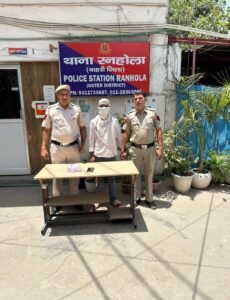
Arms Act enforcement once again proved effective in Outer Delhi after the patrol teams of Delhi Police under Police Station Ranhola arrested two accused persons in separate operations conducted during routine beat patrolling. The swift action by police not only led to the recovery of two illegal button-actuated knives and two stolen mobile phones, but also helped investigators work out two pending theft cases registered in the area.
One accused, Aman @ Pancher, was already wanted in a previous Arms Act case, while the second accused, Raja @ Boka, was identified as a habitual offender with a long criminal history. The successful operations highlighted the alertness, quick response, and strong ground-level policing of Delhi Police, whose continuous patrolling and surveillance efforts are playing a major role in controlling street crime and illegal weapon possession across the capital.
Table of Contents
Table of Contents
Growing Importance of Arms Act Enforcement in Urban Policing
Illegal possession of knives and prohibited weapons continues to remain a major concern for urban law enforcement agencies across India. Police experts say strict enforcement under the Arms Act plays a key role in controlling violent street crime, robbery, snatching, intimidation, and gang-related offences.
In many metropolitan areas, especially densely populated localities, small but dangerous weapons such as button-actuated knives are frequently used in crimes because they are easy to conceal and can be carried discreetly. Criminals often use such weapons to threaten victims during robbery or snatching incidents.
Regular Arms Act enforcement through beat patrolling, surprise checks, and local surveillance is therefore considered an essential preventive policing strategy. Delhi Police has increasingly emphasized aggressive patrolling in sensitive areas to detect suspicious movement and intercept repeat offenders before crimes take place.
The recent operations conducted by PS Ranhola patrol teams are being seen as an example of effective ground-level policing where alert officers identified suspicious behavior and acted immediately.
First Arms Act Operation Near Sunni Markaj Masjid
According to police officials, the first operation took place on May 18, 2026, during routine beat patrolling in the Vikas Nagar area.
A police team comprising HC Amit and Ct. Pardeep Kumar was patrolling near Sunni Markaj Masjid on Nala Road when they noticed one individual behaving suspiciously. The person reportedly tried to flee immediately after spotting the police staff.
Recognizing the suspicious conduct, the patrol team acted swiftly and chased the suspect before successfully apprehending him. The accused was later identified as Aman @ Pancher, a 20-year-old resident of Vikas Nagar, Delhi.
During his personal search, police recovered one button-actuated knife and a mobile phone from his possession. Since possession of such prohibited weapons falls under the Arms Act, police immediately initiated legal action.
A case under FIR No. 331/26 was registered at PS Ranhola under Section 25 of the Arms Act.
Further verification of the recovered mobile phone through its IMEI number revealed that the device was linked to an earlier theft case registered at PS Ranhola. The phone was found connected to e-FIR No. 80015676/26 dated February 20, 2026, under Section 303(2) of the Bharatiya Nyaya Sanhita (BNS).
Police officials stated that during further enquiry, it was discovered that Aman @ Pancher was already wanted in another Arms Act and criminal case registered earlier this year at the same police station.
The accused was allegedly wanted in FIR No. 51/26 dated January 18, 2026, registered under Sections 109(1)/3(5) BNS along with provisions of the Arms Act.
Investigators believe the arrest is significant because it helped police not only recover stolen property but also apprehend a wanted accused involved in previous criminal activities.
Second Arms Act Operation Conducted During Night Patrol
In another successful operation, a separate patrol team of PS Ranhola arrested a second accused during the intervening night of May 18 and 19, 2026.
The police team comprising HC Kulbir and Ct. Kamraj was conducting routine beat patrolling in the Mohan Garden area when they reached near Budh Vatika on Nala Road in Sainik Vihar.
According to officials, the police staff noticed one individual taking a sudden U-turn after sensing police presence. Such evasive behavior immediately raised suspicion among the officers.
The patrol team quickly intercepted and apprehended the suspect, who was identified as Raja @ Boka, a 24-year-old resident of Vikas Nagar.
During his search, police recovered one button-actuated knife and one mobile phone from his possession.
Following the recovery, police registered FIR No. 332/26 under Section 25 of the Arms Act at PS Ranhola.
Technical verification of the mobile phone through its IMEI number revealed that the device was linked to a theft case registered earlier this month. The phone was connected to e-FIR No. 80037766/26 dated May 9, 2026, under Section 305 BNS at PS Ranhola.
Police officials further revealed that Raja @ Boka is a listed Bad Character of PS Ranhola and has previous involvement in around 10 criminal cases.
The arrest of habitual offenders under the Arms Act is considered particularly important because such individuals often continue engaging in repeat offences including theft, robbery, snatching, and illegal weapons possession.
Role of Beat Patrolling in Crime Prevention
The operations conducted by PS Ranhola underline the importance of beat patrolling in urban policing. While large-scale investigations and specialized operations often receive public attention, routine patrol duties performed by local police staff remain one of the strongest tools in preventing crime at the ground level.
Beat officers are usually the first line of defense against street-level criminal activity. Their presence helps deter criminals, maintain public confidence, and ensure rapid response in suspicious situations.
In both Arms Act operations, the accused persons reportedly attempted to flee immediately upon seeing the police. Such behavior itself became a crucial indicator for the alert staff, who reacted without delay.
Police experts say criminals carrying illegal weapons or stolen property often display nervous or evasive behavior during patrol encounters. Experienced beat officers are trained to identify such behavioral patterns and conduct preventive checks.
The success of these operations reflects the vigilance, situational awareness, and field experience of the patrolling teams deployed in the area.
Illegal Knives and Street Crime Connection
Button-actuated knives are commonly associated with street-level criminal activities because of their portability and quick accessibility. Under the Arms Act, possession of prohibited knives without lawful authority is treated seriously due to the potential threat they pose to public safety.
Law enforcement agencies frequently recover such knives during operations related to robbery, snatching, gang rivalry, extortion, and intimidation.
Experts believe strict Arms Act enforcement helps reduce the likelihood of violent escalation during criminal incidents. Even in theft or snatching cases, the presence of weapons significantly increases danger for victims and responding police personnel.
In recent years, Delhi Police has intensified crackdowns against illegal weapons carriers, particularly in areas with repeat street crime complaints. Patrolling teams are regularly instructed to maintain strict vigil in vulnerable zones, especially during evening and night hours.
The latest recoveries by PS Ranhola indicate that proactive police action continues to play a vital role in disrupting criminal movement before larger crimes can occur.
Recovery of Stolen Mobile Phones Helps Solve Theft Cases
Apart from the Arms Act violations, the recovery of two stolen mobile phones also helped police solve two separate theft cases registered at PS Ranhola.
Investigators traced the ownership and case linkage of the devices through IMEI verification, a process widely used by law enforcement agencies to identify stolen electronic devices.
Mobile phone theft remains one of the most commonly reported urban crimes across Indian cities. Due to high resale demand and ease of illegal distribution, stolen phones are often quickly transferred between offenders or sold in grey markets.
The recovery of stolen phones during Arms Act operations demonstrates how preventive policing can simultaneously help solve pending property crime cases.
Police officials stated that both recovered devices were linked to previously registered e-FIRs, allowing investigators to connect the accused with existing offences.
Such recoveries are important because they not only strengthen criminal cases against accused persons but also help victims regain stolen property.
Criminal Backgrounds Raise Serious Concerns
The criminal history of both accused has also raised concern among investigators.
Aman @ Pancher was reportedly wanted in an earlier Arms Act case, while Raja @ Boka has a long criminal record and is officially categorized as a Bad Character at PS Ranhola.
Habitual offenders often become repeat participants in organized or street-level crimes due to established criminal networks and familiarity with illegal activities. Police officials say continuous monitoring of repeat offenders remains necessary to maintain law and order in vulnerable localities.
Crime analysts often emphasize that preventive action under the Arms Act becomes especially important when dealing with repeat offenders who may pose an ongoing threat to public safety.
The timely arrest of both accused therefore represents not only a successful recovery operation but also a preventive step against possible future crimes.
Police Teams Appreciated for Alertness and Swift Action
The successful operations have drawn appreciation for the alertness and professionalism shown by the patrol teams of PS Ranhola.
In many situations, routine patrol duty can appear uneventful, but these cases demonstrate how quick observation and immediate action by local police personnel can lead to major recoveries and arrests.
The teams led by HC Amit, Ct. Pardeep Kumar, HC Kulbir, and Ct. Kamraj displayed effective coordination and vigilance during both Arms Act operations. Their ability to identify suspicious behavior and respond immediately played a direct role in apprehending the accused.
Senior officers of Outer District have also emphasized the importance of continued preventive policing and intensive patrolling to maintain safety in the area.
Further investigation in both Arms Act cases is currently underway to examine possible links of the accused with other criminal incidents and to identify any wider criminal network associated with them.
Sudiksha is a dynamic young journalist associated with Walia News Network (WNN). As a Trainee, she covers Entertainment, Lifestyle, Education, Business, MCD and Product Review. Passionate about fact-based journalism, she is committed to delivering accurate, insightful, and well-researched stories while continuously strengthening her reporting skills and upholding the highest standards of editorial integrity.