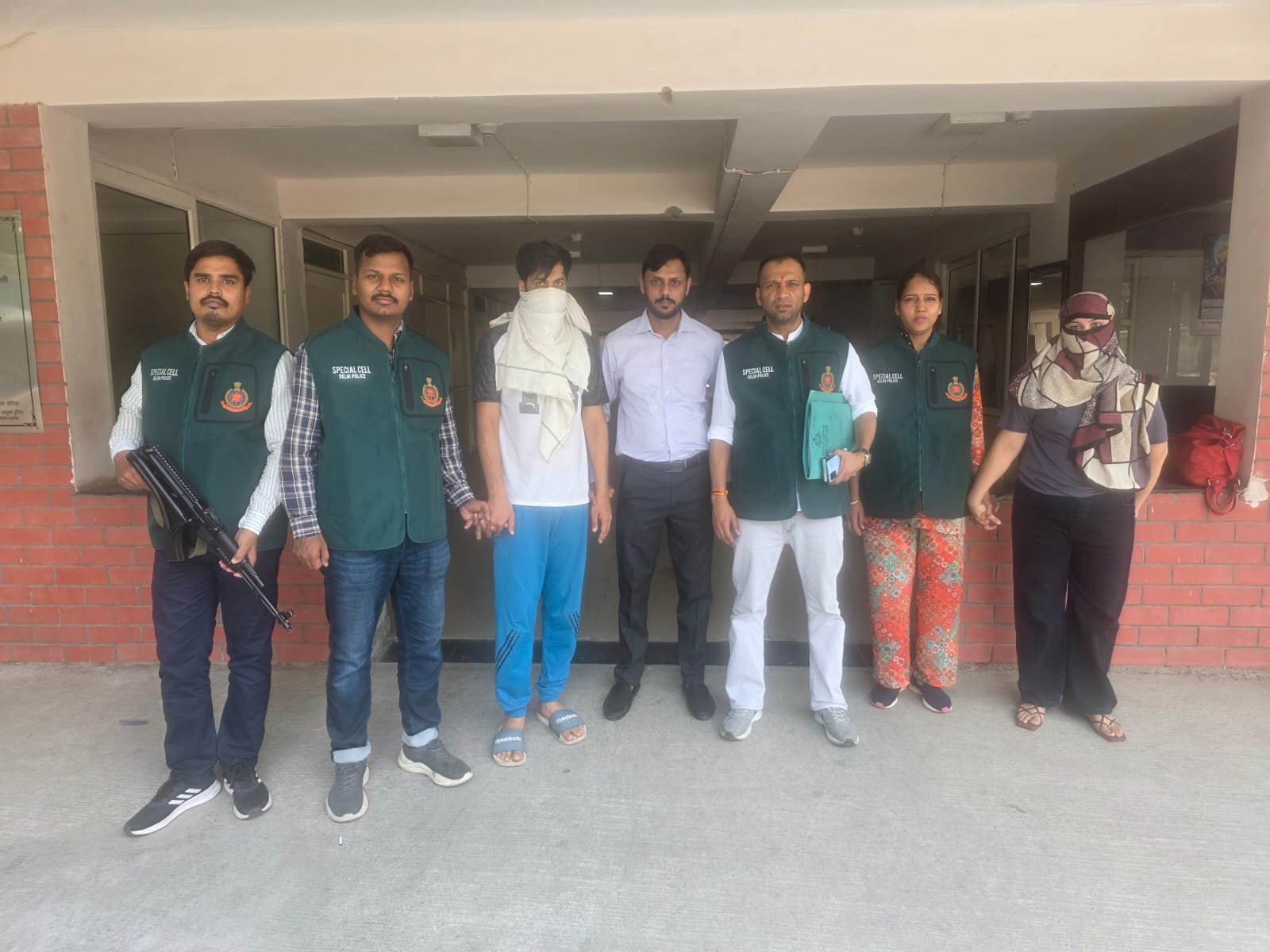
Accused Arrested in a high-profile extortion case after the Delhi Police Special Cell uncovered an alleged criminal conspiracy involving a Delhi businessman’s wife and a suspected associate of the notorious Gogi gang. The investigation, which combined technical surveillance, human intelligence, and digital forensic analysis, not only prevented a planned extortion of ₹50 lakh but also exposed an alleged plot to murder the businessman’s mother and assault him.
The operation is being viewed as a significant success for the Special Cell, highlighting how modern policing and intelligence-driven investigations can dismantle organised criminal conspiracies before they escalate into violent crimes. According to Delhi Police, the investigation led to the arrest of two key accused, the recovery of mobile phones containing incriminating conversations, and the exposure of an alleged cross-border extortion network involving international calls originating from the United States.
Table of Contents
Businessman Received Threatening Calls Demanding ₹50 Lakh
The case began in mid-June 2026 when a wholesale businessman operating in Delhi’s Laxmi Nagar area started receiving threatening phone calls and messages from an international number.
According to Delhi Police, the caller introduced himself as a member of the Gogi gang and demanded an extortion payment of ₹50 lakh. The businessman was allegedly warned that failure to pay the demanded amount would result in the murder of him and his family members.
To make the threats appear genuine, the extortionist allegedly sent photographs of the victim’s residence and business premises along with their locations. Such tactics are frequently used by organised criminal groups to convince victims that they are under constant surveillance.
Taking the threats seriously, the victim approached the police, following which an FIR was registered at Police Station Laxmi Nagar under the relevant provisions of the Bharatiya Nyaya Sanhita.
Considering the organised nature of the offence, the investigation was later transferred to the New Delhi Range of the Special Cell, where a specialised team began working on the case.
The swift transfer of the investigation ensured that experienced officers with expertise in organised crime and gang-related investigations handled the matter from its early stages.
Special Cell Launches Intelligence-Driven Investigation
Immediately after taking over the case, the Special Cell adopted a multi-dimensional investigation strategy.
Rather than relying solely on the victim’s statement, investigators combined technical surveillance, digital analysis, confidential human intelligence, and ground verification to identify those involved.
Investigators carefully examined call records, communication patterns, digital footprints, and other technical evidence while simultaneously activating trusted intelligence sources.
This systematic approach enabled officers to gradually identify individuals suspected of coordinating the extortion conspiracy.
The professionalism displayed during the investigation reflects the increasing role of technology in solving complex organised crime cases across India.
Investigation Leads Police to Suspected Gang Associate
During the course of the investigation, officers identified Rajat, a 29-year-old resident of Sonipat, Haryana, as a prime suspect.
According to Delhi Police, background verification revealed that Rajat was already known to law enforcement and had previous criminal cases registered against him, including offences under the Arms Act and a snatching case.
Ground verification further suggested that Rajat maintained contact with several individuals associated with the Gogi gang, including gangster Rohit Moi, who is currently lodged in jail.
Investigators also gathered information indicating that Rajat had links with another alleged gang associate currently based in the United States.
These findings significantly strengthened the investigation and provided investigators with a clearer picture of the suspected criminal network.
Accused Arrested Following Technical Surveillance
After developing sufficient evidence through surveillance and intelligence gathering, the Special Cell apprehended Rajat from Sonipat on June 25, 2026.
According to investigators, the operation was carefully planned to ensure the suspect could not escape or destroy digital evidence.
Following his apprehension, investigators examined his mobile phone, which allegedly contained crucial electronic evidence connected with the case.
Police stated that digital analysis revealed Rajat had remained in contact with both the alleged USA-based extortionist and members of the victim’s family.
The recovery of digital evidence became one of the most significant developments in the investigation, allowing officers to establish communication links that would otherwise have been difficult to prove.
The successful operation demonstrated how technology-supported investigations can produce strong evidence beyond traditional witness testimony.
Mobile Phones Revealed Alleged Criminal Conspiracy
According to Delhi Police, forensic examination of the seized mobile phone uncovered incriminating chats that significantly altered the direction of the investigation.
Investigators alleged that Rajat had been communicating not only with the international extortionist but also with the victim’s wife, Sapna Jain, and her sister.
Police stated that these conversations suggested the extortion attempt had not been randomly planned by gang members but was allegedly part of a larger conspiracy involving individuals close to the victim.
Digital conversations recovered from mobile devices often become critical evidence because they provide investigators with chronological records of planning, communication, and coordination.
Such electronic evidence has become increasingly important in organised crime investigations where conspirators frequently rely on digital messaging platforms.
Wife of Victim Also Accused Arrested
As the investigation progressed, police questioned Sapna Jain, the wife of the businessman.
According to Delhi Police, evidence gathered during the investigation and the interrogation of Rajat led investigators to believe that Sapna Jain had allegedly played an active role in planning the extortion.
Police subsequently arrested Sapna Jain in connection with the case.
The Accused Arrested operation marked a significant turning point in the investigation because it suggested that the alleged conspiracy involved both organised criminal elements and individuals known personally to the victim.
The arrests also highlighted the importance of evidence-based investigations, where conclusions are reached through corroborated facts rather than assumptions.
Domestic Dispute Allegedly Triggered the Conspiracy
According to investigators, the accused disclosed important details during interrogation regarding the alleged motive behind the conspiracy.
Police stated that the victim and Sapna Jain had been married since 2007 and have two teenage children.
Investigators alleged that domestic disputes had been continuing between the couple for some time.
According to police, the victim’s mother allegedly supported her son during these disagreements, resulting in strained family relations.
Investigators claim Sapna Jain allegedly approached Rajat through her sister and conspired to first extort money from her husband before allegedly planning the murder of her mother-in-law and an assault on her husband.
Police further alleged that she shared details regarding her husband’s movements to facilitate the planned offences.
These allegations form an important part of the ongoing investigation and will be examined further during legal proceedings.
International Calls Added Complexity to the Investigation
One of the most notable aspects of this investigation was the alleged use of international phone numbers to issue extortion threats.
According to Delhi Police, the threatening calls originated from a person believed to be operating from the United States.
Cross-border communication presents additional challenges for investigators because it often requires coordination with telecommunications providers, digital forensic experts, and other investigative agencies.
Despite these complexities, the Special Cell successfully traced communication patterns through technical analysis and connected them with local suspects.
The investigation demonstrates the growing capability of specialised police units to handle technologically sophisticated criminal operations involving international communication.
Digital Evidence Strengthened the Investigation
Modern organised crime investigations increasingly depend on digital forensic analysis.
Unlike conventional evidence, electronic communications often preserve detailed records of conversations, planning, timing, and coordination between suspects.
In this investigation, mobile phones allegedly containing incriminating chats became central to establishing communication links among the accused.
Digital evidence also enables investigators to verify statements made during interrogation against independently recoverable information.
Such technological capabilities have transformed criminal investigations by providing objective evidence that can later be examined during judicial proceedings.
Profile of Rajat
According to Delhi Police, Rajat is a resident of Sonipat, Haryana.
Investigators stated that he maintained contact with several alleged members of the Gogi gang, including gangster Rohit Moi, who is presently lodged in jail.
Police also alleged that approximately three years ago, Rajat came into contact with Karmveer Pehalwan, also known as Meeta, who is currently based in the United States.
Investigators are examining the extent of these associations as part of the ongoing investigation.
Delhi Police further stated that Rajat has previously been involved in multiple criminal cases, including theft and Arms Act offences registered in Sonipat.
These earlier cases are being reviewed alongside the current investigation to better understand his alleged criminal background.
Coordinated Police Effort Deserves Appreciation
The successful Accused Arrested operation reflects the professionalism and efficiency of the Delhi Police Special Cell.
The investigation required careful coordination between intelligence officers, technical surveillance teams, digital forensic experts, and field investigators.
Instead of making immediate assumptions, investigators patiently developed evidence through human intelligence, technical analysis, mobile phone examination, ground verification, and sustained interrogation.
The operation successfully prevented an alleged extortion of ₹50 lakh, uncovered a wider criminal conspiracy, recovered crucial electronic evidence, and neutralised a suspected plan that police allege included violent offences against the victim and his family.
The dedicated efforts of the Special Cell officers deserve appreciation for their meticulous investigation and prompt action. Their evidence-driven approach ensured that the accused were identified through verifiable facts rather than speculation, reflecting the high standards expected from specialised investigative units.
According to Delhi Police, further investigation is continuing to identify any additional individuals involved in the conspiracy, verify the international communication network, examine digital evidence in greater detail, and establish the complete extent of the alleged criminal plan before the matter proceeds through the legal process.