
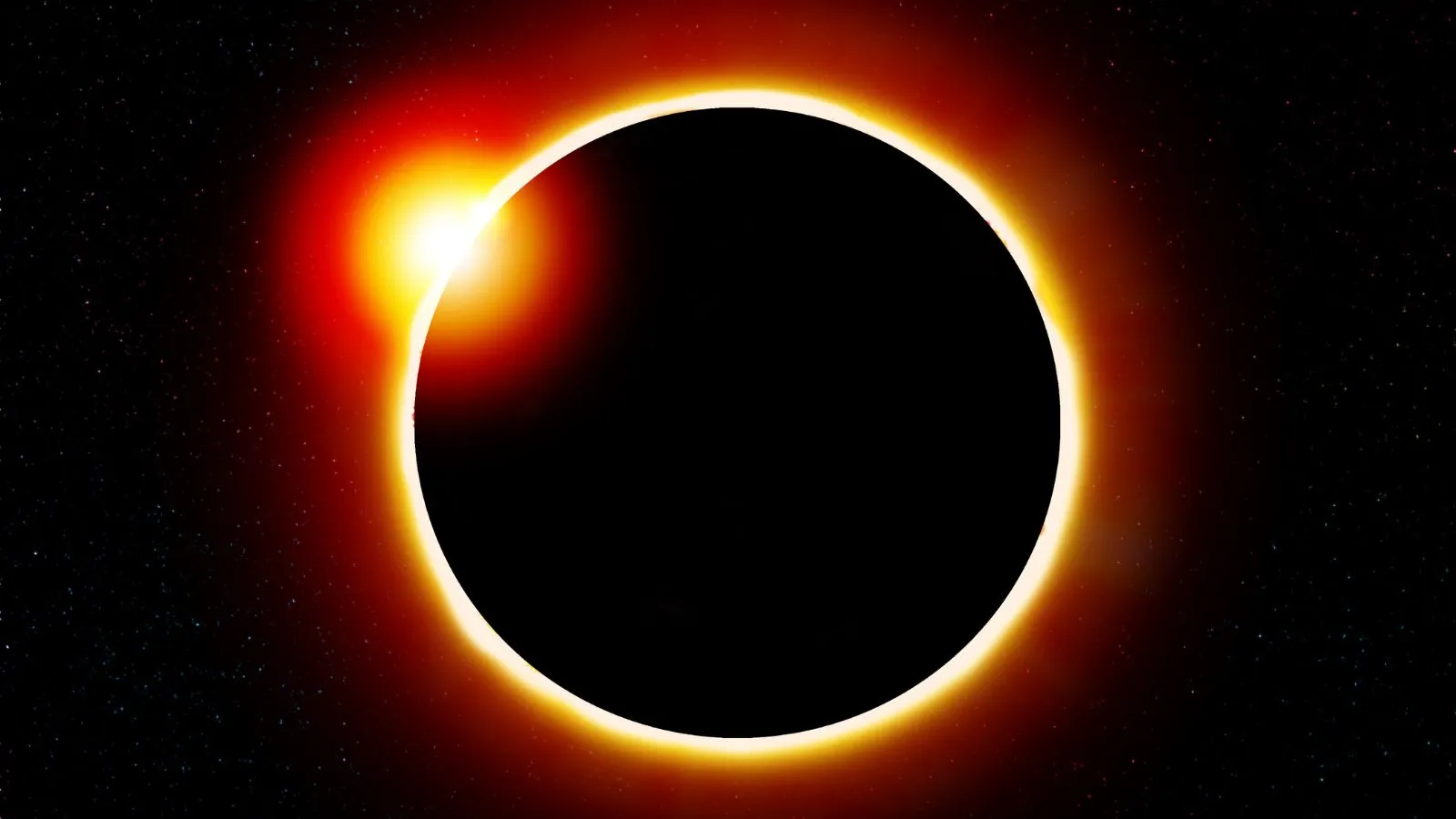
Skywatchers around the world are preparing for Solar Eclipse 2026, a major astronomical event on August 12, 2026, when a total solar eclipse will cross parts of the Northern Hemisphere. The eclipse is expected to produce a dramatic period of daytime darkness along its narrow path of totality, while much wider regions will experience a partial solar eclipse.
However, there is an important point for Indian viewers: the August 12, 2026 total solar eclipse will not be visible from India. NASA’s eclipse path shows totality passing across Greenland, Iceland, northern Russia, the Atlantic Ocean, Spain and a small part of Portugal, with partial phases visible across much of Europe, parts of North America and northwestern Africa. India lies outside the visibility zone.
Table of Contents
What Is a Total Solar Eclipse?
A solar eclipse occurs when the Moon passes between the Sun and Earth and blocks some or all of the Sun’s light from reaching a particular area on Earth.
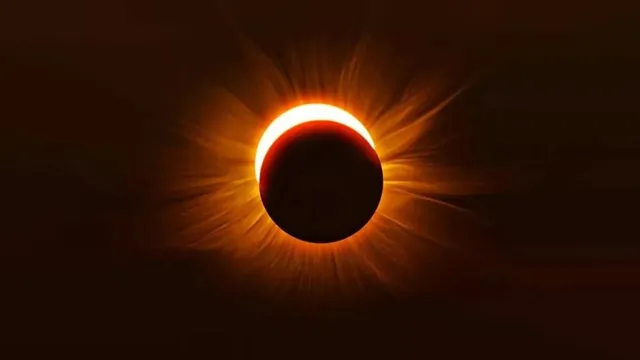
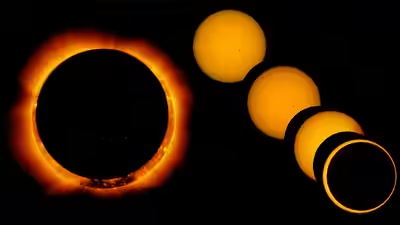
A total solar eclipse occurs when the Moon completely covers the bright face of the Sun for observers located within the Moon’s narrow central shadow, known as the path of totality.
During totality, daylight can become dramatically darker and the Sun’s bright surface is temporarily hidden. The surrounding sky can take on a twilight-like appearance, making the event one of the most striking phenomena in observational astronomy.
The August 12 eclipse will therefore be particularly significant for observers who are positioned directly along its path.
When Will the August 12, 2026 Eclipse Occur?
The date of Solar Eclipse 2026 is Wednesday, August 12, 2026.
The exact local timing will vary considerably depending on the observer’s location because the Moon’s shadow will travel across different parts of Earth.
NASA’s published eclipse information gives local timings for selected locations. For example, in Reykjavík, Iceland, the partial phase begins at 4:47 p.m. local time, totality begins at 5:48 p.m. and ends at 5:49 p.m. In León, Spain, totality begins at 8:28 p.m. local time and ends at 8:30 p.m.
These timings demonstrate how quickly the total phase passes. For most locations along the path, totality lasts less than two minutes, although it can last a little longer near the central portion of the eclipse path.
These timings will vary depending on the observer’s location during Solar Eclipse 2026.
Where Will the Total Solar Eclipse Be Visible?
The visibility map of Solar Eclipse 2026 shows a relatively narrow path of totality.
The path of totality for the August 12 eclipse is relatively narrow compared with the much larger area where a partial eclipse can be observed.
According to NASA, totality will sweep across:
- Greenland
- Iceland
- Northern Russia
- The North Atlantic
- Spain
- A small part of Portugal
These locations will experience the most dramatic phase of Solar Eclipse 2026.
The partial eclipse will be visible across a much broader area, including parts of northern and eastern North America, most of Canada, large areas of Europe and northwestern Africa.
This difference between total and partial visibility is important. Being relatively close to the eclipse path does not necessarily mean an observer will experience complete daytime darkness. Only those within the Moon’s umbral shadow will experience totality.
Will the Solar Eclipse Be Visible in India?
One of the most important questions about Solar Eclipse 2026 is whether Indian viewers will be able to see it. No. The August 12, 2026 total solar eclipse will not be visible from India.
This is one of the biggest questions surrounding the event for Indian skywatchers. India’s geographical position places it outside the regions from which either the total or partial phases of this particular eclipse can be observed.
Therefore, people in Indian cities will not see the Moon passing across the Sun during this event, and there will not be an eclipse-related period of daytime darkness in India.
Reports discussing the event in India have also confirmed that the eclipse will not be visible from the country.Unfortunately, Solar Eclipse 2026 will remain below the visibility horizon for observers in India.
Why Does Daytime Darkness Happen During a Total Eclipse?
The daytime darkness associated with Solar Eclipse 2026 will occur because the Moon temporarily blocks direct sunlight.
The Moon is much smaller than the Sun, but its apparent size in Earth’s sky can be large enough to cover the Sun completely during a total eclipse. When this alignment occurs, observers inside the path of totality can see the Sun’s bright disk disappear temporarily.
The surrounding landscape can become noticeably darker, while the sky around the eclipsed Sun takes on a very different appearance.
The effect is temporary because the Moon’s shadow is continuously moving across Earth’s surface.
How Long Will Totality Last?
One of the most exciting aspects of Solar Eclipse 2026 will be the short period of totality.
Although a total solar eclipse can be a major astronomical event, the period of complete coverage is relatively brief.
NASA states that for most people located within the path of totality on August 12, totality will last less than two minutes. Near the centre of the eclipse path in Greenland, Russia or the North Atlantic, it will last somewhat longer but still less than two and a half minutes.
Observers planning to watch Solar Eclipse 2026 should therefore pay close attention to local timings.
The entire eclipse, including the partial phases before and after totality, lasts much longer.
This is why eclipse observers often pay close attention to the exact timing for their location.
Spain and Iceland Prepare for a Dramatic Sky Show
Spain and Iceland are among the locations expected to attract attention during Solar Eclipse 2026.
In Iceland, the eclipse will occur during the late afternoon. NASA lists Reykjavík’s totality at approximately 5:48 p.m. local time.
Spain will experience totality later in the day, with locations including León, Valencia and Zaragoza falling within the total-eclipse path. In parts of Spain, the eclipse will occur relatively close to sunset, producing the possibility of a particularly dramatic visual scene.
NASA notes that in parts of western Europe and Africa where the Sun sets while still partially eclipsed, observers can experience what is sometimes called a sunset eclipse.
This could make parts of Spain especially interesting for people following Solar Eclipse 2026.
Northern Russia Also Falls on the Path
Northern Russia will also be an important location for observers of Solar Eclipse 2026.
A small and relatively remote part of northern Russia will also experience totality.
NASA notes that in this region, the total eclipse will occur around the middle of the day. The exact experience will depend on the observer’s location and local conditions.
The wide geographical spread of the totality path—from northern Russia through the Arctic region and across the North Atlantic toward Europe—illustrates how the Moon’s shadow can travel across thousands of kilometres during an eclipse.
What Makes the 2026 Eclipse Significant?
The significance of Solar Eclipse 2026 comes from the limited geographical area where totality can be experienced.
The August 12 event is significant because total solar eclipses are relatively uncommon at any particular location.
The path of totality is narrow, meaning that only a limited portion of Earth’s surface experiences the complete eclipse. Even though solar eclipses happen periodically, a particular city or region may wait many years before another total eclipse becomes visible there.
For astronomy enthusiasts, Solar Eclipse 2026 will provide a rare opportunity to observe totality from selected regions.
The Solar Eclipse 2026 will therefore attract astronomers, researchers, photographers and amateur skywatchers to locations along its path.
For scientific observers, eclipses can also provide opportunities to study the Sun’s outer atmosphere and observe changes in the environment associated with the temporary reduction in sunlight.
What Happens to the Sky During Totality?
During Solar Eclipse 2026, observers inside the path of totality will see the Sun’s bright disk temporarily disappear.
The surrounding sky becomes darker, and observers can experience a sudden transition from ordinary daylight conditions to a much darker environment.
The visual effect depends on several factors, including the observer’s exact position within the path, local weather, atmospheric conditions and the Sun’s altitude.
This is one reason why eclipse observers often choose locations carefully when planning to witness totality.
Is It Safe to Watch a Solar Eclipse?
Eye safety will remain essential for anyone planning to observe Solar Eclipse 2026.
NASA states that during the partial phases of an eclipse, observers must not look directly at the Sun without appropriate solar eye protection. Certified solar-viewing glasses or appropriate solar filters are used to reduce the Sun’s intense light to a safe level.
The rules are different only during the brief period of totality for observers who are actually within the path of totality, when the Sun is completely covered. NASA explains that direct viewing is safe only during those brief moments of complete totality; before and after totality, proper eye protection is required.
For anyone outside the totality path, including viewers in India who will not see this eclipse, there is no direct eclipse to observe.
India Will Miss This Eclipse
For Indian skywatchers, the biggest takeaway from Solar Eclipse 2026 is that the event will not be visible from the country.
The event may generate significant interest online because of dramatic images and live coverage from locations within the path of totality, but those watching from India will not experience the eclipse directly.
The official visibility map for Solar Eclipse 2026 confirms that India lies outside the eclipse’s visibility zone.
Eclipse and Perseid Meteor Shower Coincide
August 12 will be interesting for skywatchers for another reason.
The annual Perseid meteor shower reaches its peak around August 12–13. The timing coincides with the solar eclipse, creating an unusually interesting period for astronomy enthusiasts.
The Perseids are caused by Earth passing through debris associated with Comet Swift-Tuttle. The meteors appear as fast-moving streaks of light when tiny particles enter Earth’s atmosphere.
Because the August 12 eclipse occurs during a New Moon, the night sky can also be relatively favourable for observing meteors because there is little moonlight competing with the faint streaks.
The solar eclipse and meteor shower are separate astronomical phenomena, but their coincidence makes August 12–13 an especially interesting period for skywatchers.
The ‘Gravity Blackout’ Rumour Is False
Alongside genuine information about the August 12 celestial events, an unfounded claim has also circulated online suggesting that the eclipse could cause a temporary “gravity blackout.”
There is no scientific basis for such a claim.
An eclipse does not cause Earth to lose gravity. The Moon’s passage in front of the Sun changes how sunlight reaches Earth in the eclipse region, but it does not switch off Earth’s gravitational field.
People should therefore rely on established astronomical organisations and scientific sources rather than viral claims when learning about the eclipse.
What Indian Viewers Can Expect on August 12
Since Solar Eclipse 2026 will not be visible from India, viewers in the country will not experience the eclipse directly.
However, astronomy enthusiasts can follow the event through reputable scientific coverage and official information released by observatories and space agencies.
The event also provides an opportunity to learn more about how the Sun, Moon and Earth interact and why solar eclipses occur only under particular orbital conditions.
Final Takeaway
The Solar Eclipse 2026, taking place on August 12, will be one of the year’s most significant astronomical events, with the Moon’s shadow crossing Greenland, Iceland, northern Russia, the North Atlantic, Spain and a small part of Portugal. Other parts of Europe, North America and northwestern Africa will experience a partial eclipse.
For those directly inside the path of totality, the event will briefly transform daytime conditions as the Moon completely covers the Sun. However, the period of complete darkness will be short, generally lasting less than two minutes for most observers.
For India, there is no direct visibility of this particular eclipse. Indian skywatchers will therefore have to follow the event through scientific coverage rather than viewing it from their location.
With a total solar eclipse and the Perseid meteor shower occurring around the same date, August 12–13 promises to be an especially interesting period for astronomy enthusiasts worldwide.
For astronomy enthusiasts worldwide, Solar Eclipse 2026 will remain a major event to watch, particularly because of its timing alongside the Perseid meteor shower.