

Mohammad Abbas will be one of Pakistan’s most important weapons as they prepare for their upcoming three-Test series in England, with his accuracy, seam movement and ability to exploit helpful conditions likely to play a crucial role. At a time when Pakistan’s attack has increasingly relied on spin at home, the experienced seamer offers a different dimension that could prove valuable in English conditions.
At the centre of Pakistan’s bowling plans could be veteran seamer Mohammad Abbas, whose ability to extract movement from the pitch without relying on express pace makes him a particularly valuable option for the tour.
At 36, Mohammad Abbas is the only member of Pakistan’s celebrated 2020 seam-bowling trio of Abbas, Shaheen Shah Afridi and Naseem Shah to be included in the current squad. The contrast is striking. Shaheen and Naseem were viewed as the future of Pakistan’s fast-bowling attack when they toured England six years ago, but injuries, workload and selection issues have changed the landscape considerably.
Mohammad Abbas, meanwhile, has continued to build a reputation around one simple formula: precision before pace.
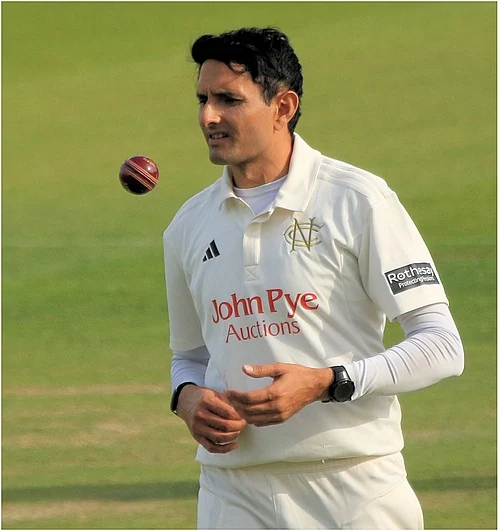
Table of Contents
Mohammad Abbas’ Control Could Be Crucial in England
Mohammad Abbas does not generate the kind of speed traditionally associated with Pakistan’s most famous fast bowlers. Operating around the mid-70mph range, he can appear relatively modest compared with modern international quicks.
Yet his record demonstrates why speed alone does not define an effective Test bowler.
Mohammad Abbas has taken 118 wickets in 30 Tests for Pakistan at an outstanding average of 22.38. His ability to repeatedly land the ball in difficult areas and make it move late has made him particularly effective against batsmen who are forced to play.
His method is based on seam presentation, wrist control and subtle variations rather than raw pace. That makes his bowling especially interesting for an England series, where movement through the air and off the surface can reward accuracy.
Former Nottinghamshire coach Peter Moores has highlighted Mohammad Abbas’ unusually long fingers and his ability to control the seam through his wrist and hand. Former Derbyshire coach Mickey Arthur has similarly described the bowler as highly precise, capable of making the ball move both ways while also using the wobble-seam delivery.
That combination gives Mohammad Abbas several ways of troubling batsmen without needing to consistently operate at high speed.
An Exceptional County Championship Record
Abbas’ familiarity with English conditions is another major advantage for Pakistan.
The veteran seamer has spent considerable time playing county cricket and has represented Leicestershire, Hampshire, Nottinghamshire and Derbyshire. Across his County Championship career, he has taken 302 wickets at an average of 20.64.
That record gives him a particularly strong connection with English cricket.
Rather than arriving in England as a bowler who needs to learn how local pitches behave, Mohammad Abbas has already experienced the demands of county cricket across different grounds and conditions.
His understanding of English surfaces could prove valuable during a three-Test series, particularly if the pitches offer movement early in matches or become more difficult for batsmen as the ball gets older.
His previous experience also means he understands the value of maintaining pressure over long spells. In Test cricket, that ability can be just as important as producing occasional bursts of extreme pace.
Pakistan’s Fast-Bowling Landscape Has Changed
When Pakistan toured England in 2020, the bowling attack represented a different generation.
Shaheen Shah Afridi was only 20 and was already being viewed as a potential world-class left-arm fast bowler. Naseem Shah, just 17, had also emerged as an exciting young prospect with genuine pace and a smooth action.
Mohammad Abbas was the experienced presence in that group.
Six years later, the balance has changed significantly. Shaheen has struggled to rediscover his previous red-ball impact following a knee injury in 2022, while Naseem has also faced setbacks during his development.
Neither is part of the current squad for the England Test series, leaving Mohammad Abbas as the surviving member of that earlier trio.
The situation underlines how quickly the demands of international cricket can reshape a bowling attack. Players once expected to dominate for years can be replaced by veterans who continue to succeed through experience and control.
Abbas’ Selection Has Not Always Been Straightforward
Despite his excellent record, Mohammad Abbas has not consistently been a first-choice selection for Pakistan.
He has earned only 30 Test caps across a nine-year international career, a relatively modest number considering his impressive statistics.
His omission has sometimes been linked to Pakistan’s preference for pace at certain stages of their Test development and, more recently, their increased reliance on spin.
The decision-making around Mohammad Abbas became particularly notable during Pakistan’s recent series against the West Indies.
After taking eight wickets in Pakistan’s defeat in the first Test in July, Mohammad Abbas was left out for the second Test. Pakistan instead leaned heavily on spin, with Sajid Khan taking eight wickets as the teams drew level in the series.
The episode highlighted the contrasting philosophies Pakistan have adopted depending on conditions.
Pakistan’s Spin Strategy Has Changed Their Test Approach
Pakistan’s recent home success has been closely connected to spin-friendly pitches.
Their last Test series victory before the England assignment came against England in October 2024. After losing the opening match, Pakistan responded by preparing surfaces in Multan and Rawalpindi that offered substantial assistance to spin.
Sajid Khan and Noman Ali exploited those conditions brilliantly, combining for 39 wickets across the final two Tests.
Shaheen and Naseem were dropped from the XI, while the spin duo became central to Pakistan’s strategy.
That series effectively demonstrated how Pakistan could win Tests by creating conditions that suited their strongest bowling resources. However, such an approach is difficult to replicate in England.
English conditions traditionally demand a different skill set, particularly from seamers who can maintain a consistent line while exploiting movement.

Jason Gillespie Had Warned About the Long-Term Cost
Former Pakistan head coach Jason Gillespie had previously expressed concerns about the team’s shift towards heavily turning home pitches.
Gillespie had initially arrived with an ambition to develop Pakistan’s fast bowlers and create surfaces where seamers could thrive. However, after early defeats, the strategy changed.
Used pitches and spin-friendly surfaces became increasingly prominent.
Gillespie regarded the change as short-sighted because it moved Pakistan away from the longer-term development of their fast-bowling resources. His influence over selection was subsequently reduced, and he resigned after his relationship with the Pakistan Cricket Board deteriorated.
The consequences of that strategy are particularly relevant now.
Pakistan have arrived in England with an attack that has had limited opportunity to develop its effectiveness on seam-friendly surfaces at home.
England Conditions Could Bring Abbas Back Into Focus
The England tour could therefore provide Mohammad Abbas with an ideal opportunity to demonstrate why his skill set remains valuable.
The veteran does not need a pitch to produce extreme bounce or turn. His greatest weapon is the ability to repeatedly place the ball in an area where batsmen are uncertain whether they should play or leave.
In England, where the Dukes ball can move through the air and off the seam, such precision can become especially dangerous.
The challenge for Pakistan will be ensuring Mohammad Abbas is used effectively rather than expecting him to carry the entire attack.
A disciplined supporting cast could allow him to operate in longer spells, building pressure while other bowlers attack from the opposite end.
Young Pace Options Will Also Be Tested
Pakistan have included younger pace options, including Ubaid Shah, the 20-year-old brother of Naseem Shah.
His inclusion provides Pakistan with an opportunity to add greater pace to the attack.
However, England’s bowling unit is likely to possess an advantage when it comes to raw speed and depth. Pakistan may therefore need to rely more heavily on accuracy, movement and tactical discipline.
Mohammad Ali, who has also played county cricket, provides another option with experience of English conditions.
That familiarity could be particularly useful as Pakistan attempt to construct a balanced attack capable of exploiting both the new ball and older-ball conditions.
Babar Azam and Rizwan Could Play Supporting Roles
The bowling strategy will also depend on Pakistan’s ability to maintain pressure through the field.
Former Pakistan captain Babar Azam remains an important part of the team’s batting structure, while wicketkeeper Mohammad Rizwan could have a tactical role behind the stumps.
With a bowler such as Abbas, wicketkeeper positioning can be particularly important. Keeping close to the stumps can create additional pressure on batsmen and reduce opportunities to leave deliveries comfortably.
If Abbas is able to consistently make the ball move late, Rizwan’s positioning could help convert edges and half-chances into wickets.
Discipline Could Define Pakistan’s England Campaign
Pakistan are unlikely to dominate England through sheer pace. Instead, their success could depend on how effectively they embrace the fundamentals of Test bowling.
Line and length, patience and disciplined field settings will be crucial.
Mohammad Abbas embodies that philosophy more than almost any other bowler in the squad.
His career is a reminder that effectiveness does not necessarily come from speed. His 118 Test wickets at 22.38 and 302 County Championship wickets at 20.64 provide statistical evidence of a method that has consistently worked.
For Pakistan, the challenge is to recognise exactly what Abbas offers and build the attack around complementary skills.

Abbas Could Be Pakistan’s Difference-Maker
The upcoming England series represents more than another assignment for a veteran bowler. It could be an opportunity for Abbas to once again establish his importance to Pakistan’s Test plans.
The contrast between his current role and the expectations surrounding him in 2020 is remarkable. Shaheen and Naseem were once regarded as the stars of Pakistan’s next generation, while Abbas was the experienced supporting act.
Today, he is the only one of those three still standing in the squad.
His pace may not dominate the speed gun, but his ability to control the seam, maintain pressure and exploit small technical weaknesses could make him one of Pakistan’s most important weapons in English conditions.
If Pakistan give him the opportunity to operate consistently, Abbas’ precision could prove more valuable than raw pace.
For a team searching for a successful formula away from the spin-friendly pitches of home, the answer may lie in returning to a simple principle: in Test cricket, precision can come before pace.