Regional Language is set to play a much bigger role in India’s legal education system as the Centre and the Bar Council of India (BCI) have begun work on a comprehensive 10-year roadmap to make law studies more inclusive and accessible. The proposed reforms aim to gradually integrate Indian languages into legal education while retaining English as an important language for legal practice and higher studies. The initiative seeks to help students from diverse linguistic backgrounds understand legal concepts more effectively, strengthen access to justice, and build a bilingual legal education system that meets the needs of both local courts and the wider legal profession.
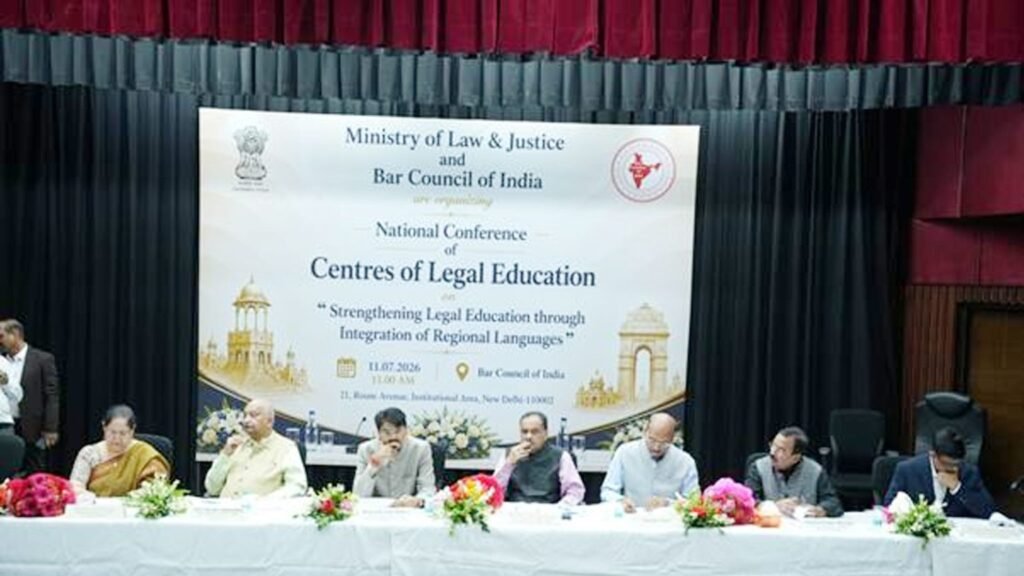
To take this vision forward, the Department of Legal Affairs under the Ministry of Law and Justice, in partnership with the Bar Council of India, organized a national conference titled “Strengthening Legal Education through Integration of Regional Languages.” The event brought together senior judges, policymakers, legal experts, academicians, vice-chancellors of law universities, and members of the legal fraternity to prepare a Ten-Year Perspective Action Plan that aims to transform legal education across the country.
The discussions focused on creating a balanced and practical roadmap that encourages the use of regional language in legal studies without reducing academic standards or limiting opportunities for students in higher courts and international legal practice.
Table of Contents
A Major Shift Towards Inclusive Legal Education
For decades, English has been the dominant language of legal education in India. Most law colleges teach in English, legal textbooks are primarily available in English, and higher courts largely function in the same language. While this system has produced generations of capable lawyers and judges, it has also created challenges for students from rural and regional backgrounds.
Every year, thousands of talented students from Hindi-medium and other regional language schools enter law colleges where they suddenly have to study complex legal concepts in English. This language gap often affects their confidence, classroom participation, and academic performance despite their intellectual ability.
The new proposal aims to bridge this gap by allowing students to understand legal principles through regional language while ensuring they also develop the English skills necessary for broader legal practice.
Officials participating in the conference stressed that the objective is not to replace English but to create a bilingual and gradually multilingual legal education system that offers equal opportunities to students from different educational backgrounds.
Why Regional Language Matters in Legal Education
India is one of the world’s most linguistically diverse countries. According to the Census of India, hundreds of languages and dialects are spoken across different states, while the Constitution recognises 22 Scheduled Languages.
Despite this diversity, legal education has remained heavily dependent on English. As a result, many aspiring lawyers who are otherwise academically strong often struggle to understand legal terminology during their initial years of study.
Expanding legal education in regional language can improve learning outcomes by allowing students to grasp legal theories, constitutional principles, criminal law, civil law, and procedural rules in a language they understand naturally.
Experts believe this approach can strengthen conceptual understanding rather than encouraging rote learning. Students who fully understand legal principles in their own language are likely to become more confident advocates, particularly when they eventually represent clients before district and subordinate courts where local languages dominate day-to-day proceedings.
Better Access to Justice Through Regional Language
One of the strongest arguments supporting regional language in legal education is its potential to improve access to justice.
India’s district courts handle millions of cases every year, and a large majority of litigants communicate in local languages rather than English. Lawyers practising in these courts often explain legal procedures, court orders, and legal rights to clients in their native language.
If future lawyers receive quality legal education in regional language alongside English, they may be better equipped to communicate with ordinary citizens, particularly those living in rural and semi-urban areas.
Legal aid programmes could also become more effective. Government-sponsored legal awareness campaigns, legal clinics in universities, and free legal assistance initiatives would become easier to conduct if legal professionals possess stronger command over legal terminology in Indian languages.
The conference highlighted that making legal knowledge easier to understand can ultimately strengthen public trust in the justice delivery system.
English Will Continue to Play an Important Role
While promoting regional language, policymakers made it clear that English will continue to remain an important part of India’s legal education framework.
The Supreme Court, several High Courts, international arbitration proceedings, corporate law firms, cross-border legal transactions, and legal research continue to rely heavily on English. Therefore, the proposed reforms seek to develop bilingual professionals rather than replacing one language with another.
Students would continue learning English legal terminology while also studying important concepts through Indian languages. This balanced approach aims to prepare graduates for both local practice and national or international opportunities.
Many experts believe bilingual legal education could become an advantage rather than a limitation by allowing lawyers to communicate effectively across different legal environments.
Technology to Play a Key Role
Technology emerged as one of the most important themes during the conference.
Participants discussed the growing role of Artificial Intelligence in translating legal documents, preparing multilingual legal databases, developing standard legal glossaries, and improving digital legal education resources.
AI-powered translation systems have become increasingly capable of converting complex legal content into multiple Indian languages. However, experts also cautioned that legal translation requires exceptional accuracy because even a minor change in wording can alter the meaning of a law or judicial decision.
For this reason, AI-generated translations will require continuous review by legal scholars, judges, language experts, and academic institutions before being used in classrooms.
The proposed roadmap also includes creating standardised legal terminology databases so that the same legal concept carries a consistent meaning across different regional language textbooks and educational materials.
Such standardisation would reduce confusion among students while maintaining academic quality nationwide.
A Structured 10-Year Implementation Plan
Rather than introducing immediate nationwide changes, the Centre and the Bar Council of India are preparing a phased implementation strategy spread over the next decade.
The proposed Ten-Year Perspective Action Plan is expected to focus on curriculum development, textbook preparation, faculty training, technological support, translation standards, digital learning resources, and regular academic evaluation.
A gradual rollout will allow universities to identify practical challenges before expanding the model across the country.
Participants also agreed to work towards a National Declaration on Indian Languages in Legal Education, which will provide guiding principles for future reforms.
In addition, a National Steering Committee will be established jointly by the Department of Legal Affairs and the Bar Council of India. This committee will supervise implementation, monitor progress, recommend policy improvements, and ensure that educational quality remains consistent throughout the transition.

Benefits for Law Students Across India
The proposed expansion of regional language in legal education could particularly benefit first-generation learners, students from government schools, and candidates belonging to rural communities.
Many talented students currently hesitate to pursue law because they fear the dominance of English in legal education. Greater availability of regional language teaching could encourage wider participation and improve diversity within the legal profession.
Universities may also witness better classroom engagement as students become more comfortable discussing legal principles in languages they have spoken throughout their lives.
Faculty members could adopt a mixed-language teaching approach where complex constitutional doctrines, criminal law provisions, contract law principles, and procedural rules are explained using both English and regional language. Such methods are already being used successfully in several professional education programmes across India.
The initiative may also strengthen judicial services preparation, particularly for candidates appearing for state judicial examinations where local language proficiency often carries significant importance.
Aligning Legal Education with India’s Long-Term Vision
The move forms part of the government’s broader objective of making education more inclusive while supporting the vision of Viksit Bharat by 2047.
Over the past few years, multiple policy initiatives have encouraged the use of Indian languages in technical education, engineering, medicine, and professional courses. Legal education is now emerging as another important sector where language accessibility is receiving greater attention.
By combining regional language instruction with modern technology, bilingual teaching methods, expert oversight, and carefully planned implementation, policymakers aim to create a legal education system that serves students from every part of the country while maintaining the highest academic standards. The proposed reforms seek to ensure that future lawyers can understand the law deeply, communicate effectively with citizens, and contribute more meaningfully to India’s justice system regardless of the language in which they began their educational journey.