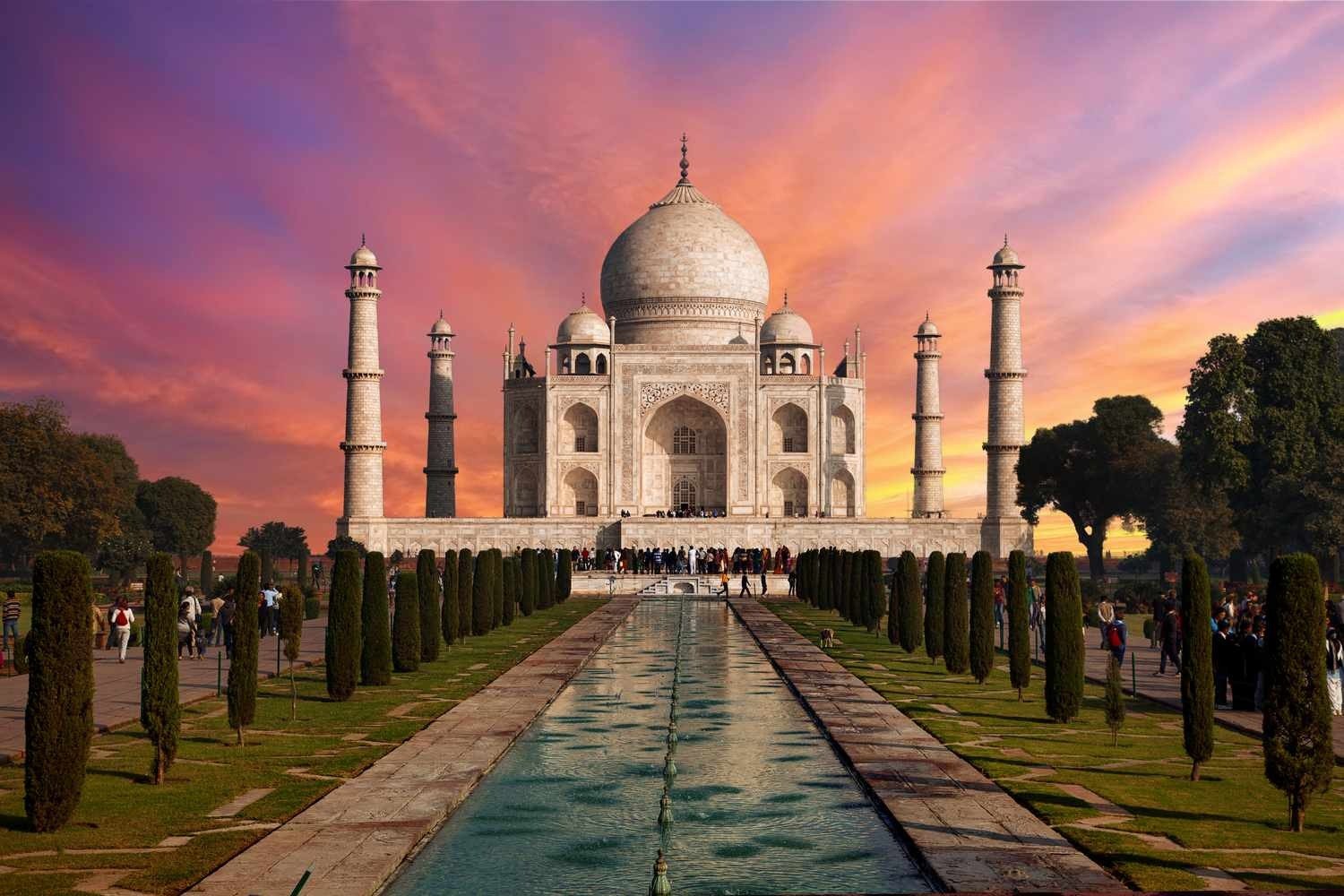
Taj Mahal continues to stand as one of the world’s most admired architectural masterpieces, attracting millions of visitors every year from across the globe. Located on the banks of the Yamuna River in Agra, Uttar Pradesh, the Taj Mahal is much more than a beautiful monument. It is a remarkable blend of history, art, engineering, culture, and craftsmanship that has represented India’s heritage for nearly four centuries. Recognised as a UNESCO World Heritage Site and one of the New Seven Wonders of the World, the Taj Mahal remains one of the country’s biggest cultural and tourism assets.
Built by the Mughal emperor Shah Jahan in memory of his beloved wife Mumtaz Mahal, the monument has become an international symbol of eternal love. However, beyond its romantic story, the Taj Mahal is also an extraordinary example of advanced engineering, artistic excellence, and architectural innovation that continues to inspire architects, historians, conservationists, and travellers worldwide.
Table of Contents
The story behind the Taj Mahal
The history of the Taj Mahal begins in 1631 when Mumtaz Mahal, the favourite wife of Mughal Emperor Shah Jahan, died while giving birth to their fourteenth child. Deeply affected by her death, Shah Jahan decided to build a grand mausoleum that would preserve her memory forever.
Construction of the Taj Mahal started in 1632 and continued for nearly 22 years before its completion in 1653. Historical records suggest that around 20,000 skilled artisans, labourers, craftsmen, stone cutters, calligraphers, sculptors, and engineers worked together to complete this extraordinary project.
The monument was designed under the supervision of renowned architect Ustad Ahmad Lahori, while specialists from Persia, Central Asia, and different parts of India contributed their expertise in construction, decoration, and design.
The result was a monument unlike anything the world had seen before—perfectly balanced in design, unmatched in beauty, and admired for centuries.
Architectural brilliance that defines perfection
One of the biggest reasons the Taj Mahal is celebrated worldwide is its remarkable architecture.
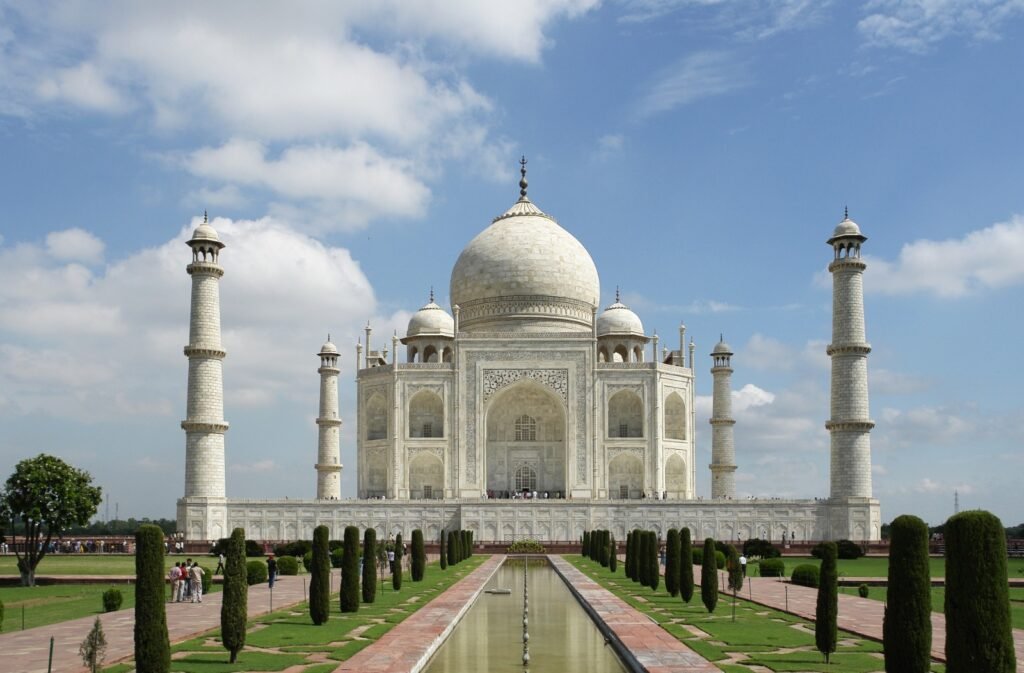
Constructed primarily from white Makrana marble sourced from Rajasthan, the monument combines Persian, Islamic, Turkish, and Indian architectural traditions into one harmonious design.
The central dome, rising nearly 73 metres above the ground, dominates the skyline and is visible from several kilometres away. Surrounding the main structure are four elegant minarets that were intentionally built with a slight outward tilt. Engineers designed them this way so that in the unlikely event of an earthquake, they would fall away from the main tomb rather than onto it.
Perfect symmetry is another defining feature of the Taj Mahal. Almost every architectural element—from the gardens and pathways to the fountains, arches, and decorative panels—has been designed with mathematical precision.
Even today, architects study the Taj Mahal to understand its proportions, geometry, and engineering techniques.
Intricate craftsmanship makes the monument unique
The beauty of the Taj Mahal extends far beyond its grand exterior.
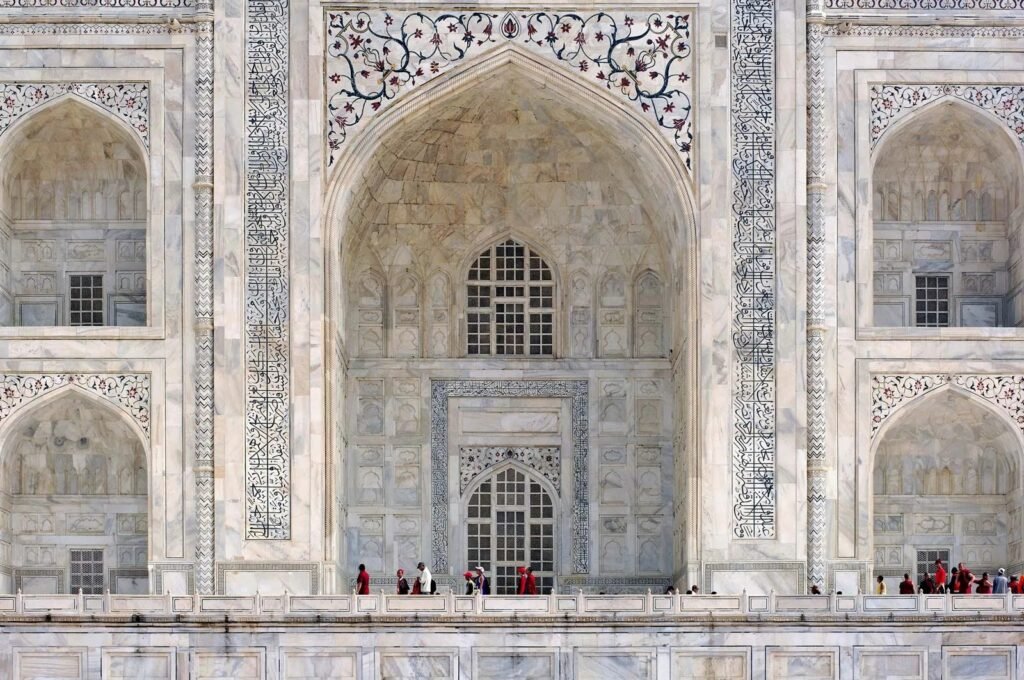
Its walls feature delicate floral carvings and intricate marble inlay work known as “Pietra Dura.” Skilled craftsmen embedded semi-precious stones such as jade, jasper, turquoise, lapis lazuli, crystal, and agate into the marble to create colourful floral patterns that remain vibrant even after centuries.
Verses from the Holy Quran decorate the entrance gates and walls through elegant black marble calligraphy. Interestingly, the size of the letters gradually increases higher up the walls, creating an optical illusion that makes every inscription appear equal in size when viewed from the ground.
The monument’s marble surface also changes colour throughout the day. During sunrise it appears soft pink, bright white under the afternoon sun, golden during sunset, and almost silver under moonlight. This changing appearance adds to the timeless charm of the Taj Mahal.
Engineering achievements far ahead of its time
The construction of the Taj Mahal demonstrated exceptional engineering knowledge for the seventeenth century.
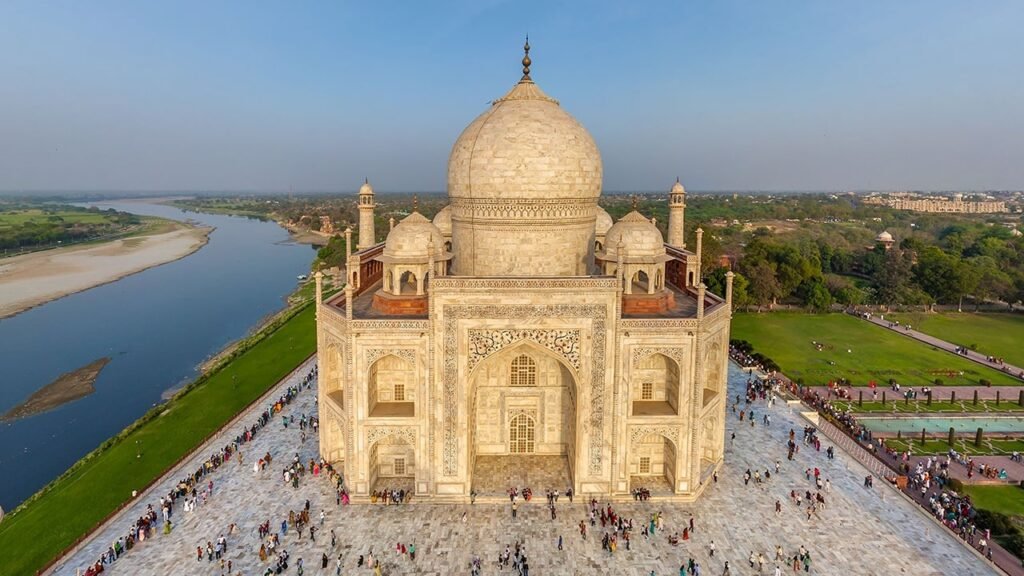
The monument stands on a strong foundation built using deep wells filled with stone and timber to provide stability near the Yamuna River. This innovative foundation has helped the structure withstand centuries of natural changes.
Heavy marble blocks were transported using specially designed carts pulled by elephants and oxen. Historical accounts mention that thousands of elephants were employed during construction to move building materials from distant regions.
The enormous dome, complex arches, underground chambers, and advanced drainage systems continue to impress engineers studying historical construction techniques.
Many experts believe the Taj Mahal remains one of the finest engineering achievements of the Mughal Empire.
Global recognition and UNESCO World Heritage status
The Taj Mahal was designated as a UNESCO World Heritage Site in 1983 because of its outstanding universal value.
UNESCO describes it as one of the greatest masterpieces of human creative achievement and one of the finest examples of Mughal architecture anywhere in the world.
Its global recognition has made the Taj Mahal one of the most photographed monuments on Earth. It frequently appears in documentaries, travel publications, history books, films, and international tourism campaigns.
In 2007, the Taj Mahal was also selected as one of the New Seven Wonders of the World through an international public voting campaign, further strengthening its global reputation.
A major driver of India’s tourism industry
Tourism remains one of the biggest economic contributions of the Taj Mahal.
Every year, millions of domestic and international tourists visit Agra specifically to experience the monument. Before the COVID-19 pandemic, annual visitor numbers regularly crossed six to seven million.
The steady flow of tourists supports thousands of local jobs in hotels, restaurants, transport services, handicrafts, photography, tour operations, and souvenir businesses.
The Taj Mahal has therefore become not only a cultural landmark but also a major economic asset for Uttar Pradesh and India’s tourism sector.
Government initiatives such as improved road connectivity, upgraded railway services, better visitor facilities, and enhanced security measures have further strengthened Agra’s position as a leading tourist destination.
Conservation efforts remain a national priority
Despite its strength, the Taj Mahal faces several environmental challenges.
Air pollution, industrial emissions, dust particles, insect activity, and changes in the Yamuna River’s water levels have raised concerns among conservation experts.
To protect the monument, the Archaeological Survey of India (ASI) regularly carries out restoration and maintenance work. One widely known conservation method involves applying Fuller’s Earth, a natural clay, to the marble surface. This treatment removes dirt and stains without damaging the stone, helping restore its original brightness.
Strict environmental regulations have also been introduced around the Taj Mahal. Polluting industries near the monument have been relocated or required to adopt cleaner technologies. Vehicular traffic is restricted close to the monument to minimise pollution levels.
These conservation efforts aim to preserve the Taj Mahal for future generations while maintaining its historical authenticity.
Cultural significance beyond architecture
The Taj Mahal represents much more than an architectural wonder.
For many people around the world, it symbolises love, devotion, sacrifice, and artistic excellence. It has inspired countless books, poems, paintings, songs, documentaries, and films over the centuries.
The monument also reflects India’s multicultural history by combining architectural traditions from different civilisations into one extraordinary structure.
Students, historians, architects, artists, and researchers continue to study the Taj Mahal to understand Mughal history, engineering innovation, landscape design, and heritage conservation.
Its influence extends far beyond India, with architects worldwide drawing inspiration from its symmetry, proportions, and decorative artistry.
Interesting facts about the Taj Mahal
Several fascinating facts continue to make the Taj Mahal one of the world’s most intriguing monuments.
The entire complex covers nearly 42 acres and includes the main mausoleum, mosque, guest house, gardens, fountains, gateways, and surrounding structures.
The cenotaphs visible inside the central chamber are symbolic memorials, while the actual tombs of Shah Jahan and Mumtaz Mahal lie in a lower chamber beneath the main hall.
The four minarets surrounding the Taj Mahal are not perfectly vertical but lean slightly outward as a safety measure.
The marble used in construction was transported from Makrana in Rajasthan, while precious stones came from different parts of Asia and Europe.
Even after almost 400 years, the Taj Mahal remains one of the finest examples of sustainable historical architecture, demonstrating exceptional planning, structural stability, artistic excellence, and engineering precision.
Today, the Taj Mahal continues to represent India’s rich cultural heritage, architectural brilliance, and historical legacy. Its unmatched beauty, fascinating history, remarkable craftsmanship, and enduring global appeal ensure that it remains one of the world’s most treasured monuments and one of the greatest achievements in the history of architecture.