
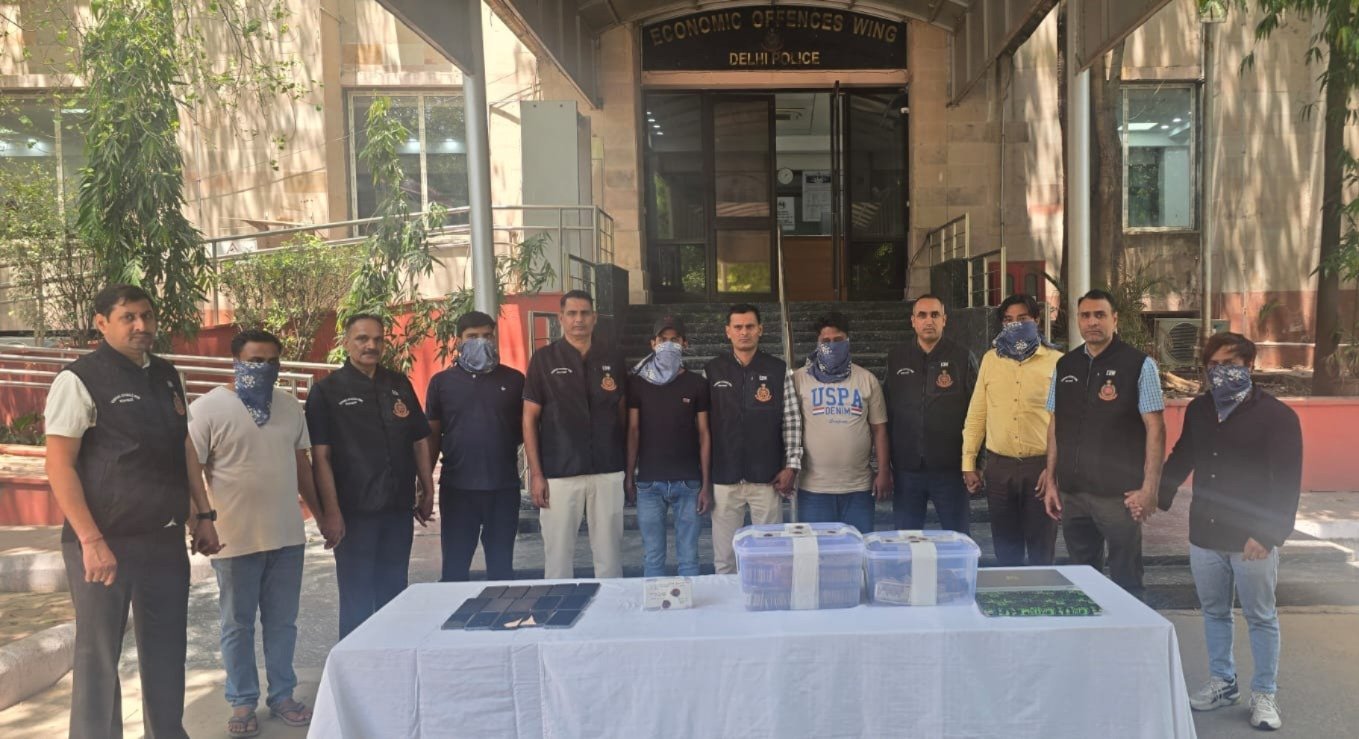
The Economic Offences Wing (EOW) of Delhi Police has exposed a massive GST Fraud syndicate allegedly involved in fake invoicing and bogus transactions worth nearly ₹128 crore. Six accused persons have been arrested for allegedly operating shell companies, generating fake GST invoices, and facilitating fraudulent Input Tax Credit (ITC) claims without any actual supply of goods or services.
The operation is being seen as one of the most significant crackdowns on GST Fraud in Delhi in recent times. Investigators uncovered a highly organized network that allegedly used forged documents, fake GST registrations, shell entities, and multiple bank accounts to route illegal transactions and evade tax scrutiny.
The Delhi Police EOW deserves appreciation for conducting a technically advanced investigation involving digital surveillance, GST data analysis, banking transaction scrutiny, and coordinated raids across Delhi-NCR. The case reflects the growing challenge of financial crimes being carried out through sophisticated digital and paper-based networks.
How the GST Fraud Case Began
The investigation started after a complaint led to the registration of FIR No. 66/2026 dated 24.03.2026 under relevant sections of the Bharatiya Nyaya Sanhita at Police Station EOW.
According to investigators, the victim was allegedly approached under the false promise of getting employment in the GST Department. During the process, the victim unknowingly shared personal documents including Aadhaar card, PAN card, electricity bill, and biometric details.
Police later discovered that these documents were allegedly misused to create a fake proprietorship firm named M/s R.K. Enterprises in September 2025 without the victim’s consent.
What initially appeared to be a simple identity misuse case soon developed into a large-scale GST Fraud investigation involving transactions exceeding ₹128 crore and fraudulent ITC claims of around ₹10 crore.
Officials stated that the fake firm was allegedly used only on paper while enormous fake financial transactions were routed through banking channels to create the appearance of legitimate business activity.
Shell Companies at the Heart of the GST Fraud
During investigation, the EOW found that the accused allegedly operated a wide network of shell companies created using forged and fraudulently obtained documents.
Investigators identified nearly 50 shell entities allegedly used for:
- Generating fake GST invoices
- Routing money through banking channels
- Providing accommodation entries
- Filing fake GST returns
- Fraudulently claiming Input Tax Credit
Police officials explained that no actual goods or services were supplied in many of these transactions. Instead, fake invoices were generated solely to claim tax benefits and circulate unaccounted money.
This type of GST Fraud has become increasingly common across India. Fraudsters create fake firms that exist only on paper and use them to issue invoices to businesses seeking to reduce their tax liabilities illegally.
Financial experts say fake invoicing is among the most damaging forms of GST Fraud because it directly affects government revenue and weakens the integrity of the taxation system.
Technical Surveillance Exposed the Syndicate
The investigation involved detailed technical surveillance and forensic analysis of:
- GST records
- Banking transactions
- Mobile phones
- Email accounts
- Internet banking details
- Digital devices
Police reportedly tracked suspicious financial patterns and linked multiple shell companies operating through common digital footprints.
Investigators identified accused Dilip Kumar and Raj Kumar Dixit as key conspirators behind the GST Fraud operation. Authorities believe they played major roles in creation of fake firms, filing of bogus GST returns, and management of fraudulent billing activities.
The use of digital tools in the racket showed the level of sophistication adopted by modern financial crime syndicates. Fake invoices, fabricated business records, and GST filings were allegedly managed through laptops, mobile devices, and online banking systems.
Officials stated that the accused also used multiple SIM cards and bank accounts to avoid detection and hide the financial trail.
 Coordinated Raids Across Delhi-NCR
To crack the network, multiple teams of Delhi Police EOW conducted coordinated raids at various locations across Delhi and NCR.
The teams included senior investigators and officers working under the supervision of ACP Virender Kadyan and senior EOW officials.
After sustained surveillance and technical tracking, police arrested six accused persons on 15 May 2026 from different locations in Delhi-NCR.
The arrested accused include:
- Raj Kumar Dixit
- Amar Kumar
- Vibhash Kumar Mitra
- Nitin Verma
- Mohd. Waseem
- Abid
Police said all accused were interrogated and arrested according to legal procedure.
The successful raids demonstrated the strong investigative capabilities of the Economic Offences Wing in handling complex GST Fraud operations involving multiple entities and digital evidence.
Mastermind Allegedly Operated Hundreds of Fake Firms
Investigators described accused Raj Kumar Dixit as the alleged mastermind behind the GST Fraud syndicate.
According to police, despite studying only up to the ninth standard, he allegedly managed a large fake invoicing network from Daryaganj, Delhi.
Authorities claim he operated nearly 250 shell companies with the help of associates, accountants, and intermediaries.
Investigators believe these fake firms were created using forged documents and identity papers obtained fraudulently from unsuspecting individuals.
The accused allegedly used multiple mobile numbers, bank accounts, forged seals, and fabricated business records to conceal the operation and avoid scrutiny by enforcement agencies.
Police officials say such organized GST Fraud networks function like parallel financial systems where transactions exist only on paper while money is routed digitally through several layers.
Role of Other Accused in the GST Fraud
Investigators revealed that accused Vibhash Kumar Mitra and Amar Kumar allegedly handled accounting and GST filing-related work for the syndicate.
Both had reportedly come to Delhi for higher studies and later became involved in GST-related financial activities.
Police allege they helped create and operate numerous shell firms using identity documents of unsuspecting persons in exchange for money.
Accused Nitin Verma allegedly managed fake firms and participated in bogus billing activities without any real supply of goods.
Meanwhile, Mohd. Waseem was allegedly involved in operating bank accounts and facilitating fake transactions linked to the GST Fraud network.
Another accused, Abid, allegedly provided multiple bank accounts that were used for routing funds connected to shell entities.
Investigators believe each accused had a defined role within the larger GST Fraud operation, making the syndicate highly organized and difficult to detect initially.
Huge Recovery Made During Investigation
Delhi Police EOW recovered significant evidence during the raids, strengthening the case against the accused.
The recovered items include:
- ₹51.12 lakh cash
- Fake stamps
- Forged documents
- Fake invoices
- 15 mobile phones
- Multiple SIM cards
- Two laptops
- Two cars
Police officials stated that laptops and mobile phones contained massive amounts of digital GST data, invoice records, and details of shell companies.
The recovery of both physical and digital fake invoices highlighted the scale at which the GST Fraud network was operating.
Investigators are currently examining the seized digital devices to identify additional beneficiaries and linked entities.
Understanding How Fake GST Fraud Works
However, in GST Fraud cases, fake companies generate invoices without actual transactions. These invoices are then used by businesses to claim fraudulent tax credits.
For example, a fake company may issue an invoice showing sale of goods worth several crores even though no goods were actually delivered. Another company then uses that invoice to claim Input Tax Credit and reduce tax liability illegally.
Experts say such frauds not only result in loss of public revenue but also create unfair competition for genuine businesses that follow tax rules honestly.
Rising Concern Over Identity Misuse
One of the most alarming aspects of the case is the alleged misuse of personal identity documents.
Investigators found that unsuspecting individuals’ Aadhaar cards, PAN cards, and biometric details were allegedly used to create fake firms without their knowledge.
Police officials have repeatedly warned citizens against casually sharing identity documents or biometric information.
Experts believe awareness among common people is crucial because many GST Fraud syndicates target financially vulnerable individuals who may not understand how their documents can be misused.
Authorities advise citizens to regularly monitor financial activity linked to their PAN and GST records to avoid becoming victims of identity-based financial crimes.
Investigation Continues Into Wider GST Fraud Network
The Economic Offences Wing believes the current arrests may only reveal part of a much larger GST Fraud network.
Investigators are now examining whether additional businesses benefitted from fake invoices generated by the accused. Authorities are also tracing financial trails connected to shell entities spread across multiple locations.
Officials suspect interstate links and additional beneficiaries may emerge as digital evidence and banking data continue to be analyzed.
The Delhi Police crackdown reflects increasing efforts by law enforcement agencies to combat organized GST Fraud through technology-driven investigations, digital tracking, and financial intelligence analysis.
The case also highlights how modern financial crimes are becoming more sophisticated, involving online systems, fake registrations, digital transactions, and complex layers of shell entities designed to escape detection.