Bayern Munich Academy chief Jochen Sauer believes India’s ambition to become a stronger force in world football will require more than short-term projects, new academies or high-profile partnerships. According to Sauer, the country’s biggest opportunity lies in building a clear development structure, investing in quality coaching and, most importantly, giving young players enough time and freedom to develop their footballing abilities.
In an exclusive interview with NDTV during a visit to Germany, Sauer discussed what India could learn from the Bayern Munich academy system and other football-development models. While acknowledging that he does not have detailed knowledge of every aspect of Indian football, he pointed to several principles that he believes are essential for any country seeking to build a successful football ecosystem.
His central message was straightforward: India needs a long-term plan and must be prepared to follow it consistently for at least a decade.
Sauer also referred to his experience working with academies in China, warning against repeatedly changing development strategies before they have had enough time to produce results. For him, youth development cannot be judged in a matter of months or even a couple of years. Players who enter a development programme at 11 or 12 may need several years before their true potential becomes clear.
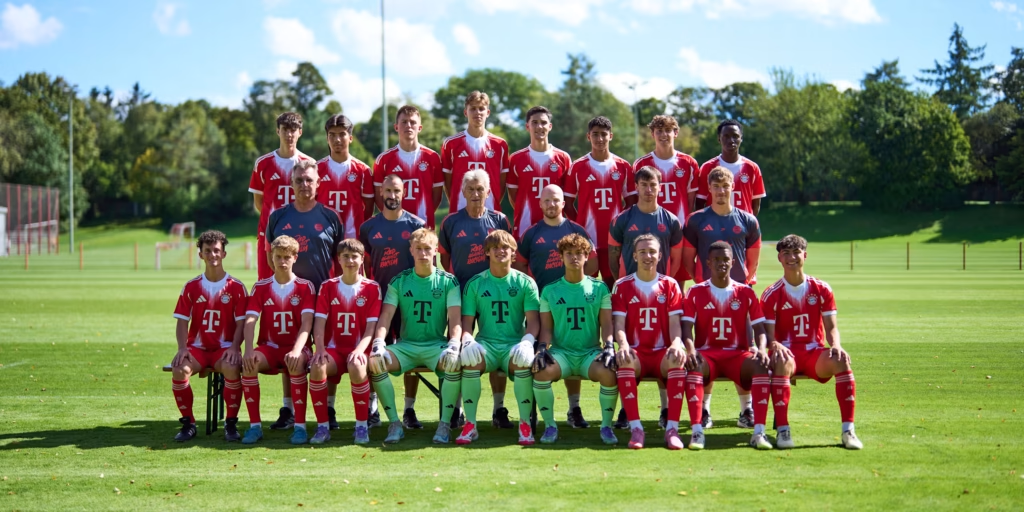
Structure Should Be the Foundation of Indian Football
Bayern Munich Academy Sauer believes that the first major requirement for a country attempting to improve its football standards is a clearly defined structure.
That structure, according to the Bayern Campus director, must cover multiple levels of the sport, including the professional league system, youth competitions and pathways for identifying and developing talented players.
The objective should be to create an environment in which the best young players regularly compete against one another at an appropriate level.
Bayern Munich Academy for India, this means looking beyond individual academies or isolated development programmes. A successful football system needs connections between grassroots football, youth academies, competitive leagues and the senior national setup.
A structured pathway can help talented players understand what comes next at every stage of their development. It can also make talent identification more consistent rather than dependent on individual tournaments or short-term scouting initiatives.
Bayern Munich Academy Sauer’s comments suggest that India’s challenge is not simply finding talented youngsters. The bigger task is creating an ecosystem capable of consistently developing those players over many years.
Consistency Is Crucial to Long-Term Development
One of Sauer’s strongest messages was the importance of consistency.
Bayern Munich Academy he argued that a country needs to establish a clear plan and then follow it for at least 10 years before making major judgments about whether the strategy has succeeded.
His comments were shaped partly by his experience with football academies in China. Sauer recalled seeing repeated discussions about changing the country’s youth-development approach, including shifting between academy structures, partnerships with top clubs and links with universities.
Bayern Munich Academy he described this constant movement between different strategies as a major mistake.
Youth football, he explained, operates on a completely different timeline from senior football. A professional club can potentially assess the impact of a tactical or managerial change within a season. Youth development requires much longer.
Bayern Munich Academy a player entering an academy at 11 may not reach senior football until several years later. Consequently, changing the development system every few years can make it difficult to determine whether the original approach was working.
For India, Bayern Munich Academy’s recommendation is therefore based on patience: establish a structure, define the objectives, implement the plan and give it enough time to produce measurable outcomes.
Bayern Munich’s Own Academy Provides an Example
Sauer also used Bayern Munich’s own experience to explain why patience is necessary.
He recalled that Bayern supervisory board member Uli Hoeness asked about the availability of top talents only two years after the Bayern Campus had begun its work.
Sauer’s response was that it would be more appropriate to ask the question five years later.
The reason was simple. The academy was working with players who were only 11 or 12 years old. Their long-term potential could not realistically be determined immediately.
Bayern Munich Academy by the time those players reached 17 or 18, the academy would have a much clearer understanding of how effectively they had developed.
The Bayern Munich Academy example illustrates one of the central principles of youth football: development is a gradual process.
For India, the same principle applies at a national level. A new grassroots programme should not necessarily be judged by the number of senior internationals it produces after only a few years. The development cycle needs sufficient time before meaningful conclusions can be drawn.
Grassroots Football Must Start With the Ball
While structure is important, Sauer believes India’s priorities should ultimately return to the most basic element of the sport: playing football.
Bayern Munich Academy his strongest recommendation for the youngest age groups is to give children as much opportunity as possible to play with the ball.
He pointed to young players in parts of Africa, where children often spend significant amounts of time playing football outside formal training environments. The experience of constantly interacting with the ball can help players develop natural comfort and confidence.
Sauer believes some football-development systems can become overly focused on physical development, athletic testing or formal academy structures.
According to him, those elements should not replace the fundamental objective of helping young players become better footballers.
“The game is played with the ball,” was the core message behind his recommendation.
For young players, the Bayern Munich Academy approach shows how repeated contact with the ball can provide opportunities to develop technical skills, decision-making and creativity in a natural environment.
Technical Development Should Come Before Excessive Physical Focus
Modern football increasingly uses data, athletic testing and tactical analysis. These tools can be valuable at different stages of a player’s development, but Sauer warned against allowing them to overshadow individual football quality.
He argued that youth academies should concentrate primarily on the player and the game rather than placing excessive emphasis on data or athletic characteristics.
This is particularly relevant when dealing with younger age groups.
Children develop at different rates, and early physical advantages do not necessarily guarantee long-term success in football. A young player who is physically advanced at one age may not remain ahead of peers later in adolescence.
Technical ability, understanding of the game, confidence and the ability to make decisions with the ball can therefore be crucial elements of long-term development.
The Bayern Munich Academy approach places individual football quality at the centre of the process.

Quality Coaches Could Make the Biggest Difference
Another major element of Sauer’s proposed roadmap for India is coaching.
He described the quality of coaches as one of the most important factors in youth development and suggested that this aspect can sometimes be underestimated even in European football.
Bayern Munich Academy the role of a youth coach extends beyond organising training sessions. Coaches influence how young players understand the game, how they respond to challenges and how they develop their technical and tactical abilities.
For India, the Bayern Munich Academy approach to improving coaching quality could therefore have an impact across the entire football pyramid.
Instead of focusing only on elite academies, coach education can also help strengthen grassroots programmes. Better-trained coaches at younger age groups can create stronger foundations for players who eventually progress into higher levels of competition.
Sauer’s recommendation is to identify and develop the best possible coaches while ensuring that they remain focused on football itself.
India Already Has Emerging Talent
Despite highlighting the challenges facing Indian football, Sauer offered an encouraging assessment of the country’s young players.
He said Bayern Munich has integrated Indian players into some of its youth initiatives, including programmes such as the Youth Cup, World Squad and Global Academy.
According to Sauer, the quality of Indian players involved in these projects has improved compared with 10 or 15 years ago.
That observation suggests that India already has a foundation on which it can build.
The challenge now is to ensure that improvements continue rather than becoming isolated successes.
The Bayern Munich Academy experience highlights why young Indian players need consistent access to quality coaching, competitive matches and environments that allow them to develop over a long period.
What India Can Learn From the German Academy Model
Sauer believes Germany’s youth academy structure remains among the strongest in Europe and that India could learn from several aspects of the system.
However, he does not suggest that India should simply copy Germany.
Football development systems need to reflect the circumstances of individual countries. India has a vastly different population, sporting culture, infrastructure landscape and football history.
The useful lesson is therefore not necessarily to reproduce every German model but to understand the principles behind successful development.
The Bayern Munich Academy model includes structured youth pathways, strong coaching, competitive environments and a long-term approach to player development.
Sauer also stressed the need to adapt continuously while avoiding constant strategic changes.
In other words, a system can evolve without completely abandoning its fundamental direction.
The China Experience Offers a Warning
Sauer’s reference to China was one of the clearest warnings in his discussion.
He explained that repeated changes in strategy created uncertainty around youth development. Different approaches were introduced and then replaced before they had sufficient time to mature.
This can make it difficult for academies, coaches and players to work toward a common long-term objective.
For India, the lesson is particularly relevant because football development requires coordination across multiple institutions.
If priorities change too frequently, resources can become fragmented and programmes may struggle to build continuity.
Sauer’s “10-year” recommendation is therefore less about choosing a perfect strategy immediately and more about creating a stable framework capable of improving over time.
A Long-Term Roadmap Could Transform India’s Football System
The Bayern Munich academy director’s recommendations can broadly be divided into four priorities for India: structure, coaching, grassroots football and patience.
First, the country needs a clearly defined football pyramid connecting grassroots participation with elite youth development and professional football.
Second, coach education needs to remain a central priority because talented players require talented coaches to reach their potential.
Third, children should be encouraged to play football regularly and develop their technical relationship with the ball rather than being introduced too early to excessive physical or data-driven approaches.
Finally, the entire system needs time.
India has already experimented with academies, youth competitions, international partnerships and different development programmes. Sauer’s argument is that the next stage should focus on connecting these efforts into a coherent long-term structure.
Why Patience Could Be India’s Biggest Advantage
Perhaps the most important message from Sauer’s interview is that football development cannot be rushed.
Bayern Munich Academy the success of a national football system cannot be measured simply by short-term tournament results. It must also be assessed through the number and quality of players progressing through the system over many years.
A generation of 11-year-olds today could become the core of a national team several years from now. That makes consistency particularly important.
If India can establish a clear development philosophy and maintain it for a decade or longer, the results could become increasingly visible as successive age groups move through the system.
The country already has a huge population of young people and, as Sauer noted, a strong interest in sport. Turning that enthusiasm into sustained football success will require organisation, expertise and patience.

Bayern Munich’s Message for India’s Football Future
Jochen Sauer’s roadmap offers a clear message for Indian football: there is no shortcut to building a successful football culture.
The priorities are relatively straightforward—create the right structure, develop high-quality coaches, give young players the ball, provide them with opportunities to compete and remain committed to the process for many years.
His experience at Bayern Munich also demonstrates why patience matters. Even one of Europe’s most established football institutions cannot immediately determine whether a young academy player will become a top professional.
For India, the challenge is even broader because the goal is to strengthen an entire football ecosystem rather than one club academy.
The country’s emerging talent, growing football interest and expanding development programmes provide a foundation. The next step is ensuring that these elements are connected through a stable and carefully planned system.
If India’s football authorities, academies, coaches and development programmes can learn from the Bayern Munich Academy approach and maintain that long-term focus, Sauer’s central warning may become one of the most important lessons for the country’s football future: build the structure, trust the process and give the next generation enough time to grow.