
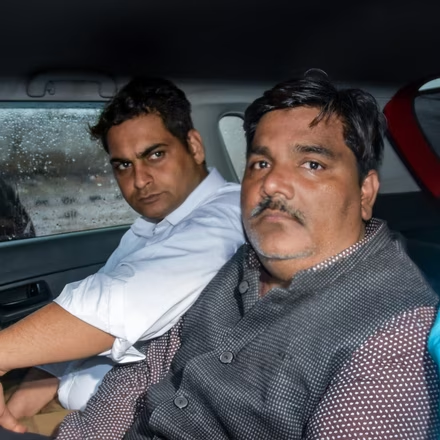
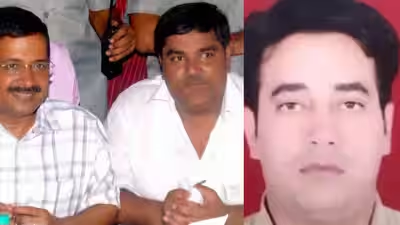
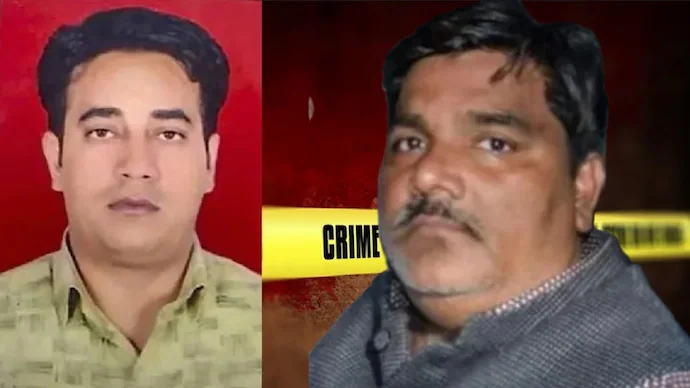
Ankit Sharma, In a landmark judgment related to the 2020 Northeast Delhi riots, a Delhi court has sentenced former Aam Aadmi Party (AAP) councillor Tahir Hussain and four co-convicts to life imprisonment for the murder of Intelligence Bureau (IB) staffer Ankit Sharma. While describing the killing as exceptionally brutal and acknowledging the cruel manner in which the crime was committed, the court held that the case did not satisfy the legal threshold for the death penalty under the “rarest of rare” doctrine.
The Ankit Sharma murder case verdict marks one of the most significant judicial developments arising from the February 2020 communal violence in Northeast Delhi, which claimed more than 50 lives and left hundreds injured. The prosecution had sought capital punishment, arguing that the murder was premeditated and carried out with extreme brutality. However, after considering aggravating and mitigating circumstances, the court awarded life imprisonment.
Table of Contents
Court Awards Life Imprisonment
The sentence was pronounced by an Additional Sessions Judge at Delhi’s Karkardooma Court after hearing arguments on the quantum of punishment.
The court sentenced:
- Tahir Hussain
- Four co-convicts found guilty in the case
to imprisonment for life for the murder of Intelligence Bureau officer Ankit Sharma during the 2020 riots. The court also imposed sentences under other applicable offences for rioting and related crimes, with the substantive sentence being life imprisonment.
Court Rejects Death Penalty
During sentencing, the prosecution argued that the murder was so brutal that it deserved the maximum punishment available under law.
The court acknowledged the seriousness and cruelty of the offence but concluded that the legal test required for imposing the death penalty had not been met. It observed that although the offence was grave, it could not be categorised within the narrow category of the “rarest of rare” cases that warrant capital punishment.
The court’s observation in the Ankit Sharma murder case highlighted the seriousness of the crime while maintaining the legal principles governing capital punishment.
The judgment reflects the Supreme Court’s long-established principle that the death penalty should be imposed only in exceptional cases where life imprisonment is considered wholly inadequate.
Background of the Ankit Sharma Murder Case
The Ankit Sharma murder case relates to the killing of an Intelligence Bureau staff member during the communal violence that erupted in Northeast Delhi in February 2020.
Sharma went missing during the riots, and his body was later recovered from a nearby drain. The death of Ankit Sharma became one of the most high-profile criminal cases arising from the violence and remained under judicial scrutiny for several years.
Delhi Police alleged that Ankit Sharma was attacked during the riots and that the crime formed part of organised violence in the affected area.
Conviction Before Sentencing
Before the sentencing order, the trial court had already convicted Tahir Hussain and the co-accused for offences including murder, rioting and other related provisions of the Indian Penal Code after evaluating witness testimony, forensic evidence and other material presented during the trial.
The sentencing hearing focused only on determining the appropriate punishment after the conviction had been recorded.
Prosecution’s Stand
During arguments on sentencing, the prosecution pressed for the death penalty.
It argued that:
- The murder was pre-planned.
- The attack demonstrated extreme brutality.
- The crime occurred during large-scale communal violence.
- The circumstances justified the harshest punishment under Indian law.
The prosecution contended that the nature of the offence satisfied the requirements for capital punishment.
Defence Arguments
The defence opposed the plea for the death penalty and urged the court to award life imprisonment instead.
It relied on mitigating circumstances while requesting a sentence less severe than capital punishment.
After hearing both sides, the court chose life imprisonment over the death sentence.
Significance of the Judgment
The verdict is regarded as one of the most important outcomes among criminal prosecutions linked to the 2020 Northeast Delhi riots.
Legal observers say the judgment highlights:
- The completion of a lengthy criminal trial.
- Judicial examination of evidence gathered during the riots investigation.
- Application of sentencing principles balancing aggravating and mitigating circumstances.
- Continued legal accountability in riot-related cases.
The ruling is also among the first major murder convictions arising from the 2020 violence.
What Is the ‘Rarest of Rare’ Principle?
Indian courts do not award the death penalty in every murder case.
The Supreme Court has consistently held that capital punishment should be reserved only for the “rarest of rare” cases, where life imprisonment would be insufficient considering both the crime and the offender.
Before imposing a death sentence, courts weigh factors such as:
- Nature of the offence.
- Degree of brutality.
- Circumstances of the crime.
- Possibility of reform.
- Mitigating and aggravating factors.
In this case, although the court found the crime to be extremely serious, it concluded that life imprisonment was the appropriate punishment.
Timeline of the Case
February 2020: Communal violence erupts in Northeast Delhi.
February 2020: Ankit Sharma goes missing during the riots; his body is later recovered from a drain.
Investigation: Delhi Police files charges after investigation into the murder.
Trial: Multiple witnesses, documentary evidence and forensic material are examined over several years.
July 2026: The court convicts Tahir Hussain and the co-accused.
July 31, 2026: The court sentences them to life imprisonment.
Wider Context
The Northeast Delhi riots remain one of the most significant incidents of communal violence in recent years.
Several criminal investigations and trials arising from the violence have continued in courts over the past six years.
The Ankit Sharma case attracted nationwide attention because the victim was an Intelligence Bureau employee and because of the seriousness of the allegations and evidence presented during the proceedings.
Legal Options Ahead
Under Indian law, the convicted persons have the right to challenge both the conviction and the sentence before a higher court.
Following the judgment, Tahir Hussain indicated that he intends to appeal the decision before the Delhi High Court.
If an appeal is filed, the High Court will examine both the findings of guilt and the sentence imposed by the trial court.
The Delhi court’s decision to sentence former AAP councillor Tahir Hussain and four co-convicts to life imprisonment in the murder of IB staffer Ankit Sharma marks a major judicial milestone in one of the most closely watched cases arising from the 2020 Northeast Delhi riots. While the court acknowledged the brutal nature of the crime, it held that the legal standards governing the death penalty were not met, opting instead for life imprisonment. The judgment reinforces the principle that sentencing in serious criminal cases must balance the gravity of the offence with established constitutional and judicial standards.