

Ammonia sensor technology has taken a major leap forward as Indian scientists have developed an ultra-sensitive device capable of detecting toxic ammonia gas at extremely low concentrations while operating efficiently at room temperature. The innovation, created by researchers at the Centre for Nano and Soft Matter Sciences (CeNS), Bengaluru, is expected to improve industrial safety, environmental monitoring, and public health through portable, wearable, and self-powered gas detection systems.
Developed under the Department of Science and Technology (DST), the new sensing platform addresses one of the biggest challenges in gas monitoring—detecting hazardous leaks quickly without relying on bulky equipment or energy-intensive systems. By combining advanced nanomaterials with practical engineering, the research team has created an ammonia sensor that can be integrated into wearable devices, smart safety bands, industrial monitoring equipment, and intelligent warning systems.
The research, published in the internationally recognised journal ACS Sensors, showcases how cutting-edge materials science can be transformed into real-world technology capable of protecting workers, industries, and communities from dangerous gas exposure.
Table of Contents
Why Ammonia detection matters
Ammonia is one of the most widely used industrial chemicals across the world. It plays a critical role in fertiliser production, refrigeration plants, pharmaceutical manufacturing, chemical processing, food storage facilities, and agricultural operations.
Despite its importance, ammonia is also classified as a hazardous gas. Even brief exposure to high concentrations can irritate the eyes, nose, throat, and skin. Prolonged exposure may lead to severe respiratory problems and other health complications.
Industrial accidents involving ammonia leaks have highlighted the need for continuous monitoring systems. Workers operating in fertiliser factories, cold storage facilities, laboratories, and chemical plants often rely on gas detection devices to receive early warnings before gas concentrations become dangerous.
This is where the newly developed ammonia sensor offers a significant advantage. Its ability to detect extremely small amounts of ammonia gives users more time to respond before exposure reaches harmful levels.
Built using advanced nanotechnology
The research team designed the ammonia sensor using an innovative hybrid material known as a vanadium oxide–vanadium sulfide (VOx/VS₂) heterostructure.
Although the scientific terminology may sound complex, the concept is relatively simple. The hybrid material creates a much larger active surface where ammonia molecules can attach themselves. Once the gas interacts with the sensing surface, the electrical properties of the material change, allowing the device to recognise even tiny amounts of ammonia.
Researchers achieved this through a carefully controlled surface transformation process that increased both sensitivity and charge transport efficiency.
The result is a sensor capable of responding faster and more accurately than many conventional gas detectors.
Detects ammonia at extremely low concentrations
One of the most impressive achievements of the new ammonia sensor is its remarkable sensitivity.
The device can detect ammonia concentrations as low as 319 parts per billion (ppb).
To understand how small this measurement is, one part per billion is comparable to a single drop of water mixed into an Olympic-sized swimming pool. Detecting ammonia at such low levels allows industries to identify leaks long before they become serious hazards.
This sensitivity places the sensor well below occupational safety exposure limits, giving workers valuable additional time to take preventive action.
Early detection is one of the most effective ways to reduce accidents involving toxic gases, especially in enclosed industrial environments.
Operates without heating, reducing energy consumption
Many traditional gas detection systems require elevated temperatures to function effectively. These heating mechanisms increase energy consumption, make devices bulkier, and limit their portability.
The newly developed ammonia sensor eliminates this problem by operating entirely at room temperature.
This achievement offers several practical benefits.
Lower energy consumption means reduced operating costs for industries. It also enables smaller, lightweight devices that can be carried easily or integrated into wearable safety equipment.
Because the sensor functions efficiently without external heating, it becomes much easier to deploy in factories, laboratories, agricultural fields, warehouses, and remote monitoring stations.
The room-temperature operation also opens possibilities for battery-powered and self-powered monitoring systems that require minimal maintenance.
High selectivity improves reliability
Gas detection becomes more challenging in industrial environments where multiple gases are often present simultaneously.
A reliable ammonia sensor must distinguish ammonia from other surrounding gases without generating false alarms.
According to the research team, the new device demonstrated excellent selectivity, accurately identifying ammonia even in the presence of various commonly encountered gases.
This capability significantly improves reliability and reduces unnecessary emergency responses caused by inaccurate readings.
The sensor also maintained stable performance across repeated testing cycles and continued operating reliably for more than ten weeks, indicating strong long-term durability.
Such consistency is particularly important for industrial safety systems that operate continuously around the clock.

Portable monitoring system for quick decision-making
Beyond developing the sensing material itself, researchers transformed their laboratory innovation into practical devices suitable for everyday use.
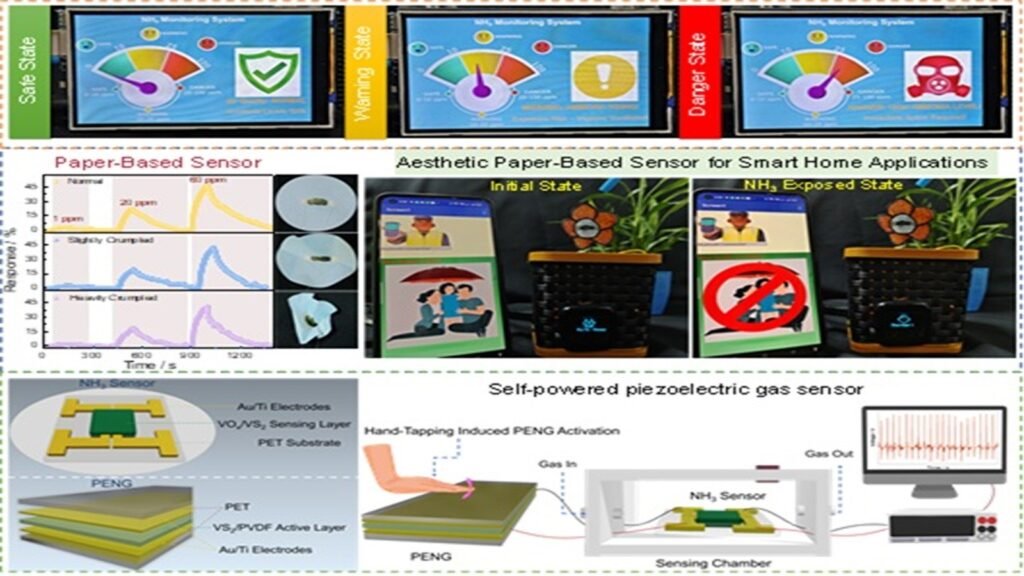
Among the most useful prototypes is a portable monitoring unit capable of automatically categorising ammonia concentrations into three safety levels:
- Safe
- Warning
- Danger
Instead of displaying only numerical readings, the device provides an easy-to-understand safety indication that enables workers and supervisors to react immediately.
This feature makes the ammonia sensor suitable even for users without technical expertise.
The portable system can be deployed across fertiliser plants, chemical storage facilities, cold storage warehouses, laboratories, agricultural operations, and manufacturing units where accidental ammonia leaks remain a constant safety concern.
Self-powered technology removes dependency on batteries
Another remarkable innovation introduced by the research team is a self-powered ammonia sensor.
The scientists integrated the sensing platform with a flexible piezoelectric nanogenerator capable of harvesting energy generated through simple human movement.
Walking, bending, or routine body motion creates enough mechanical energy to operate the sensing system.
This eliminates dependence on conventional batteries or continuous electrical supply.
Self-powered sensors are particularly valuable in remote industrial locations where replacing batteries can be difficult or expensive.
They also support sustainable technology development by reducing electronic waste and lowering maintenance requirements.
As industries increasingly move towards energy-efficient monitoring solutions, self-powered sensors could become an important part of future workplace safety infrastructure.
Flexible design supports wearable technology
The research team also explored wearable applications for the ammonia sensor by fabricating flexible versions on different substrates, including polymers, paper, and textile materials.
Unlike rigid electronic devices, these flexible sensors continued functioning even after being bent, folded, or twisted.
Maintaining sensing performance under physical stress is essential for wearable electronics because clothing and accessories constantly move during normal use.
The lightweight construction makes these sensors suitable for workers performing physically demanding tasks in factories, warehouses, farms, and laboratories.
Such wearable systems could continuously monitor air quality throughout an employee’s work shift while providing instant alerts if ammonia levels rise unexpectedly.
Smart prototypes demonstrate real-world applications
To demonstrate the practical potential of their research, the scientists developed several working prototypes rather than limiting the project to laboratory experiments.
These include wearable smart bands capable of personal safety monitoring, intelligent smart-home warning systems for indoor gas detection, and electronic textile platforms that integrate gas sensing directly into fabrics.
These applications illustrate how the ammonia sensor could eventually become part of everyday safety equipment instead of remaining a specialised industrial instrument.
Smart warning systems could automatically Ammonia sensor trigger alarms, activate ventilation systems, or notify emergency response teams whenever dangerous ammonia concentrations are detected.
Such intelligent monitoring could significantly reduce response times during industrial accidents.
Research driven by Indian scientific expertise
The project was led by Professor Angappane Subramanian along with Dr. Vishnu G. Nath, Ankur Verma, Abhijit Paul, and Dr. Subash Cherumannil Karumuthil at the Centre for Nano and Soft Matter Sciences in Bengaluru.
The team’s work represents a strong example of India’s growing expertise in advanced materials research and Ammonia sensor technology.
Rather than focusing solely on scientific discovery, the researchers successfully translated laboratory findings into practical prototypes that address real industrial and public safety challenges.
Their work demonstrates how nanotechnology can directly contribute to improving workplace safety, reducing environmental risks, and advancing wearable healthcare Ammonia sensor technologies.
The development of this next-generation ammonia sensor marks an important advancement in toxic gas monitoring. By combining ultra-high sensitivity, room-temperature operation, flexible design, self-powered capability, and wearable applications into a single platform, Indian researchers have opened new possibilities for safer industries, smarter environmental monitoring, and more effective personal protection against hazardous gas exposure.