Stock Market investors witnessed one of the steepest declines in recent months as Indian benchmark indices suffered their biggest single-day fall in more than three months amid renewed geopolitical tensions in West Asia. The sharp correction erased significant market value, with investors reacting cautiously after fresh uncertainty emerged following comments by US President Donald Trump regarding the Iran ceasefire.
The broad-based selloff affected nearly every sector, pushing both the BSE Sensex and NSE Nifty sharply lower. Analysts believe the decline reflects growing concerns over global geopolitical risks rather than any weakness in India’s domestic economic fundamentals. As uncertainty increases across international markets, investors often shift away from riskier assets such as equities, leading to widespread selling pressure.
The latest fall serves as another reminder that the Stock Market is closely connected to global developments, where international conflicts and political statements can influence investor sentiment almost instantly.
Table of Contents
Sensex and Nifty Register Biggest Decline in Months
Wednesday’s trading session ended with heavy losses across benchmark indices.
The BSE Sensex declined by 1,677.12 points, or 2.15 percent, closing at 76,503.60. At the same time, the NSE Nifty 50 dropped 516.65 points, or 2.12 percent, ending the day at 23,882.05.
The magnitude of the decline marked the sharpest single-day fall for the Stock Market in more than three months, reflecting widespread panic selling throughout the trading session.
Selling pressure remained strong from the opening bell as investors reacted to global developments, with little sign of recovery during the day.
What Triggered the Sharp Market Fall?
The primary reason behind the sudden correction was escalating geopolitical uncertainty in West Asia.
Investor confidence weakened after US President Donald Trump stated that the ceasefire with Iran had effectively ended, even though diplomatic negotiations could continue after recent exchanges involving the Strait of Hormuz.
The Strait of Hormuz is one of the world’s most strategically important maritime routes, through which a significant portion of global crude oil supplies is transported every day.
Whenever tensions rise in this region, financial markets immediately begin pricing in the possibility of disruptions to energy supplies, rising oil prices, inflationary pressures, and slower global economic growth.
As these concerns intensified, investors reduced their exposure to equities, leading to heavy selling across the Stock Market.
Why Geopolitical Events Affect the Stock Market
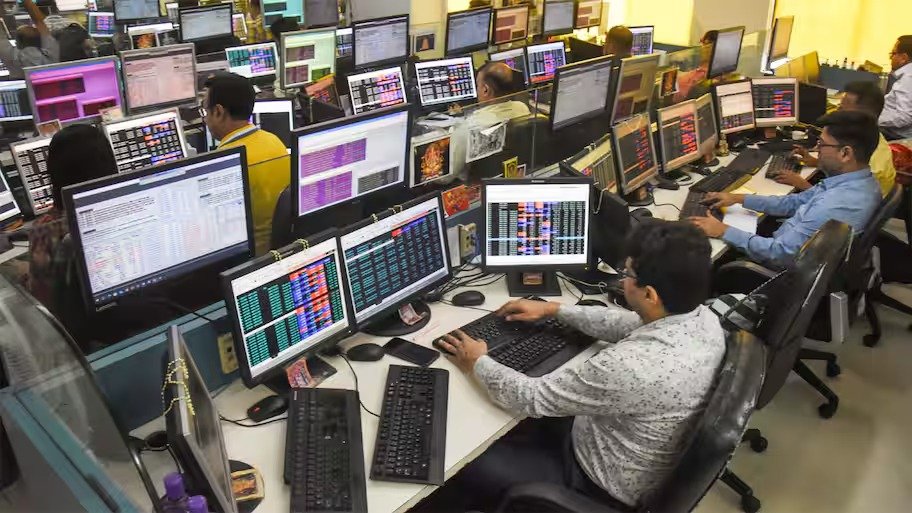
Global financial markets are highly sensitive to geopolitical developments because uncertainty increases investment risks.
When conflicts escalate or diplomatic relations deteriorate, investors typically move their money toward safer investment options such as gold, government bonds, or cash while reducing investments in equities.
This shift is commonly referred to as a “risk-off” sentiment.
Although India’s domestic economy remains relatively stable, international developments often influence foreign institutional investors, who play an important role in Indian equity markets.
If global investors become cautious, they may temporarily reduce investments in emerging markets, including India, creating additional pressure on the Stock Market.
Banking Stocks Lead the Decline
The banking sector experienced the heaviest selling during Wednesday’s session.
Both the Nifty Bank and Nifty PSU Bank indices emerged as the worst-performing sectoral indices of the day.
Banks generally react quickly to changes in investor confidence because they are closely linked with economic growth, borrowing activity, and overall business sentiment.
When uncertainty increases globally, financial stocks often witness stronger selling compared to defensive sectors.
The weakness in banking shares contributed significantly to the overall decline in benchmark indices.
Most Sectors Ended Deep in the Red
The market correction was not limited to a single industry.
Almost every major sector experienced losses, highlighting the broad-based nature of the selloff.
Financial services, banking, automobiles, information technology, infrastructure, and consumer-focused companies all ended the trading session lower.
However, some sectors managed to perform relatively better than others.
The Nifty Metal and Nifty Pharma indices outperformed most other sectoral benchmarks by limiting their losses despite closing in negative territory.
Healthcare and pharmaceutical companies are often viewed as comparatively defensive investments during uncertain market conditions because demand for healthcare services generally remains stable regardless of economic cycles.
Similarly, metal companies showed greater resilience compared to financial stocks, although they were unable to avoid losses entirely.

Only a Handful of Stocks Ended Higher
The weakness across the Stock Market was reflected in individual stock performance as well.
Out of all the companies listed in the Nifty 50 index, only four stocks managed to close in positive territory.
The remaining constituents finished lower, demonstrating the widespread nature of investor selling.
Among the biggest losers were:
- Jio Financial Services
- InterGlobe Aviation
- Shriram Finance
These companies witnessed significant declines as investors reduced positions across financial and travel-related sectors.
Such broad participation in the selloff often indicates a market-wide correction rather than weakness limited to specific companies.
Technical Outlook for the Stock Market
Market analysts believe the technical picture has become more cautious following Wednesday’s decline.
According to technical experts, the 24,000 level on the Nifty is expected to act as the first major resistance zone.
Another important resistance is seen around 24,200.
Analysts suggest that the Stock Market would require a sustained move above these levels before the short-term technical structure can improve.
On the downside, 23,800 has emerged as an important support level.
If the Nifty falls decisively below this mark, technical analysts believe selling pressure could increase further.
In such a scenario, the index may move towards the 23,600–23,500 range, where additional support could emerge.
These technical levels are closely monitored by traders while making short-term investment decisions.
Global Markets Continue to Influence Indian Equities
The recent correction highlights the increasing integration of Indian financial markets with global economic developments.
In today’s interconnected economy, events occurring thousands of kilometres away can have an immediate impact on domestic equity markets.
International conflicts, interest rate decisions by major central banks, inflation data, crude oil prices, and geopolitical developments all influence investor behaviour.
When uncertainty rises globally, institutional investors often rebalance their portfolios, affecting markets across Asia, Europe, and the United States simultaneously.
The latest movement in the Stock Market demonstrates how external factors continue to shape daily market performance despite India’s relatively strong domestic economic indicators.
Investor Sentiment Remains Cautious
The sharp correction reflects changing investor psychology rather than any sudden deterioration in corporate earnings or economic growth.
Financial markets typically dislike uncertainty.
Whenever global political risks increase, investors become more defensive until greater clarity emerges.
While short-term volatility can appear alarming, experienced market participants often focus on long-term fundamentals instead of reacting solely to daily price movements.
Analysts note that geopolitical developments can create temporary corrections, but sustained market direction generally depends on factors such as corporate earnings, economic growth, inflation, monetary policy, and foreign investment flows.
Volatility Likely to Continue
The coming trading sessions may remain volatile as investors closely monitor developments in West Asia and any further diplomatic announcements.
Global crude oil prices, foreign institutional investment trends, and international market performance are expected to remain key factors influencing the Stock Market in the near term.
Traders will also watch whether benchmark indices manage to hold above important technical support levels or witness further selling pressure.
For long-term investors, the recent decline serves as another example of how global events can temporarily influence equity markets. While short-term fluctuations are a natural part of investing, the Stock Market continues to respond rapidly to geopolitical uncertainty, making global developments an important factor for investors to track alongside domestic economic indicators.