Khalifa: The Ruler Movie Review: Director Vysakh’s, starring Prithviraj Sukumaran and Neil Nitin Mukesh, attempts to deliver a larger-than-life action spectacle built around gold smuggling, family conflict, crime and revenge. While Prithviraj Sukumaran brings considerable screen presence and style to the central character, the film struggles to give him a story and screenplay strong enough to match his star power.
At a runtime of nearly two hours and 49 minutes, Khalifa has all the ingredients associated with a traditional mass entertainer — a powerful protagonist, criminal underworld politics, shootouts, corruption, family drama, stylish action sequences and a threatening antagonist. Yet the film’s biggest weakness is that these elements rarely come together into a convincing emotional or narrative whole.
The result is a film that often looks impressive but struggles to generate the emotional investment expected from a character-driven action drama.
Table of Contents
Prithviraj Sukumaran Takes Centre Stage as Aamir Ali
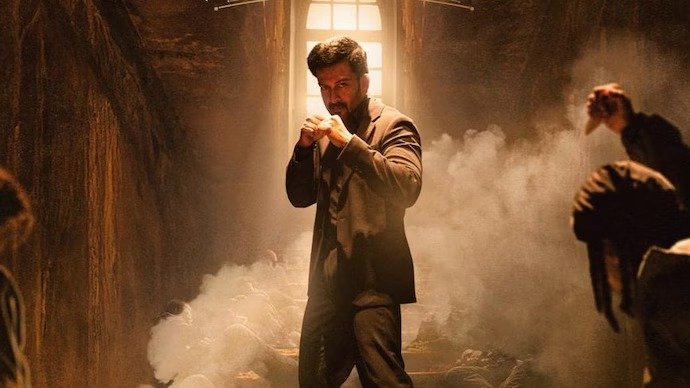
Prithviraj Sukumaran plays Aamir Ali, a character whose journey forms the backbone of Khalifa. Aamir has taken refuge in London and is wanted by the authorities in connection with a murder. He is also known as a notorious gold smuggler, raising an immediate question: how did a successful businessman from a respectable family end up becoming involved in organised crime?
The film attempts to answer that question through Aamir’s past and his relationship with his family.
Aamir was once a successful textile businessman, with much of his family based in Kerala. Circumstances eventually push him towards gold smuggling, forcing him into a world where money, power, corruption and violence become intertwined.
This setup gives Khalifa the potential to become more than a conventional gangster-action film. An origin story exploring the transformation of an ordinary businessman into a feared criminal could have provided the film with a strong emotional foundation.
However, the screenplay does not fully exploit that opportunity.
A Promising Premise That Remains Formulaic
The basic idea behind Khalifa is not particularly unfamiliar. Crime dramas involving gold smuggling, family disputes and rival underworld figures have been explored repeatedly in Indian cinema.
That does not necessarily make the concept a weakness. A familiar premise can still work if the screenplay introduces distinctive characters, unexpected conflicts or a compelling emotional perspective.
Unfortunately, Khalifa does not consistently find those inventive touches.
Aamir has an emotional reason for entering the gold-smuggling business, and initially this motivation gives his journey some purpose. But once that particular conflict is resolved around the middle of the film, the protagonist’s continued involvement in the criminal world becomes increasingly difficult to understand.
The screenplay does not provide a sufficiently convincing answer to the most important question surrounding Aamir: what does he actually want?
Is he seeking wealth? Power? Revenge? Security? Does he genuinely enjoy the influence that comes with being a powerful smuggler? Or has he simply become trapped in a world from which there is no escape?
The film raises these possibilities but does not explore them with enough depth.
When the Character Motivation Begins to Fade
One of the biggest problems with Khalifa is the disconnect between Aamir’s emotional motivation and his later actions.
A character can remain in a criminal world even after his original motivation disappears, but the audience needs to understand why. The film’s explanation that Aamir may simply be too deeply involved to walk away does not feel sufficiently developed.
As a result, the protagonist’s journey begins to feel more like a requirement of the plot than a natural progression of his character.
This becomes particularly noticeable as the film shifts from family drama towards a conventional mass-action format. The emotional questions surrounding Aamir gradually take a back seat, while style and spectacle become increasingly important.
Prithviraj Sukumaran’s Screen Presence Works
If there is one department where Khalifa remains consistently effective, it is Prithviraj Sukumaran’s screen presence.
The actor brings physicality, confidence and attitude to Aamir Ali. His toned physique, stylish costumes and controlled expressions help establish the character as someone who commands attention whenever he enters a scene.
The film clearly understands the appeal of Prithviraj Sukumaran as a mass-action star. His walk, mannerisms and overall screen presence are repeatedly used to create moments designed for audience applause.
Jakes Bejoy’s music further amplifies this presentation, particularly during Aamir’s stylish entrances and action-heavy sequences.
Prithviraj also manages to communicate some of Aamir’s emotions through his expressions. However, performance alone cannot compensate for a character whose motivations are not sufficiently developed.
The actor appears capable of giving Aamir considerably more depth, but the screenplay does not always give him the material necessary to do so.
Neil Nitin Mukesh’s Antagonist Fails to Make a Strong Impact
Neil Nitin Mukesh plays Harris, a rival smuggler positioned as the principal antagonist.
On paper, Harris has the potential to become an effective counterpoint to Aamir. A strong antagonist could have transformed their rivalry into the emotional and dramatic centre of the film.
Instead, Harris largely remains a conventional villain.
His character relies heavily on threats and intimidation, but the screenplay does not give him enough opportunities to demonstrate genuine strategic intelligence or psychological menace. Consequently, the rivalry between Aamir and Harris feels more like a procedural battle over territory and influence than a deeply personal confrontation.
Police, customs officials and the judiciary are also brought into the conflict, adding layers to the criminal world. Yet these elements do not always translate into meaningful dramatic tension.
A stronger villain could have significantly elevated Khalifa.
The Father-Son Relationship Provides the Emotional Core
Among the film’s more engaging elements is its father-son relationship.
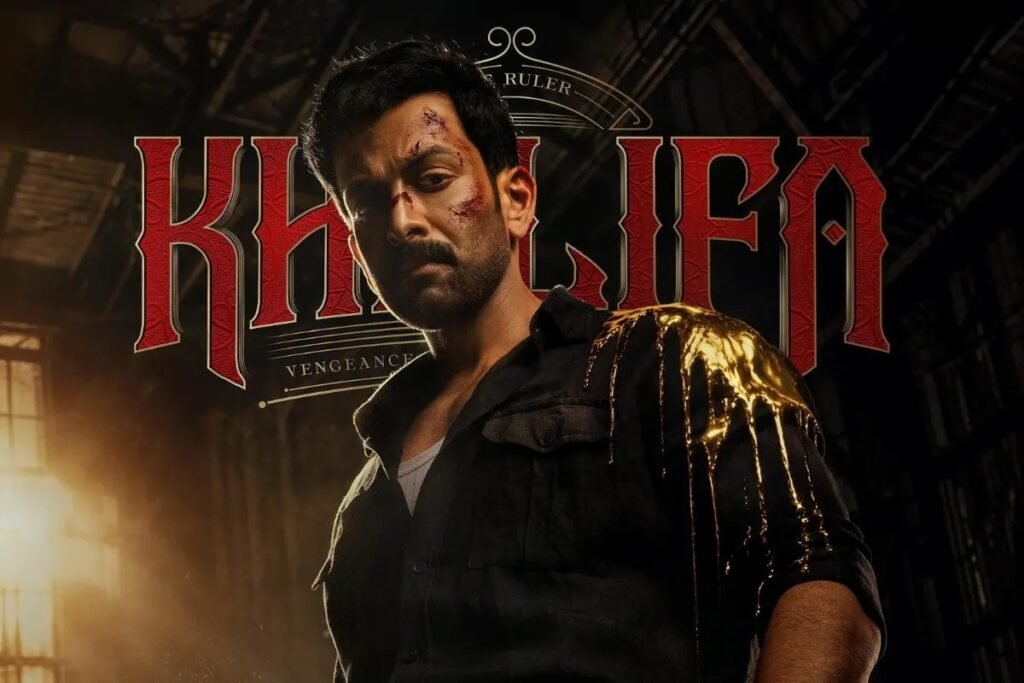
Shammi Thilakan plays Younis Khan, Aamir’s father, and delivers one of the film’s more memorable performances. His character receives a relatively well-rounded arc, giving the first half of Khalifa some emotional weight.
The father-son dynamic offers a glimpse of the film that Khalifa could have become — a crime drama rooted in family, choices and consequences rather than merely a collection of action set pieces.
The emotional conflict between personal relationships and Aamir’s criminal life is potentially the film’s strongest dramatic material.
However, the narrative eventually moves away from this emotional foundation and embraces the larger-than-life action format.

Action, Gold Smuggling and Familiar Masala Elements
Khalifa does not lack action.
Shootouts, criminal operations, gold-smuggling techniques and corruption within various departments are repeatedly incorporated into the narrative. The film attempts to maintain momentum by introducing one conventional masala element after another.
There are moments where the methods used to smuggle gold provide some intrigue. The involvement of multiple institutions also gives the story the appearance of a larger criminal network.
But the problem is not the absence of events. It is the absence of meaningful progression.
Once the central conflict appears to be resolved, the story struggles to find a fresh direction. Instead of moving decisively towards a new dramatic phase, the narrative repeatedly circles around familiar conflicts.
This makes the film feel stretched, particularly given its lengthy runtime.
A Screenplay That Struggles to Create High Points
Written by Jinu V Abraham, the screenplay is perhaps Khalifa‘s biggest weakness.
A mass-action film does not necessarily require an extremely complicated plot. However, it needs strong turning points, memorable confrontations and emotional stakes that make audiences care about what happens next.
Khalifa frequently moves from one event to another without creating enough of these high points.
The film has shootouts, confrontations, criminal schemes and dramatic reveals, but many of them fail to produce the impact expected from a film of this scale.
Even the cameo appearances towards the end do little to generate the emotional or theatrical high the narrative appears to be aiming for.
The problem becomes particularly evident when the film begins to repeat its conflicts instead of escalating them.

Women Remain on the Margins
Another noticeable weakness is the limited role given to the female characters.
The narrative is dominated by male characters, particularly Aamir, Harris and the various figures operating within the criminal and institutional worlds.
The women in Khalifa receive little meaningful dialogue or narrative agency. Their presence rarely influences the central conflict in a substantial way.
For a film built around family, relationships and emotional consequences, this is a missed opportunity. More developed female characters could have brought another perspective to Aamir’s choices and the consequences of his transformation.
The Sequel Setup Raises Questions
Khalifa: The Ruler concludes by opening the door for a sequel.
The ending suggests that the story is far from over, with revenge becoming an important component of what could follow. However, Prithviraj Sukumaran the setup also raises concerns because the sequel may face the same fundamental problem as the first instalment if it relies primarily on revenge without building a broader and more compelling central conflict.
If another chapter is made, the franchise will need to strengthen its storytelling considerably.
A sequel could benefit from a more layered protagonist, a genuinely formidable antagonist and a screenplay that gives every major character a clear purpose.
Verdict: Style Over Substance
Khalifa: The Ruler is a film that clearly knows how to present its leading man.
Prithviraj Sukumaran looks convincing as Aamir Ali, carries himself with authority and brings the swagger expected from a mass-action protagonist. Jakes Bejoy’s music and the film’s action-driven presentation complement his screen presence.
But the film’s technical and star-driven strengths cannot completely hide its narrative shortcomings.
The Prithviraj Sukumaran central character’s motivations become unclear, the antagonist lacks menace, the emotional core is underdeveloped and the screenplay struggles to maintain momentum after the principal conflict loses its force. The lengthy runtime further exposes these weaknesses.
The Prithviraj Sukumaran father-son track featuring Shammi Thilakan provides some of the film’s strongest emotional material, but it is not enough to sustain the entire narrative.
Ultimately, Khalifa feels like a familiar masala action entertainer built around the charisma of Prithviraj Sukumaran rather than a story powerful enough to justify that charisma. The Prithviraj Sukumaran actor walks, talks and fights like a star, but the screenplay repeatedly struggles to give his character the emotional weight needed to Prithviraj Sukumaran make Aamir Ali truly memorable.
For the proposed sequel, the message is clear: more than bigger action or greater scale, Prithviraj Sukumaran the franchise needs a stronger story, sharper screenplay, deeper characterisation and a villain capable of matching its protagonist. Prithviraj Sukumaran Khalifa: The Ruler delivers style, swagger and action, but its formulaic storytelling prevents it from becoming the compelling crime drama it could have been. Prithviraj Sukumaran remains the film’s biggest strength, but even his screen presence cannot fully rescue a story that repeatedly loses its way.