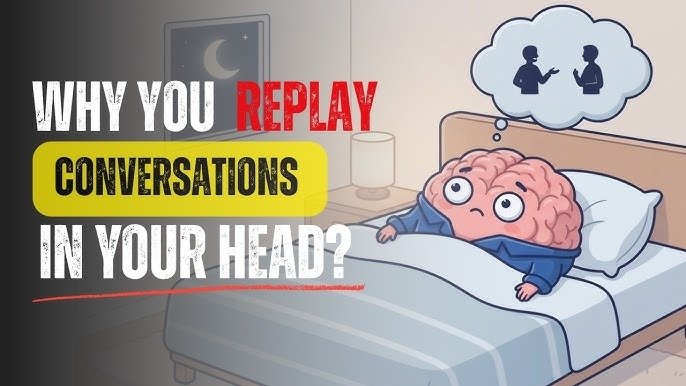
Have you ever walked away from a conversation feeling perfectly fine, only to replay it repeatedly hours later? Perhaps you suddenly remember a sentence you wish you had phrased differently, wonder whether your joke was misunderstood, or question whether the other person noticed an awkward pause.
For many people, this familiar mental replay can turn an ordinary conversation into an extended internal analysis. A simple exchange that lasted a few minutes can occupy the mind for hours: Why did I say that? Did I sound strange? Why did they respond like that? Should I have said something else?
Psychologists often describe this pattern as post-event rumination or post-event processing — repetitive, detailed thinking about a social interaction after it has ended. Research has found a meaningful relationship between this type of rumination and social anxiety, although replaying conversations occasionally does not automatically mean someone has a mental health disorder.
So why does the brain keep returning to conversations that are already over?
Table of Contents
What Is Post-Conversation Rumination?
Post-conversation rumination happens when a person repeatedly reviews a past social interaction, often focusing on what they believe went wrong.
Unlike simply remembering what happened, rumination tends to involve evaluation and interpretation. The mind does not merely recall the conversation; it searches for evidence about how the interaction was perceived.
A person might remember:
- The exact words they used.
- The other person’s facial expression.
- A pause or change in tone.
- Something they wish they had said differently.
- A joke that may not have received the expected reaction.
- Whether they talked too much or too little.
- Whether they appeared nervous or awkward.
The problem is that the review often becomes increasingly negative. Instead of reaching a conclusion and moving on, the mind repeatedly asks the same questions without producing a definitive answer.
Research published in the Journal of Psychiatric Research in 2024 found a moderate association between post-event rumination and social anxiety symptoms, based on a meta-analysis of 35 studies involving more than 10,000 participants.
That does not mean every person who replays conversations has social anxiety. Rather, it suggests that persistent post-event rumination is particularly relevant to understanding why social anxiety can continue or intensify.

Why Does the Brain Replay Conversations?
One explanation is that the brain is constantly trying to make sense of socially important experiences.
Human beings depend heavily on social relationships. Acceptance, rejection, cooperation and reputation can influence friendships, romantic relationships, professional opportunities and a sense of belonging.
As a result, social interactions can carry emotional significance.
When a conversation feels ambiguous, uncomfortable or particularly important, the brain may attempt to resolve that uncertainty by reviewing what happened.
The problem is that social interactions rarely provide perfect information.
You cannot directly know what another person was thinking when they smiled, paused, looked away or gave a short response. Yet an anxious mind may attempt to fill those gaps with explanations.
A neutral response can therefore become:
“They probably didn’t like what I said.”
A pause can become:
“I made things awkward.”
A short text response later can become:
“Maybe they regretted talking to me.”
The mind is essentially trying to turn uncertainty into certainty — but because the other person’s thoughts are unavailable, the process can continue indefinitely.
The Difference Between Reflection and Rumination
Not every review of a conversation is harmful.
Sometimes thinking about a conversation can actually be useful.
For example, someone might realise:
“I interrupted them several times. Next time I’ll listen more carefully.”
That is reflection. It identifies something specific and produces a possible lesson.
Rumination tends to sound different:
“Why did I say that? Maybe they thought I was annoying. I shouldn’t have said anything. Why am I like this?”
The distinction is important.
Reflection generally moves toward understanding or action. Rumination repeatedly circles around the same uncertainty.
Research on post-event processing suggests that people experiencing social anxiety can engage in detailed reviews of social interactions that emphasise negative self-perceptions and perceived mistakes.
In other words, the issue is not necessarily that someone remembers a conversation. It is what their mind does with that memory.

Why Awkward Moments Feel Bigger Than They Were
One reason conversations can become distorted during mental replay is that memory is not a perfect recording of reality.
When people are anxious about how they were perceived, they may pay disproportionate attention to moments that confirm their fears.
Imagine a 20-minute conversation in which everything went relatively well, but there was one five-second awkward pause.
Someone who is prone to social rumination may repeatedly focus on those five seconds while barely considering the other 19 minutes and 55 seconds.
The awkward moment becomes the headline of the entire conversation.
Research into post-event processing has linked it with negative memory and interpretation biases in social anxiety. A 2024 scoping review found that post-event processing is associated with negative memory biases and worsening performance appraisals, while self-focused attention may contribute to the process.
This can create a misleading impression that the conversation was much worse than it actually was.
The Role of Fear of Judgment
At the centre of many post-conversation spirals is a basic concern:
“What did they think of me?”
People naturally care about how others perceive them. However, the concern can become intense when a person places excessive importance on avoiding negative evaluation.
Instead of asking, “How did that conversation go?”, the mind may ask:
“Did I look stupid?”
“Did they think I was boring?”
“Did I talk too much?”
“Did they notice that I was nervous?”
“What if they don’t want to talk to me again?”
This shift from evaluating the interaction to evaluating one’s entire social identity can make the mental replay much more emotionally intense.
Research has repeatedly connected fear of negative evaluation, self-focused attention and post-event rumination with social anxiety.
Why Important Conversations Are More Likely to Stay in Your Head
Not every conversation receives the same amount of mental attention.
A casual exchange with a stranger may disappear from memory within minutes. A conversation with a romantic interest, close friend, manager, interviewer or someone whose opinion matters may be replayed much more intensely.
That is because the perceived stakes are higher.
If someone cares deeply about the outcome of an interaction, uncertainty becomes harder to tolerate.
For example, after a job interview, a person might replay every answer because the conversation could influence their career.
After a first date, they might analyse every expression because they want to know whether the other person was interested.
After an argument with a friend, they might repeatedly reconsider their words because the relationship matters.
The more emotionally significant the interaction feels, the greater the temptation to mentally revisit it.
Social Media Can Add Another Layer
Modern communication has made post-conversation analysis even easier.
A person can now continue monitoring an interaction after it has ended.
They might check whether someone has:
- Seen their message.
- Liked a post.
- Viewed their story.
- Replied quickly or slowly.
- Changed their online behaviour.
- Been active without responding.
A conversation that once ended when two people walked away can now generate hours of additional digital clues.
However, these clues are often ambiguous.
Someone being online does not necessarily mean they are deliberately ignoring a message. A short reply does not automatically indicate anger. A delayed response can have countless explanations.
Yet when someone is already anxious, ambiguous digital signals can become additional material for rumination.

The “What If I Had Said…” Trap
Another common feature of conversation overthinking is counterfactual thinking.
This is the mental habit of imagining alternative versions of the past:
“What if I had said this instead?”
“What if I hadn’t made that joke?”
“What if I had stayed quiet?”
“What if I had responded differently?”
Research on socially anxious individuals has found greater use of negative and “if only” counterfactual thoughts following socially stressful situations.
Counterfactual thinking can sometimes help people learn from mistakes. But when there is no realistic action left to take, repeatedly reconstructing the past can become emotionally exhausting.
The conversation cannot be edited.
Yet the mind keeps trying to rewrite it.
Why Rumination Can Become a Cycle
Post-conversation rumination can potentially reinforce the very anxiety that triggered it.
The cycle may look something like this:
Conversation → uncertainty → negative interpretation → mental replay → increased anxiety → greater fear of future conversations → more monitoring during the next interaction → more rumination afterward.
Research describes post-event rumination as an important maintaining factor in social anxiety.
This means the issue is not only what happens after a conversation. Excessive post-event analysis can influence how someone approaches future social situations.
If a person repeatedly concludes that their conversations go badly, they may become more nervous before the next one.
That nervousness can increase self-consciousness during the interaction.
Afterward, they may once again search for mistakes.
The cycle continues.
How to Stop Overthinking a Conversation
Breaking the habit does not require forcing yourself to “stop thinking” immediately. Trying to suppress a thought can sometimes make it feel even more prominent.
Instead, the goal can be to change how you respond to the thought.
1. Ask Whether You Are Learning or Repeating
When the conversation returns to your mind, ask:
“Am I actually solving something, or am I replaying the same question?”
If you have already identified what you could do differently next time, continuing to analyse the interaction may not provide additional value.
2. Separate Facts From Interpretations
Write down what you actually know.
For example:
Fact: They paused before answering.
Interpretation: They thought my comment was stupid.
The first statement describes an observable event. The second is an assumption about another person’s thoughts.
Keeping those categories separate can reduce the tendency to treat assumptions as facts.
3. Consider Alternative Explanations
Instead of automatically choosing the most negative explanation, consider several possibilities.
If someone gave a short response, they could have been tired, distracted, busy, uncomfortable, or simply unsure what to say.
You may never know exactly what they were thinking — and learning to tolerate that uncertainty can be more useful than trying to eliminate it.
4. Stop Treating Every Conversation Like a Performance
A conversation is not an examination.
There is no perfect sentence, perfectly timed joke or universally correct reaction.
Other people also stumble over their words, pause unexpectedly and say things they later reconsider.
Allowing yourself the same imperfections you naturally allow others can make social interactions less threatening.
5. Shift Attention Back to the Present
If your mind is repeatedly returning to an old conversation, deliberately engage with something happening now.
Take a walk, work on a task, listen to music, speak to someone else or focus on a physical activity.
The objective is not to escape every uncomfortable thought but to prevent the thought from consuming the entire evening.
When Overthinking Becomes a Bigger Concern
Occasional conversation replay is normal.
However, persistent rumination can become more concerning when it causes significant distress, interferes with sleep, affects relationships, leads someone to avoid social situations or makes everyday interactions feel overwhelmingly threatening.
Research has found a moderate relationship between post-event rumination and social anxiety symptoms across the general population, not only among people with a formal diagnosis.
The good news is that psychological treatments can help address this pattern. A systematic review and meta-analysis of 26 studies found that psychological treatments reduced both pre-event and post-event rumination among adults with social anxiety, with cognitive behavioural therapy showing large effects in the studies analysed.
Anyone experiencing persistent or severe anxiety around social situations can consider speaking with a qualified mental health professional.
The Conversation Is Over — But Your Brain May Need Time to Catch Up
Overthinking a conversation does not necessarily mean that something went wrong.
Often, it means the interaction mattered to you.
The human brain naturally pays attention to socially significant experiences, especially when there is uncertainty about how we were perceived. But when remembering turns into endless analysis, the mind can transform a small moment into a much larger source of distress.
The next time you find yourself replaying a conversation late at night, it may help to pause before judging yourself.
Ask what you actually know.
Separate facts from assumptions.
Consider whether there is a useful lesson — and, if there is, take it.
Then allow the conversation to remain where it belongs: in the past.
Because not every awkward pause needs an explanation, not every facial expression carries a hidden meaning, and not every sentence needs to be replayed until it feels perfect. Sometimes, the healthiest response to an imperfect conversation is simply to accept that it happened, learn what is useful and move forward.