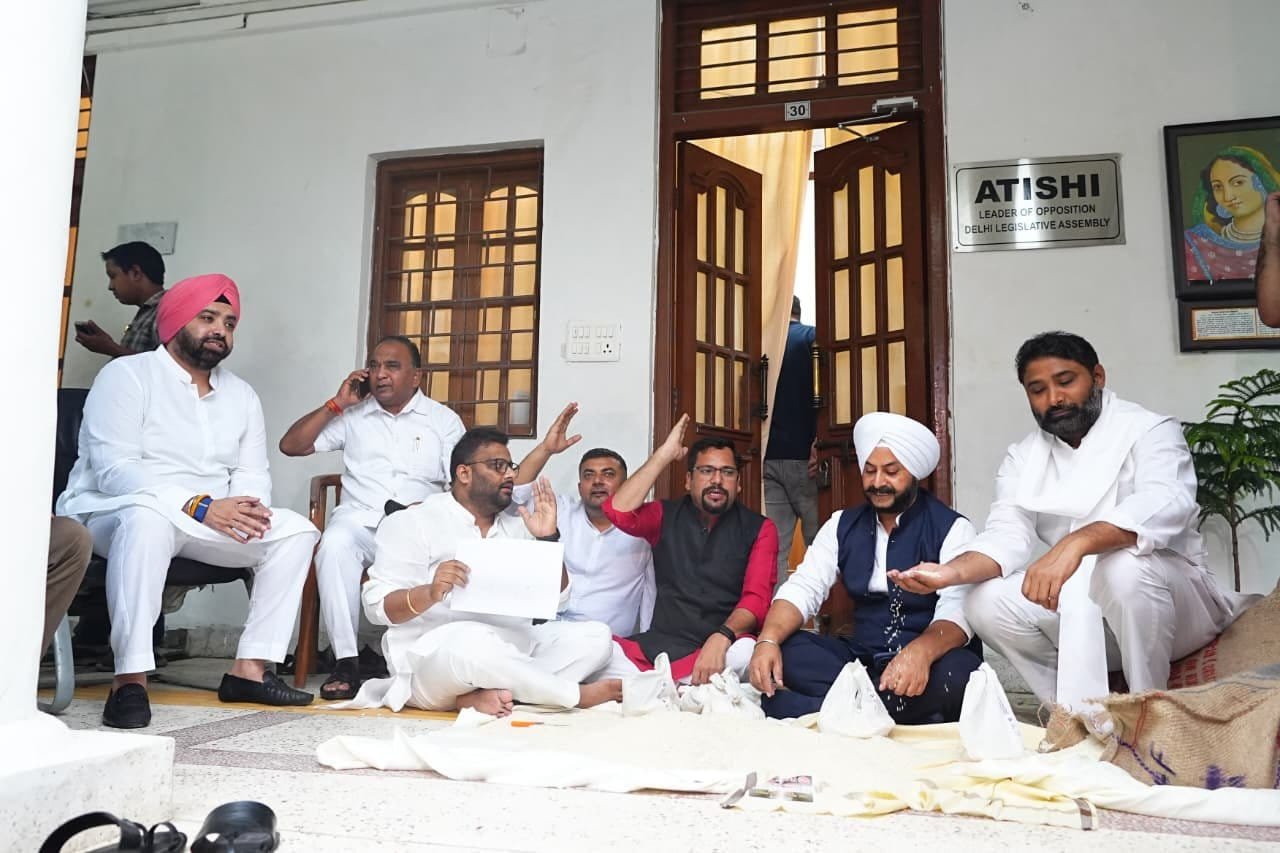
The Delhi Assembly witnessed a political protest on August 11, 2026, as Aam Aadmi Party (AAP) legislators staged a symbolic demonstration by setting up a “rice shop” inside the Assembly premises over allegations concerning the distribution of subsidised rice meant for poor and migrant families.
The AAP demanded the dismissal of Delhi Food and Civil Supplies Minister Manjinder Singh Sirsa, alleging serious irregularities in the procurement and distribution process. The party has alleged that subsidised rice intended for beneficiaries in Delhi was diverted and sold in the open market in Haryana.
The allegations have become another point of confrontation between the Delhi government and the opposition. The claims made by AAP leaders, however, remain allegations and would require verification through an official investigation and due process.
Table of Contents
The protest also disrupted proceedings in the Delhi Assembly. According to The Times of India, eight opposition MLAs were marshalled out of the House after seeking an urgent discussion on alleged irregularities involving subsidised foodgrain distribution.
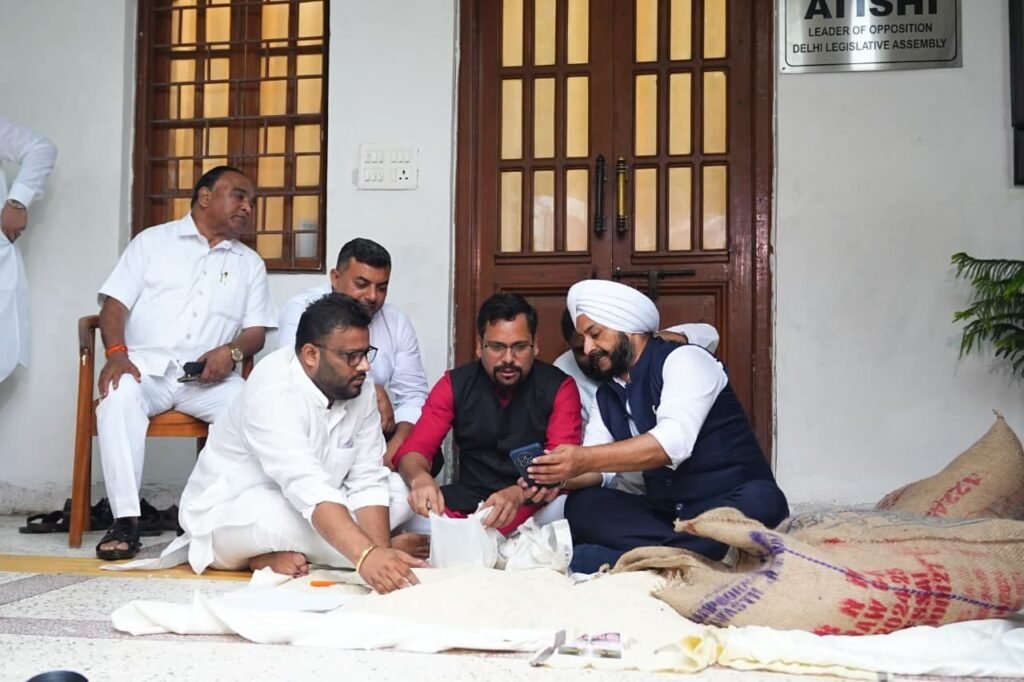
AAP Stages ‘Rice Shop’ Protest Inside Assembly
The AAP legislators used an unusual “rice shop” protest to draw attention to the alleged rice distribution irregularities.
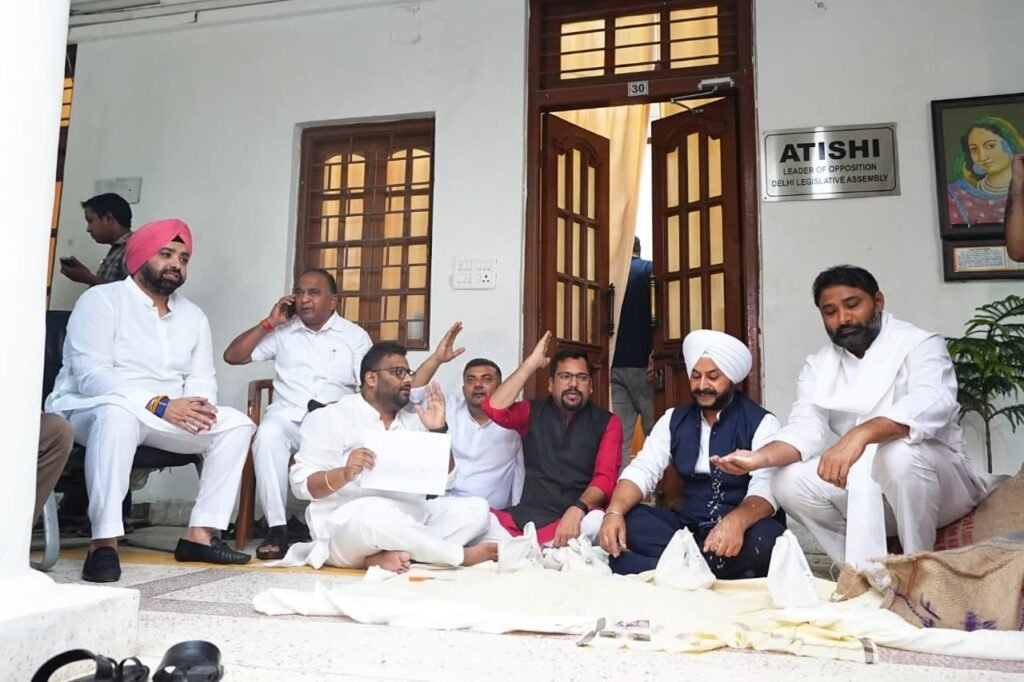
A symbolic “rice shop” was set up on the Assembly premises, with party leaders using the demonstration to highlight their claim that foodgrain meant for economically vulnerable families had been diverted for private commercial gain.
The “rice shop” was designed as a symbolic representation of the rice that AAP leaders alleged should have reached poor and migrant families.
The protest was led by opposition legislators, who demanded answers from the Delhi government and called for action against Minister Manjinder Singh Sirsa.
AAP Delhi unit president Saurabh Bharadwaj alleged that the Food and Civil Supplies Department had recommended that subsidised rice from the Food Corporation of India (FCI) be supplied to a corporation based in Assam for distribution among poor and migrant residents of Delhi.
According to Bharadwaj, the rice was subsequently sold to a private company in Haryana instead of being distributed to the intended beneficiaries.
These claims form the basis of the AAP’s political attack on the Delhi government. The government or the minister concerned would need to respond to the allegations and any investigation would determine whether wrongdoing occurred.
What the “Rice Shop” Protest Says About the Subsidised Rice Row
At the centre of “rice shop” protest is the controversy is subsidised foodgrain that was reportedly intended for vulnerable sections of the population.
AAP leaders claim that the rice was procured through a government-supported system at subsidised rates and was meant to reach poor and migrant families who may not have conventional documentation such as ration cards or Aadhaar cards.
The “rice shop” demonstration was intended to highlight the opposition’s concerns about how the subsidised rice was allegedly handled.
Bharadwaj alleged that the foodgrain was instead diverted towards a private company in Haryana.
The opposition has described the alleged diversion as a serious issue because subsidised foodgrain is intended to serve a public welfare purpose rather than generate private profits.
The controversy therefore raises broader questions about the movement of subsidised foodgrains, the role of government departments and corporations, and the monitoring mechanisms in place to ensure that welfare supplies reach their intended recipients.
AAP Claims ₹22,000-Crore Irregularity
AAP MLA Sanjeev Jha alleged that irregularities involving the rice distribution system could amount to approximately ₹22,000 crore.
Jha claimed that around 31,000 metric tonnes of rice were being procured every week and alleged that the stock was subsequently being sold in Haryana’s open market.
He further claimed that this represented a potential financial irregularity of around ₹500 crore per week.
These figures were presented by AAP leaders during the protest and should be treated as political allegations rather than established findings unless confirmed by an official investigation, audit or competent authority.
The scale of the figure has nevertheless intensified the political debate surrounding the “rice shop” protest, with the opposition demanding a detailed examination of how the rice was procured, transported, allocated and ultimately distributed.
Demand for Minister Manjinder Singh Sirsa’s Dismissal
A major demand raised during the “rice shop” protest was the dismissal of Food and Civil Supplies Minister Manjinder Singh Sirsa.
AAP leaders argued that responsibility should be fixed at the ministerial level if irregularities occurred within the department.
Sanjeev Jha said the opposition would continue to raise the issue both inside and outside the Assembly until the government provides answers.
AAP MLA Kuldeep Kumar also questioned why action against the minister had not been taken, while referring to the reported suspension of Additional Commissioner Arun Jha in connection with the matter.
Kumar asked why, if an official had faced disciplinary action, the minister should not also face scrutiny.
However, administrative responsibility and criminal or financial liability are separate questions. Any action against a minister would need to follow applicable rules and the findings of an appropriate inquiry.
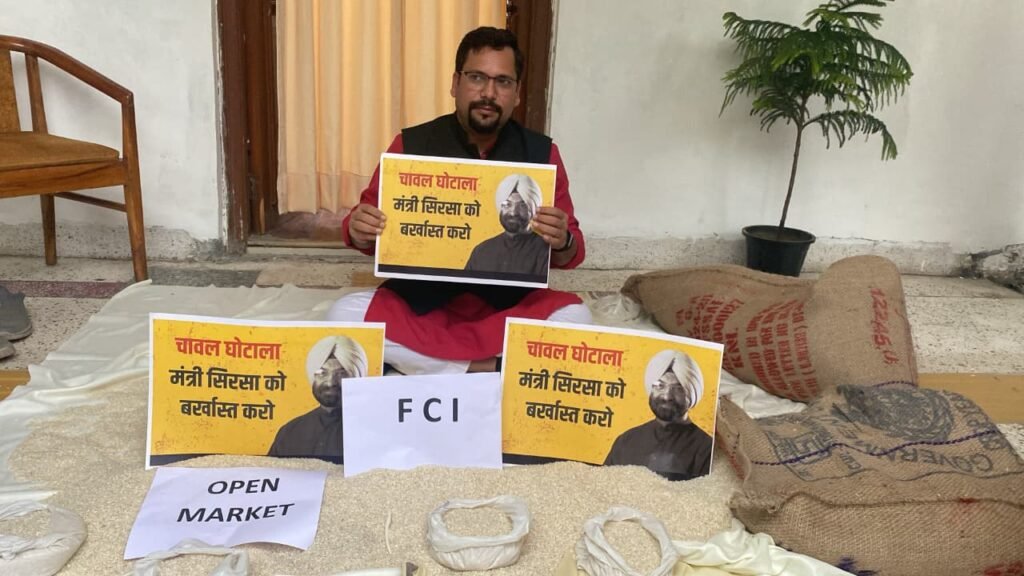
Questions Over the Role of FCI and Assam Corporation
The allegations also bring the role of several organisations into focus.
The Food Corporation of India, or FCI, is a central government organisation responsible for major functions related to the procurement, storage, movement and distribution of foodgrains.
According to the allegations highlighted through the “rice shop” demonstration, the Delhi department had requested that subsidised rice be provided through a corporation based in Assam for distribution among poor people in Delhi.
The opposition claims that the rice was subsequently sold to private traders in Haryana.
This raises several questions that would need to be answered through documentary records and official investigation, including:
- Who authorised the allocation of the rice?
- What was the intended distribution mechanism?
- Who took possession of the foodgrain?
- Where was the rice transported?
- Who authorised its sale?
- At what price was it sold?
- Who received the proceeds?
- Were government rules and procurement conditions followed?
Answering these questions would be important for establishing whether the allegations have substance and whether any rules were violated.
Kuldeep Kumar Questions Action Against Officials
AAP’s Kondli MLA Kuldeep Kumar said the rice was meant for poor families and migrant workers.
He alleged that the rice, obtained at subsidised rates, was subsequently sold in Haryana’s open market at a higher price.
Kumar also referred to action reportedly taken against Additional Commissioner Arun Jha and questioned whether similar scrutiny should extend to the political leadership.
The AAP has used the “rice shop” demonstration to strengthen its demand for the minister’s dismissal.
However, whether a minister is accountable for an alleged administrative irregularity depends on the specific findings of an inquiry, the chain of responsibility and the applicable legal and administrative framework.
Special Ravi Says Poor Were Denied Subsidised Food
Karol Bagh MLA Vishesh Ravi also participated in the opposition’s criticism of the government.
The “rice shop” protest was also used to draw attention to the alleged impact on poor households.
Ravi alleged that subsidised rice brought for distribution among poor residents of Delhi was instead sold to private traders.
He described the alleged diversion as another example of what the AAP calls corruption under the BJP-led Delhi government.
The MLA also demanded that the matter be discussed in the Assembly so that the public can receive details about the movement and distribution of the foodgrain.
Assembly Proceedings Become Another Flashpoint
The rice controversy unfolded against a wider political dispute inside the Delhi Assembly.
The opposition has accused the government of avoiding discussion on issues it considers important to the public.
Sanjeev Jha alleged that valuable Assembly time was being spent praising the government instead of discussing matters such as alleged irregularities in medicine, bicycles and rice distribution.
The “rice shop” protest therefore became part of a broader confrontation.
over the role of the opposition and the functioning of the House.
The Times of India reported that eight opposition MLAs were marshalled out of the Assembly after demanding an urgent discussion on alleged irregularities involving subsidised foodgrain.
Why Subsidised Rice Matters
Through the “rice shop” demonstration, AAP legislators sought to connect the political allegations with concerns about food security.
Subsidised foodgrain programmes are designed to ensure that vulnerable households can access essential food at affordable rates.
For poor families, the availability of subsidised rice can have a direct impact on household food security.
This makes allegations of diversion particularly sensitive.
If foodgrain intended for beneficiaries is improperly diverted, it could potentially affect both public finances and the people who were supposed to receive the benefit.
At the same time, allegations involving large sums of money should be established through evidence rather than political claims alone.
What an Investigation Would Need to Establish
A proper investigation would need to examine the complete chain of the alleged transaction.
This could include government correspondence, FCI allocation records, transport documents, warehouse records, purchase and sale invoices, payment records and details of the organisations involved.
Investigators would also need to determine whether the rice was legally transferred, whether the receiving corporation was authorised to handle it, and whether any subsequent sale complied with applicable regulations.
The investigation would also need to establish whether any government officials or private entities benefited improperly.
Until such questions are answered through competent authorities, the allegations remain part of the ongoing political dispute.
AAP Promises to Continue Raising the Issue
The AAP has said that it will continue to raise the matter inside the Assembly as well as outside it.
The party’s central demand is greater transparency regarding the alleged diversion of subsidised rice and accountability for those responsible if wrongdoing is established.
The symbolic rice shop was intended to make the issue more visible and connect the alleged administrative irregularities with their potential impact on ordinary families.
The protest also demonstrates how food distribution and welfare schemes can become major political issues when questions arise about their implementation.
What Happens Next?
The next stage of the controversy is likely to depend on the response from the Delhi government and the relevant authorities.
The government will face pressure to clarify the allegations regarding the procurement, allocation and distribution of the rice.
The opposition, meanwhile, is expected to continue demanding a discussion in the Assembly and action against those it believes should be held responsible.
If an official inquiry is conducted, its findings could provide clarity on whether the alleged diversion occurred, how much rice was involved and whether public funds or subsidised foodgrain were misused.
The Delhi rice distribution controversy has emerged as a fresh political flashpoint between the AAP and the BJP-led Delhi government.
The AAP’s decision to stage a symbolic “rice shop” protest inside the Assembly was aimed at highlighting allegations that subsidised rice meant for poor and migrant families was diverted and sold in Haryana’s open market.
AAP leaders, including Saurabh Bharadwaj, Sanjeev Jha, Kuldeep Kumar and Vishesh Ravi, have demanded action against Food and Civil Supplies Minister Manjinder Singh Sirsa and called for a detailed discussion of the matter.
The opposition has also raised allegations involving approximately 31,000 metric tonnes of rice and claimed that the potential irregularities could involve ₹22,000 crore. These figures and allegations have not been established as facts and require verification through official investigation and due process.
The “rice shop” protest has also kept the focus on questions surrounding transparency, accountability and the distribution of subsidised foodgrain, accountability within government departments and the functioning of the Delhi Assembly. Ultimately, a clear documentary record and an impartial inquiry will be crucial in determining what happened to the rice and whether any rules were violated.