
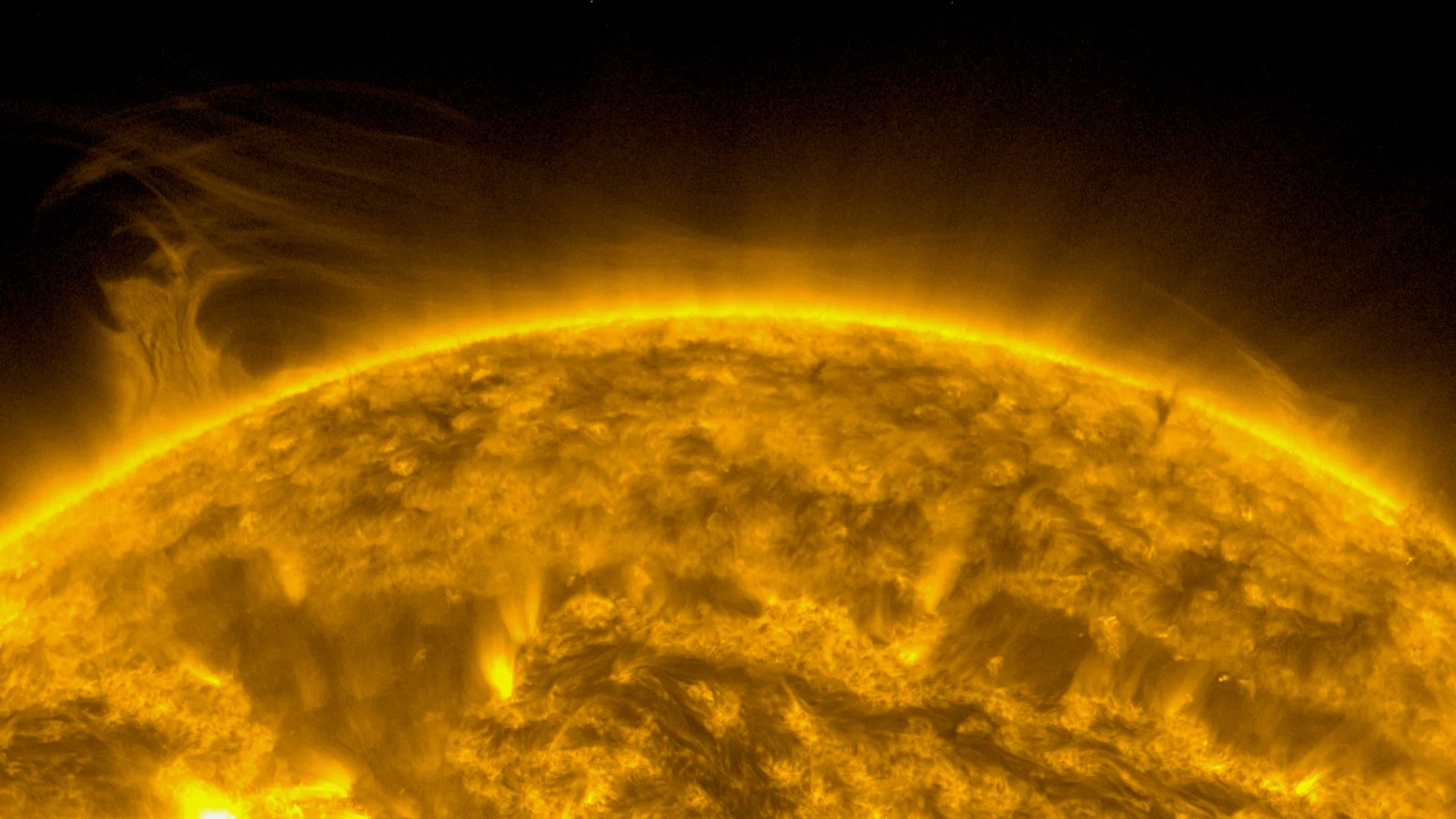
Washington: Astronomers have captured the highest-resolution images ever taken of the Sun’s visible surface, revealing spectacular swirling vortex-like patterns in superheated solar plasma that scientists say could transform our understanding of how the Sun generates powerful eruptions and transfers energy through its atmosphere.
The unprecedented observations were made using the U.S. National Science Foundation’s Daniel K. Inouye Solar Telescope in Hawaii, the world’s most powerful solar telescope. The findings, published in the prestigious journal Nature, provide the first direct evidence of a physical phenomenon known as Kelvin-Helmholtz Instability (KHI) occurring on the surface of a star.
Researchers describe the discovery as a landmark achievement in modern solar physics, offering new insights into the processes that trigger solar flares, coronal mass ejections, and other explosive events capable of affecting satellites, GPS navigation, communication systems, and power grids on Earth.
Table of Contents
Highest-Resolution View Yet of the Sun’s Surface
The observations focused on a small section of the Sun’s photosphere, the thin visible layer from which sunlight escapes into space. Although the photosphere is only about 100 kilometres (60 miles) thick compared to the Sun’s overall diameter of approximately 1.4 million kilometres (865,000 miles), it is one of the most dynamic regions of the solar atmosphere.
Using cutting-edge optical technology, astronomers recorded extraordinary still images and time-lapse sequences showing countless rotating structures forming, growing, interacting, and disappearing across the solar surface.
These whirlpool-like formations consist of extremely hot plasma—gas heated to temperatures exceeding 5,500 degrees Celsius (around 10,000 degrees Fahrenheit)—where electrons separate from atoms, creating an electrically charged fluid strongly influenced by magnetic fields.
The observed vortices ranged from approximately 19 kilometres (12 miles) in diameter—the smallest structures the telescope can currently detect—to nearly 170 kilometres (100 miles) across.
Scientists Identify Kelvin-Helmholtz Instability on a Star
One of the most remarkable aspects of the discovery is that the swirling structures are not random turbulent motions.
Researchers identified them as the first confirmed observation of Kelvin-Helmholtz Instability (KHI) occurring directly on the surface of a star.
The phenomenon was first described mathematically during the nineteenth century by physicists Lord Kelvin and Hermann von Helmholtz.
KHI develops when two layers of fluids or gases move alongside one another at different speeds. The velocity difference creates an unstable boundary where wave-like curls begin to form, eventually rolling into characteristic vortex structures before breaking apart.
According to study co-lead author Friedrich Wöger, Senior Scientist at the National Science Foundation’s National Solar Observatory and Instrument Program Scientist for the Daniel K. Inouye Solar Telescope, the process resembles waves forming on lakes or oceans during windy conditions.
“The interface can become unstable and develop wave-like vortices that grow in size until they break apart,” Wöger explained.
Similar Phenomena Seen on Earth and Giant Planets
Although Kelvin-Helmholtz Instability is rarely observed on Earth, it is a recognised atmospheric phenomenon.
It occasionally produces dramatic cloud formations that appear as evenly spaced curling waves in the sky.
Scientists have also previously observed similar instability in the atmospheres of Jupiter and Saturn, where massive atmospheric flows interact.
However, the newly detected solar version differs significantly because the interacting fluids are not ordinary gases but intensely hot plasma moving through powerful magnetic fields.
The combination of high temperatures, ionised particles, and magnetic forces creates conditions unlike those found in Earth’s atmosphere.
Researchers say these magnetic interactions make the instability especially important for understanding solar activity.
Magnetic Fields Hold the Key
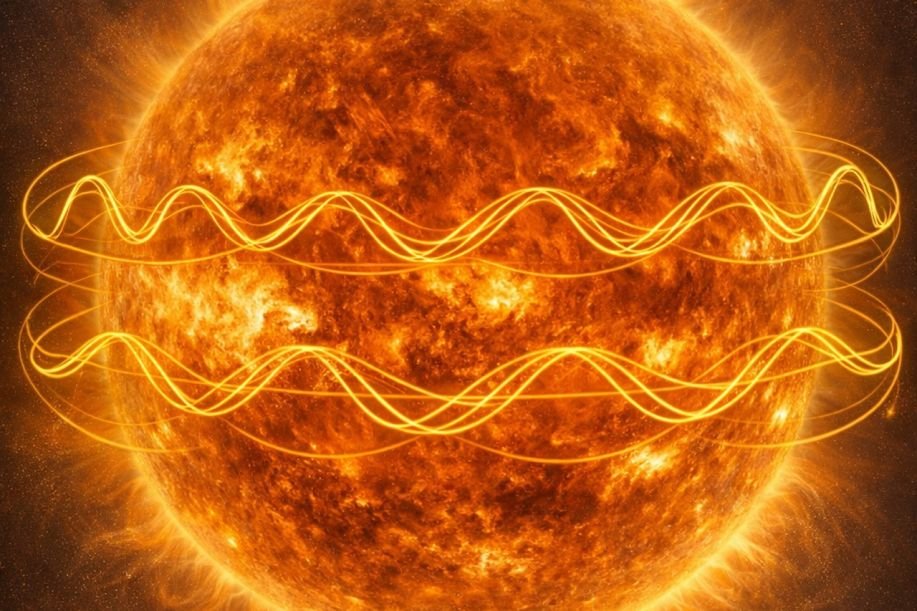
Unlike ordinary fluid turbulence, the Sun’s plasma constantly interacts with magnetic field lines generated by the movement of electrically charged particles.
Scientists believe Kelvin-Helmholtz Instability twists and stretches these magnetic fields, gradually storing enormous amounts of magnetic energy.
As the energy accumulates, it can suddenly be released in the form of violent solar explosions.
This process may explain one of the biggest unanswered questions in solar physics: how energy is transported from the Sun’s surface into its outer atmosphere, known as the corona.
Discovery Could Explain Solar Flares and Coronal Mass Ejections
The research may significantly improve scientific understanding of some of the Sun’s most powerful eruptions.
According to co-lead author David Kuridze of the National Solar Observatory, the continuous twisting motions generated by KHI may slowly build sufficient magnetic energy to trigger solar flares and coronal mass ejections (CMEs).
Solar flares are enormous explosions that release vast amounts of electromagnetic radiation, high-energy particles, and intense bursts of light into space.
Coronal mass ejections involve gigantic clouds of magnetised plasma being hurled away from the Sun at millions of kilometres per hour.
When directed toward Earth, these events can produce geomagnetic storms capable of disrupting satellite operations, radio communications, navigation systems, aviation routes, and electricity transmission networks.
Understanding the physical mechanisms behind these eruptions is therefore essential not only for astronomy but also for protecting modern technological infrastructure.
Researchers Call It a “Game-Changer”
Scientists involved in the project believe the findings represent one of the most significant advances in recent solar research.
Wöger described the detection of solar Kelvin-Helmholtz Instability as “a true game-changer,” saying it provides an entirely new framework for understanding how the Sun energises its atmosphere.
Kuridze added that the Sun is an extremely dynamic star characterised by continuous magnetic explosions occurring on multiple scales.
Determining exactly how these explosive events begin has remained one of the major frontiers in modern astrophysics.
The newly observed instability may provide an important missing piece of that puzzle.
Implications Beyond the Sun
Although the research focuses on our own star, its significance extends far beyond the Solar System.
Because many stars possess magnetic fields and hot plasma atmospheres, similar instability may occur throughout the universe.
The findings could therefore help astronomers better understand stellar behaviour, magnetic activity, and energy transport in numerous types of stars.
Improved knowledge of plasma dynamics may also contribute to research in astrophysics, fusion energy, and space weather forecasting.
A Telescope Built for Solar Exploration
The observations were made using the Daniel K. Inouye Solar Telescope, located atop Haleakalā volcano in Hawaii.
Operated by the National Solar Observatory, the facility is regarded as the world’s most advanced ground-based solar observatory.
Its enormous 4-metre primary mirror allows scientists to observe structures on the Sun at unprecedented resolution.
The telescope has already produced several groundbreaking discoveries since becoming operational and continues to provide detailed views of solar processes previously beyond scientific reach.
Researchers expect future observations using the telescope will reveal even more about the complex interactions between plasma, magnetic fields, and solar energy.
Science Meets Art
Beyond their scientific importance, the images have captured widespread attention for their remarkable beauty.
The swirling plasma patterns bear a striking resemblance to the dramatic sky painted by Dutch artist Vincent van Gogh in his famous 1889 masterpiece “The Starry Night.”
Researchers noted that artists have intuitively represented similar fluid patterns long before science could observe them directly.
Kuridze pointed out another artistic parallel with Katsushika Hokusai’s iconic woodblock print “The Great Wave off Kanagawa,” whose curling wave crests closely resemble the characteristic billows produced by Kelvin-Helmholtz Instability.
According to the researchers, these similarities demonstrate how the fundamental geometry governing natural processes often appears in artistic expression.
Wöger described the newly captured solar images simply as “magnificent.”
A New Era in Solar Physics
The discovery marks a major milestone in humanity’s effort to understand the nearest star to Earth.
For decades, scientists have sought to explain how magnetic energy builds up and is suddenly released through solar eruptions. Directly observing Kelvin-Helmholtz Instability on the Sun’s surface provides compelling evidence that these vortex structures play a central role in transferring and storing energy.
As further observations are conducted using next-generation instruments such as the Daniel K. Inouye Solar Telescope, researchers expect to uncover additional details about the Sun’s magnetic behaviour, ultimately improving forecasts of space weather that can affect life and technology on Earth.
The findings not only deepen scientific understanding of stellar physics but also highlight the extraordinary complexity and beauty of the dynamic processes occurring continuously on the surface of our nearest star.