Political tensions remained high in the national capital on Tuesday after Delhi Police released Leader of Opposition Rahul Gandhi, Congress MP Priyanka Gandhi Vadra, and several other Opposition leaders who had earlier been detained during a sit-in protest outside Prime Minister Narendra Modi’s official residence at Lok Kalyan Marg. The protest, organised by the Congress on the second day of the Monsoon Session of Parliament, was held over the alleged NEET paper leak, reported police action against student protesters, and the demand for the resignation of Union Education Minister Dharmendra Pradhan.
The developments witnessed several rounds of discussions between Congress leaders and the government, repeated appeals by the police to end the protest, the detention of senior Opposition leaders, and sharp political reactions from both the ruling Bharatiya Janata Party (BJP) and the Congress.
Table of Contents
While the Congress accused the government of refusing to take responsibility for issues affecting students and alleged examination irregularities, the BJP criticised the protest, calling it an act of anarchy in one of the country’s most sensitive security zones.
Delhi Police Release Detained Congress Leaders
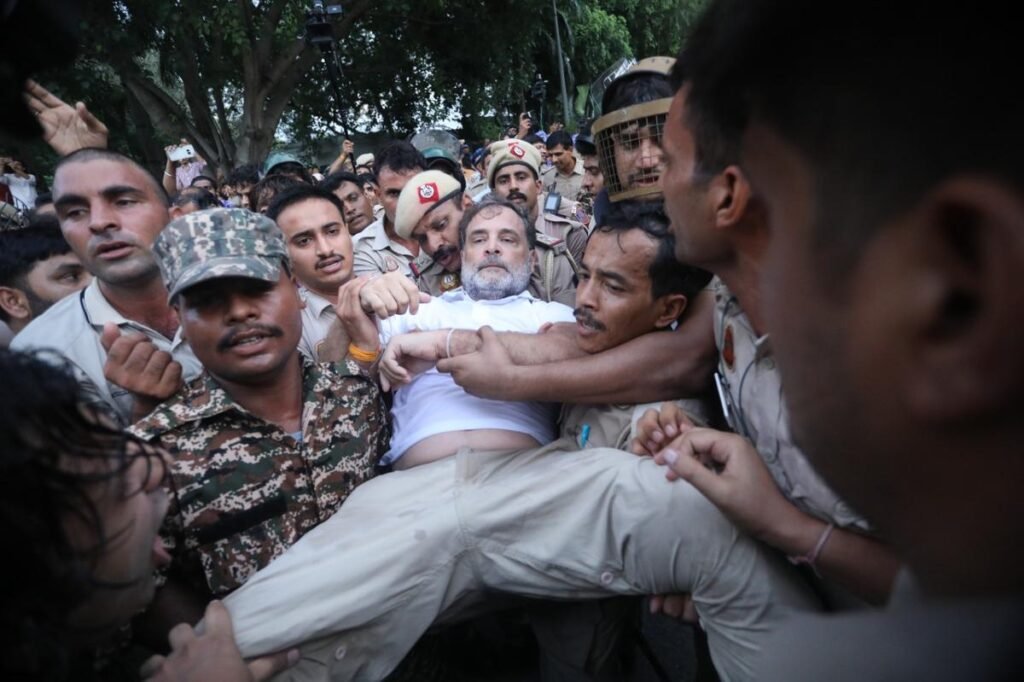
After several hours of detention, Delhi Police released Rahul Gandhi, Priyanka Gandhi Vadra, and other Congress leaders who had been taken into custody during the protest near the Prime Minister’s residence.
Police also began releasing other detained leaders who had participated in the demonstration.
According to officials, all Congress leaders were booked under Section 65 of the Delhi Police Act before being released later in the day.
The detentions came after the protest continued for several hours despite repeated appeals by authorities to vacate the high-security area.
The release of the leaders marked the end of the day’s police action, although the political confrontation between the government and the Opposition continued.
Congress Protest Focused on NEET and Student Issues
The Congress organised the protest to highlight concerns surrounding the alleged NEET paper leak, police action against student demonstrators, and what it described as failures in the country’s examination system.
Before staging the sit-in, Congress leaders marched from the residence of Congress President Mallikarjun Kharge towards the Prime Minister’s residence.
The demonstration was led by Rahul Gandhi, Priyanka Gandhi Vadra, Mallikarjun Kharge, and several senior Members of Parliament.
The party reiterated its demand for the resignation of Union Education Minister Dharmendra Pradhan and sought a discussion on the examination issue inside Parliament.
Rahul Gandhi Says Students Deserve Answers
During the protest, Rahul Gandhi said the march towards the Prime Minister’s residence was intended to seek answers regarding the reported police action against students during the previous day’s demonstrations.
He alleged that the government neither wanted to accept responsibility nor permit a discussion on the issue in Parliament.
Speaking to the media, Rahul Gandhi claimed that students across the country believed their future was at risk while ministers were more concerned about protecting their positions.
According to him, a situation in which students lose faith in their future while political leaders avoid accountability raises serious questions about justice.
He maintained that the concerns raised by students should be debated inside Parliament.
Government Initiates Dialogue Through Jitendra Singh
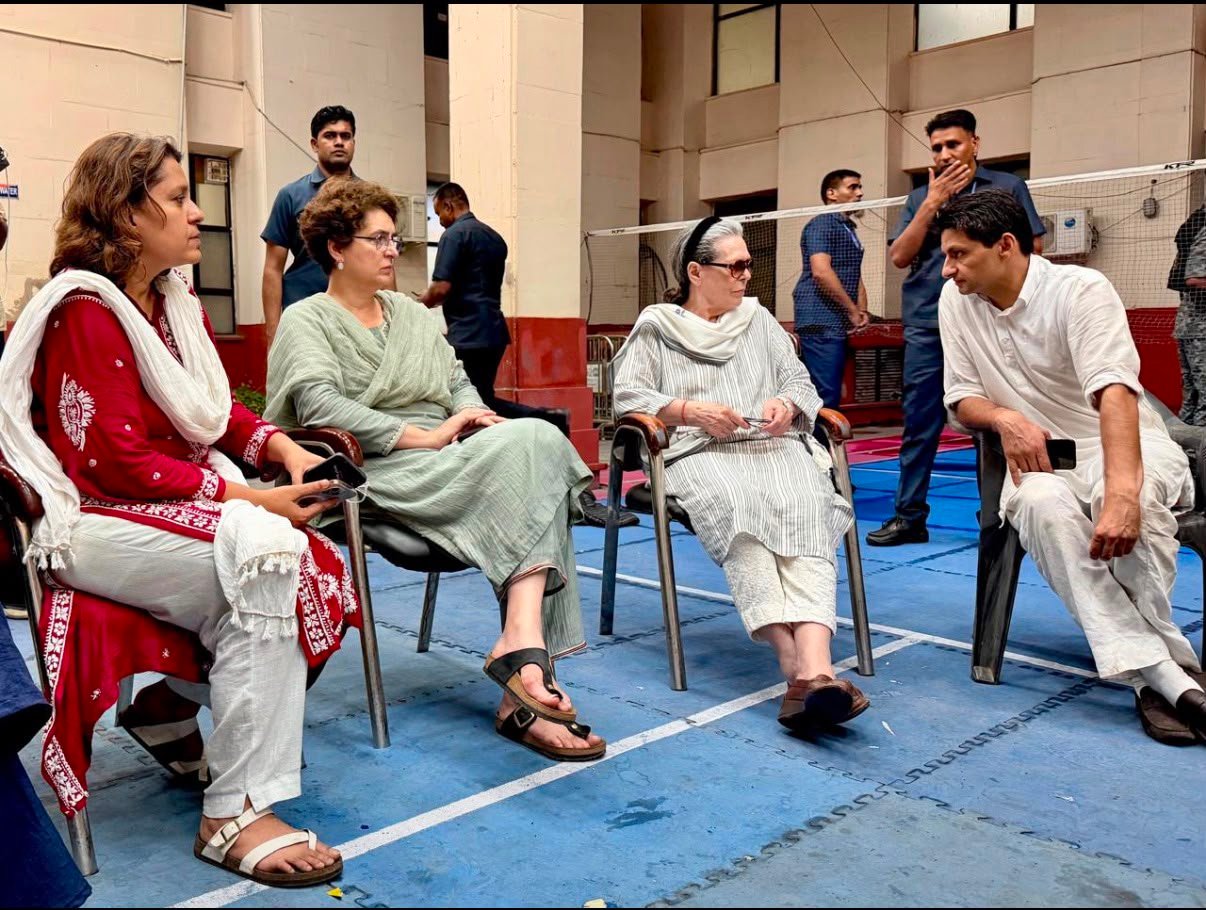
As the protest continued outside Lok Kalyan Marg, Union Minister of State in the Prime Minister’s Office, Dr Jitendra Singh, arrived at the protest site to initiate discussions with Rahul Gandhi.
The minister held a conversation with Rahul Gandhi that lasted for around thirty minutes.
According to government sources, the discussion focused on the Congress party’s demands relating to the alleged paper leak controversy and the proposed parliamentary discussion on the issue.
After the initial meeting, Jitendra Singh left the protest site and later met Union Home Minister Amit Shah to brief him on the developments.
He subsequently returned to continue discussions with Rahul Gandhi.
Home Secretary Also Joins Discussions
Senior government officials also reached the protest site during the negotiations.
Among them was Union Home Secretary Govind Mohan, who joined Jitendra Singh in attempting to persuade Rahul Gandhi and other Congress leaders to end the sit-in.
Government representatives continued discussions with the Congress leadership while the protest remained underway for more than two hours.
Officials appealed to the protesters to resolve the matter through dialogue instead of continuing the demonstration in a high-security area.
Despite these efforts, the protest continued as both sides remained firm on their respective positions.
Government Offers Parliamentary Discussion
Following consultations with the government’s senior leadership, Jitendra Singh informed Rahul Gandhi that the government was prepared to hold a discussion in Parliament regarding the alleged NEET paper leak and related examination issues.
According to the minister, Rahul Gandhi had earlier indicated that such an assurance could help resolve the immediate protest.
Jitendra Singh later stated through a post on social media that the government had accepted Rahul Gandhi’s demand for a parliamentary discussion.
However, he alleged that Rahul Gandhi subsequently insisted on securing the resignation of Union Education Minister Dharmendra Pradhan before ending the protest.
The minister described the change in demands as the principal reason why discussions failed to produce an agreement.
Rahul Gandhi Stands Firm on Minister’s Resignation
According to the Congress, discussion alone would not be sufficient without political accountability.
Rahul Gandhi continued demanding the resignation of the Union Education Minister while insisting that issues concerning examination irregularities deserved responsibility at the highest level.
The Congress maintained that repeated controversies relating to competitive examinations had undermined public confidence and required decisive action.
The disagreement over this demand ultimately prevented both sides from reaching a settlement during the negotiations.
Police Remove Protesters After Several Hours
As the protest continued for nearly three hours, Delhi Police initiated action to clear the demonstration site.
Police personnel detained Rahul Gandhi, Priyanka Gandhi Vadra, Akhilesh Yadav, and several other Opposition leaders before moving them away from the area in police buses.
The removal of protesters came after repeated attempts by authorities to persuade them to disperse voluntarily.
Police stated that the protest site was located in an extremely sensitive security zone where prolonged demonstrations could not be permitted.
Authorities also cited public inconvenience as one of the reasons for removing the protesters.
Congress Leaders Taken Into Custody
Several Congress leaders, including Sukhjinder Singh Randhawa and Charanjit Singh Channi, were also taken into custody during the operation.
Earlier during the protest, Congress leaders had symbolically handcuffed themselves to demonstrate what they described as suppression of democratic voices.
Police deployed multiple buses near the protest site while carrying out the detentions.
Several senior leaders accompanied Rahul Gandhi during the operation before later being released.
Sonia Gandhi Visits Police Station
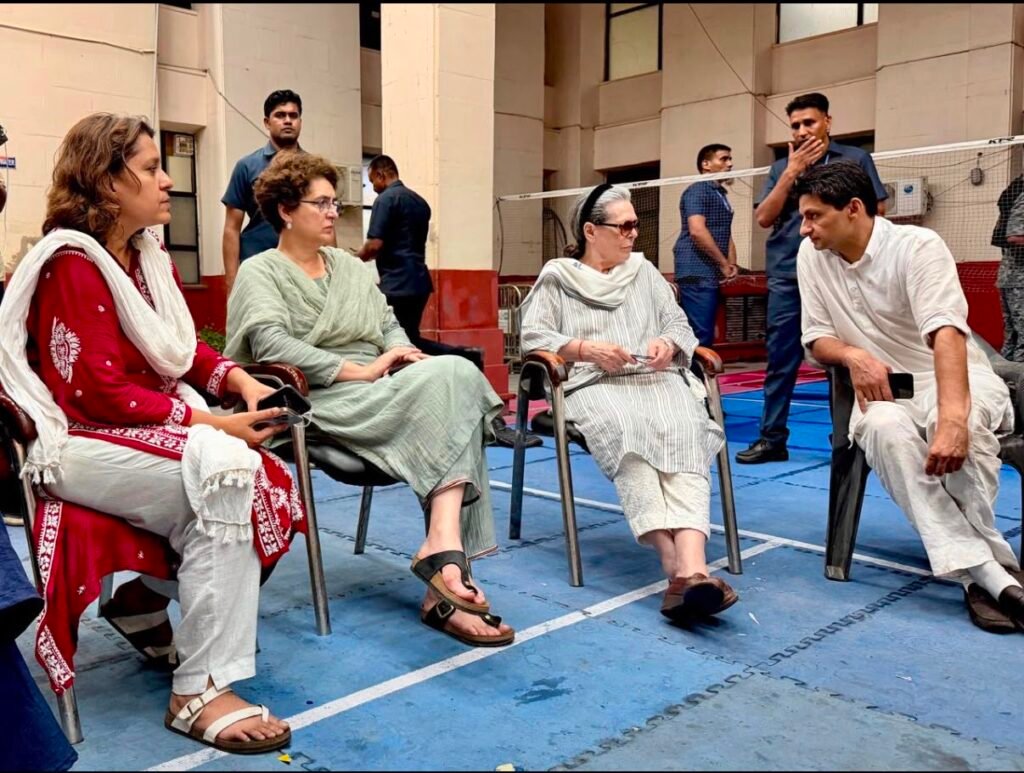
Congress Parliamentary Party Chairperson Sonia Gandhi later reached Mandir Marg Police Station, where reports indicated that Priyanka Gandhi Vadra had been taken following her detention.
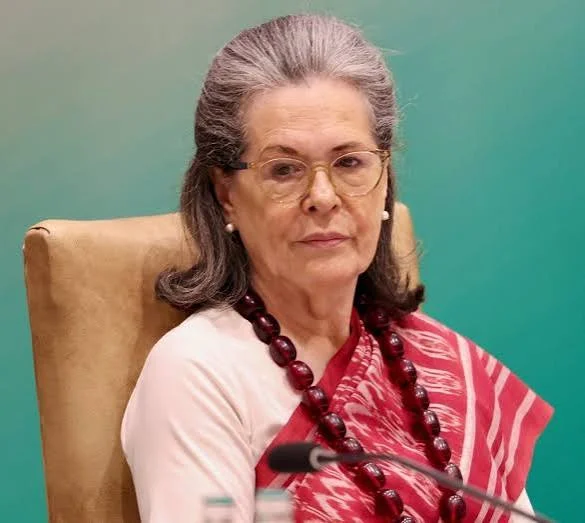
Her visit drew further political attention as senior Congress leaders monitored developments surrounding the detained protesters.
The party continued coordinating with its leaders while police completed procedural formalities before releasing them.
BJP President Nitin Naveen Criticises Protest
Reacting to the demonstration, BJP national president Nitin Naveen strongly criticised the Congress.
He described the protest near the Prime Minister’s residence as an act of anarchy rather than a legitimate democratic demonstration.
According to Naveen, staging such a protest in a high-security area represented irresponsible political conduct.
He also described the day’s developments as a “black day in history.”
His remarks reflected the BJP’s position that security considerations around the Prime Minister’s residence must remain paramount.
Clash Between Police and Congress Workers
During the protest, reports emerged of a scuffle between Congress workers and police personnel stationed near the protest site.
Police attempted to remove demonstrators while Congress workers continued raising slogans.
The confrontation remained limited, although tensions increased as security personnel escorted protesters towards waiting police buses.
Authorities continued appealing to protesters to cooperate with law enforcement officials.
Rahul Gandhi Appeals to Citizens
Following his detention, Rahul Gandhi posted a message on social media asserting that the fight for justice for students would continue.
He stated that no amount of pressure would stop the movement seeking accountability over examination-related issues.
Earlier, he had appealed to citizens across the country to support the sit-in and stand in solidarity with students demanding justice.
Rahul Gandhi argued that an attack on students represented an attack on every Indian family and maintained that the voices of young people should not be ignored.
Rahul Gandhi Criticises Examination System
During the protest, Rahul Gandhi alleged that opportunities for young people had steadily declined.
He argued that the country’s competitive examination system had deteriorated and that students’ grievances extended beyond education to concerns about their future.
According to him, examination controversies had eroded confidence among students preparing for competitive recruitment and admission processes.
He called upon the government to acknowledge these concerns and address them through meaningful reforms.
Allegations Regarding Education System
Rahul Gandhi also alleged that students believed the education system had come under the influence of a few powerful interests.
He claimed that the issue extended far beyond individual examinations and involved broader questions relating to the future of India’s youth.
The Congress maintained that these concerns deserved a comprehensive debate inside Parliament rather than administrative action against protesters.
The government has consistently maintained that reforms and investigations are being carried out through established institutional mechanisms.
Political Debate Continues
The protest has further intensified political debate surrounding examination reforms, police action against demonstrators, and parliamentary accountability.
While the Congress continues demanding political responsibility and the resignation of the Education Minister, the government has reiterated its willingness to discuss the issue in Parliament.
The contrasting positions adopted by both sides suggest that the controversy is likely to remain a major issue during the ongoing Monsoon Session.
Political observers believe further discussions inside Parliament may shape the future course of the debate.
The release of Rahul Gandhi, Priyanka Gandhi Vadra, and other detained Opposition leaders brought an end to a day marked by protests, negotiations, detentions, and sharp political exchanges in the national capital. While the Congress remains firm on its demand for the resignation of Union Education Minister Dharmendra Pradhan and greater accountability over the alleged NEET paper leak, the government has maintained that it is prepared to discuss the issue in Parliament but has defended the police action taken near the Prime Minister’s residence. With both sides refusing to soften their positions, the controversy continues to dominate political discourse during the Monsoon Session, ensuring that examination reforms and student concerns remain central issues in the days ahead.