

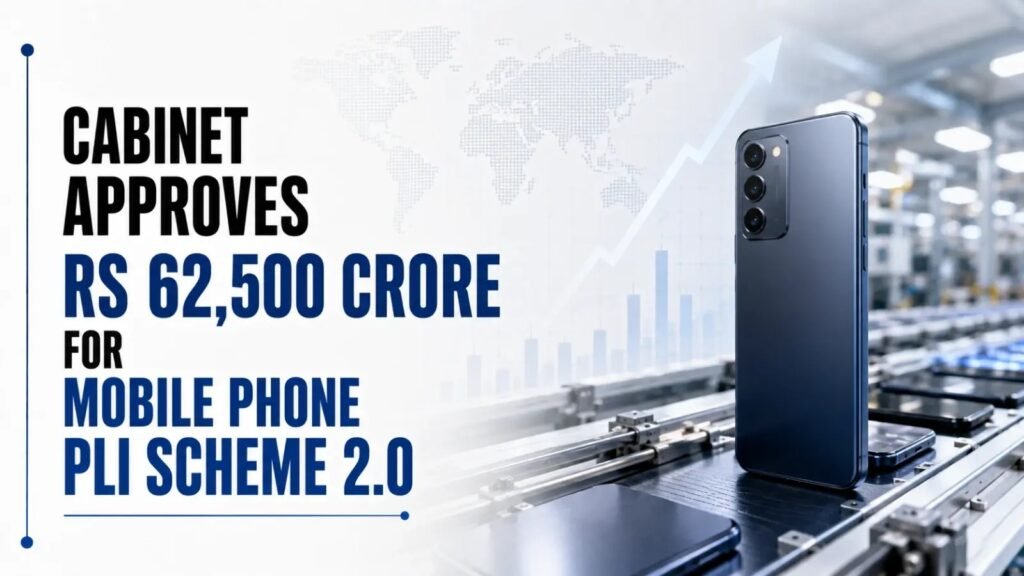
Manufacturing Scheme received a major push after the Union Cabinet, chaired by Prime Minister Narendra Modi, approved a new ₹62,500 crore Mobile Phone Manufacturing Scheme (MPMS). The ambitious initiative is designed to strengthen India’s position as a global manufacturing hub by expanding mobile phone production, increasing domestic value addition, encouraging innovation, and supporting the growth of Indian smartphone brands.
The new Manufacturing Scheme will be implemented over five financial years, from FY 2026-27 to FY 2030-31. It comes after the successful completion of the Production Linked Incentive (PLI) Scheme for Large Scale Electronics Manufacturing, which played a significant role in transforming India into one of the world’s largest mobile phone manufacturing destinations.
The government’s latest decision signals that India is now entering the next phase of electronics manufacturing, where the focus is no longer limited to assembling devices but extends to designing products, manufacturing critical components, developing intellectual property, and creating globally competitive Indian brands.
Table of Contents
Manufacturing Scheme aims to expand India’s electronics ecosystem
The primary objective of the Manufacturing Scheme is to make India a stronger and more self-reliant player in the global electronics industry. While India has already emerged as the world’s second-largest mobile phone manufacturer by volume, policymakers believe there is still enormous scope to increase domestic production of components and improve value addition.
The scheme has been structured to support manufacturers that produce mobile phones in India while encouraging companies to source more parts locally. This approach is expected to reduce dependence on imported components and strengthen the country’s electronics supply chain.
By encouraging greater localisation, the Manufacturing Scheme seeks to ensure that a larger share of every smartphone’s value is created within India rather than overseas. This would benefit component manufacturers, suppliers, logistics companies, and thousands of small and medium enterprises connected to the electronics sector.
Incentive structure designed to reward production and localisation
One of the most significant features of the Manufacturing Scheme is its carefully designed incentive mechanism.
Under the programme, eligible manufacturers will receive production-linked incentives ranging between 2.25 percent and 5 percent on qualifying mobile phone sales made from India. The exact incentive will depend on various eligibility conditions prescribed under the scheme.
To further promote domestic manufacturing, the government has introduced an additional incentive of up to 1.5 percent for companies that source key components and sub-assemblies from within the country. This provision directly encourages manufacturers to build stronger local supply chains rather than relying heavily on imports.
Another notable feature of the Manufacturing Scheme is the special support for innovation. Companies investing in product design, research and development (R&D), and intellectual property creation can receive an additional incentive of up to 3 percent on eligible sales.
This marks an important shift in India’s industrial policy, where incentives are no longer focused only on manufacturing output but also reward technological development and product innovation.
Strong focus on Indian mobile phone brands
Unlike earlier programmes that primarily attracted global manufacturers, the Manufacturing Scheme places considerable emphasis on nurturing Indian smartphone brands.
The government wants domestic companies to compete not only in the Indian market but also internationally by developing original designs, proprietary technologies, and globally recognised products.
Support for research, design, and intellectual property creation is expected to help Indian companies move beyond contract manufacturing and establish themselves as technology-driven enterprises.
Industry experts have long argued that while India has made remarkable progress in assembling smartphones, long-term competitiveness depends on creating indigenous technology and building strong domestic brands. The latest Manufacturing Scheme attempts to address this challenge by providing direct financial incentives linked to innovation.
Massive production target over the next five years
The government has set ambitious expectations for the Manufacturing Scheme.
During its implementation period, cumulative mobile phone production is projected to reach nearly ₹39 lakh crore. Such a production scale would further strengthen India’s role in global electronics manufacturing and significantly increase exports.
This projected growth reflects the rising global demand for smartphones as well as India’s improving manufacturing capabilities, expanding industrial infrastructure, and favourable policy environment.
The Manufacturing Scheme is expected to encourage both existing manufacturers and new investors to expand production facilities across different parts of the country.
Large manufacturing clusters in states such as Tamil Nadu, Uttar Pradesh, Karnataka, Andhra Pradesh, and Telangana are likely to benefit from additional investments under the scheme.
Employment generation remains a key objective
Apart from increasing production, employment creation is another major objective of the Manufacturing Scheme.
The government estimates that the initiative will generate around 60,000 direct jobs during its implementation period. These opportunities will span manufacturing, quality control, engineering, logistics, research, supply chain management, and technical support.
Indirect employment is also expected to rise as demand increases for packaging, transportation, warehousing, industrial services, electronic component manufacturing, and supporting industries.
The electronics manufacturing sector has already become one of India’s fastest-growing employment generators, particularly for young workers from rural and semi-urban areas.
Many large electronics manufacturing facilities now employ more than 5,000 workers at a single location, demonstrating the industry’s growing contribution to industrial employment.
Building on the success of Make in India
The Manufacturing Scheme represents the next chapter of the Make in India initiative launched by Prime Minister Narendra Modi.
Over the past decade, India’s electronics manufacturing sector has witnessed remarkable expansion.
According to government data, electronics manufacturing has increased seven-fold since FY 2014-15, while electronics exports have grown eleven-fold during the same period.
Several global smartphone manufacturers have shifted a significant portion of their production to India, supported by improved infrastructure, government incentives, skilled manpower, and expanding domestic demand.
The rapid growth has transformed India from a major importer of mobile phones into one of the world’s leading manufacturing centres.
Today, approximately 99.2 percent of the mobile phones used in India are manufactured domestically, highlighting the dramatic change in the country’s manufacturing landscape.
Smartphones become India’s leading export product
One of the strongest indicators of India’s manufacturing progress has been the rise of smartphone exports.
According to the government, smartphones became India’s largest export product category in 2025, overtaking traditional export leaders such as diesel fuel and cut diamonds.
This milestone reflects India’s growing integration into global supply chains and the increasing confidence of international companies in India’s manufacturing capabilities.
The Manufacturing Scheme is expected to further strengthen this trend by encouraging higher production volumes, greater localisation, and improved global competitiveness.
Higher exports also contribute positively to foreign exchange earnings while helping reduce the country’s dependence on imports in the electronics sector.
From assembly to advanced manufacturing
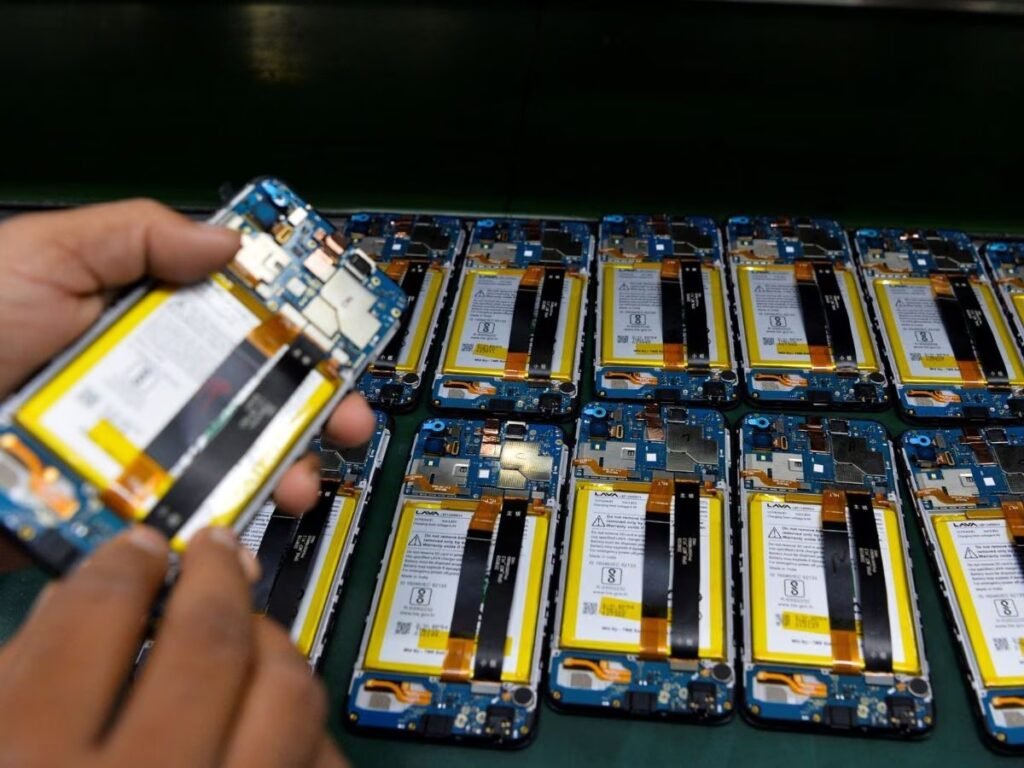
Industry observers believe India’s electronics sector is gradually moving from simple assembly operations towards more sophisticated manufacturing activities.
Earlier phases of growth were largely driven by assembling imported components. However, the new Manufacturing Scheme encourages domestic production of critical parts, advanced manufacturing processes, and research-driven product development.
This evolution is essential because higher domestic value addition allows the country to retain a greater share of economic benefits while reducing vulnerability to global supply chain disruptions.
Encouraging companies to manufacture components locally also strengthens supplier networks and creates opportunities for thousands of Indian businesses involved in electronics manufacturing.
Manufacturing Scheme to strengthen India’s global competitiveness
The recently approved Manufacturing Scheme is expected to improve India’s position in the highly competitive global electronics market.
Countries across Asia continue to compete aggressively for electronics investments through infrastructure development, tax incentives, and industrial policies. India’s latest initiative aims to ensure that it remains an attractive destination for global manufacturers while simultaneously building stronger domestic capabilities.
The emphasis on localisation, innovation, design, research, and Indian brands indicates that the country’s manufacturing strategy is evolving beyond production volumes alone.
As mobile phones continue to dominate India’s electronics exports and domestic manufacturing expands rapidly, the Manufacturing Scheme is expected to play a significant role in shaping the next phase of the country’s industrial growth, strengthening supply chains, increasing exports, supporting innovation, and creating a more competitive electronics manufacturing ecosystem.