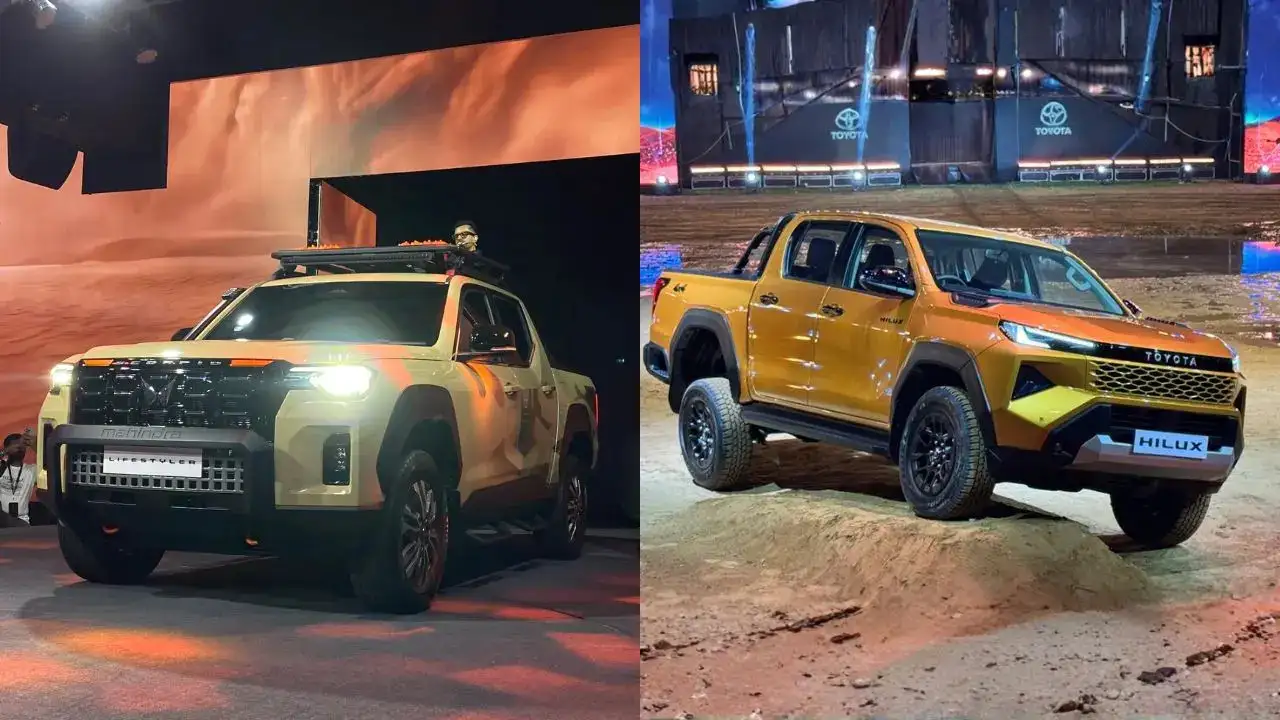
Rear disc brakes, automatic climate control and 18-inch alloy wheels give the Scorpio Lifestyler a clear equipment advantage over the India-spec Toyota Hilux
Toyota Hilux is set to face a new challenge in India’s lifestyle pickup truck market with the upcoming Mahindra Scorpio Lifestyler, a new dual-cab pickup positioned to compete with established rivals. The production-ready Scorpio Lifestyler has been unveiled ahead of its planned India launch in April 2027, with Mahindra targeting buyers looking for a combination of rugged capability, road presence and passenger-car-like features. Recent reports put its starting price below ₹19.79 lakh ex-showroom, while the truck is based on the Scorpio-N’s ladder-frame architecture.
The Toyota Hilux, meanwhile, has entered a new generation in India. Toyota launched the latest Hilux in July 2026 at a starting price of ₹31.99 lakh ex-showroom, with the refreshed pickup available in three automatic variants and deliveries beginning in August.
Both vehicles follow the traditional body-on-frame pickup formula, but they are taking somewhat different approaches to the lifestyle-pickup market. Toyota continues to emphasise the Hilux’s reputation for durability and off-road ability, while Mahindra is placing considerable emphasis on design, cabin equipment and everyday usability.
Here are three areas where the Scorpio Lifestyler is positioned to offer features that the India-spec Hilux does not.

Table of Contents
1. Rear Disc Brakes Give Scorpio Lifestyler a Different Braking Setup
One of the key hardware differences highlighted in the supplied comparison is the use of rear disc brakes on the Mahindra Scorpio Lifestyler.
The Toyota Hilux, in contrast, continues with rear drum brakes in its India-spec configuration, according to comparison reports on the new model.
The difference is significant because braking hardware is an important part of the overall driving characteristics of both the Mahindra Scorpio Lifestyler and Toyota Hilux.
Disc brakes generally offer more consistent heat management during repeated braking compared with conventional drum systems. That can become relevant when a vehicle is carrying passengers or cargo, travelling downhill or undergoing repeated hard braking.
For a lifestyle pickup, the braking system has to serve two purposes. It needs to provide confidence during everyday urban driving, while also remaining dependable when the Mahindra Scorpio Lifestyler or Toyota Hilux is being used on highways, rough roads or with additional load.
The Mahindra Scorpio Lifestyler’s rear-disc setup therefore gives Mahindra a useful equipment advantage on paper over the Toyota Hilux.
It is also consistent with the company’s broader strategy of positioning the Mahindra Scorpio Lifestyler as a more premium alternative rather than a purely utilitarian work vehicle.
At the same time, braking hardware alone does not determine overall braking performance. Tyres, brake calibration, vehicle weight, suspension tuning and electronic safety systems all contribute to the final result in both the Mahindra Scorpio Lifestyler and Toyota Hilux.
That means the Scorpio Lifestyler’s rear discs are best viewed as one part of its overall hardware package rather than proof that it will automatically out-brake the Toyota Hilux in every situation.
2. Automatic Climate Control Adds a More Premium Cabin Experience
The second major difference concerns climate control.
The supplied comparison identifies automatic climate control as a feature available on the Mahindra Scorpio Lifestyler but absent from the India-spec Toyota Hilux.
Recent reporting on the India-spec Toyota Hilux also notes that the Indian model misses out on automatic climate control and instead uses manual air conditioning.
This may sound like a relatively small feature, but it matters in the lifestyle-pickup segment because both the Mahindra Scorpio Lifestyler and Toyota Hilux are increasingly being used as everyday family and personal vehicles.
Automatic climate control allows occupants to set a desired temperature while the system manages airflow and cooling with less manual intervention.
That becomes particularly useful in a country such as India, where cabin temperatures can vary sharply depending on the season, region and time of day.
The feature also helps the Mahindra Scorpio Lifestyler feel closer to a premium SUV in day-to-day use.
That is an important part of Mahindra’s strategy.
The Mahindra Scorpio Lifestyler is not being positioned solely as a load-carrying vehicle. Its dual-cab design, Scorpio branding and lifestyle-oriented positioning are aimed at customers who may use the truck for commuting during the week and leisure or outdoor travel at weekends.
In that context, features that improve passenger comfort become more important when comparing the Mahindra Scorpio Lifestyler with the Toyota Hilux.
Toyota, on the other hand, has chosen to maintain a more rugged and functional positioning for the India-spec Toyota Hilux. The new Hilux still gains a more modern cabin, upgraded displays and connected technology, but the Indian equipment specification differs from some higher-spec global versions.
That creates an interesting contrast between the Mahindra Scorpio Lifestyler and Toyota Hilux.
Mahindra is trying to maximise everyday feature value, while Toyota is leaning heavily on the established reputation and proven pickup credentials of the Toyota Hilux.
3. 18-Inch Alloy Wheels Give the Scorpio a Larger Road Presence
The third notable difference in the supplied comparison is wheel size.
The Mahindra Scorpio Lifestyler gets 18-inch alloy wheels, while the India-spec new Toyota Hilux uses 17-inch wheels. Recent reporting on the India-spec Toyota Hilux confirms the 17-inch wheel setup.
Wheel size can influence both appearance and driving characteristics.
From a styling perspective, larger wheels can fill the wheel arches more effectively and create a more aggressive stance. That is particularly relevant for a lifestyle pickup, where visual presence is a major part of the product’s appeal.
The Mahindra Scorpio Lifestyler’s muscular bodywork is designed to give it a strong road presence, and the larger 18-inch wheels complement that design.
For comparison, the Toyota Hilux’s 17-inch wheels maintain a slightly more conservative appearance and can also provide more tyre sidewall depending on the exact tyre specification.
That extra sidewall can sometimes be useful on rough terrain because it provides a greater cushion between the wheel and road surface.
As a result, the larger wheel is not automatically a functional advantage in every driving environment for the Mahindra Scorpio Lifestyler or Toyota Hilux.
However, for buyers prioritising styling and a more premium appearance, the Mahindra Scorpio Lifestyler’s 18-inch alloy wheels give Mahindra another strong showroom talking point against the Toyota Hilux.
Mahindra and Toyota Are Taking Different Routes
The equipment differences between the Mahindra Scorpio Lifestyler and Toyota Hilux become more meaningful when considered alongside the overall philosophy of the two pickups.
Toyota has spent decades building the Toyota Hilux name around durability, reliability and off-road capability. The latest Indian model continues that tradition while adding modern equipment, a more contemporary design and a more powerful version of the 2.8-litre diesel engine. Toyota’s official launch information lists 204PS, 500Nm, a six-speed automatic gearbox and a four-wheel-drive system with high- and low-range functionality on applicable variants.
The Toyota Hilux also gets a modern 12.3-inch infotainment system, a 7-inch combination meter, Toyota i-Connect features, voice controls, eight-speaker audio and a range of safety systems including seven airbags, stability control, ABS and a panoramic-view monitor.
Mahindra’s approach with the Mahindra Scorpio Lifestyler is somewhat different.
The pickup is based on the Scorpio-N’s ladder-frame platform and is designed to blend rugged utility with a more lifestyle-focused character. Recent reports say Mahindra plans to launch the Mahindra Scorpio Lifestyler in India by April 2027, with the company targeting a starting price below ₹19.79 lakh ex-showroom.
That expected pricing could become one of Mahindra’s most important competitive advantages over the Toyota Hilux.

The Scorpio Lifestyler Is Aiming at More Than Utility Buyers
Lifestyle pickups occupy a unique position in the Indian automobile market.
Unlike traditional commercial pickups, these vehicles are expected to serve as both practical machines and personal vehicles.
Owners may use them for long-distance travel, outdoor activities, family trips and weekend adventures rather than simply transporting goods.
That is why features such as automatic climate control and larger alloy wheels can have an outsized influence on buyer perception.
The Scorpio Lifestyler’s positioning reflects this shift.
Mahindra is taking the Scorpio name — already strongly associated with SUVs in India — and extending it into the pickup segment.
The result is a product intended to appeal to customers who want the rugged image of a pickup without giving up some of the comfort and styling associated with premium SUVs.
Toyota Hilux Still Has Important Advantages
Despite the three highlighted differences, the equipment comparison does not mean that the Scorpio Lifestyler is universally superior to the Hilux.
Toyota has significant advantages of its own.
The new Hilux is built around Toyota’s long-established pickup heritage and uses a proven body-on-frame architecture. The latest version also gets a 2.8-litre diesel engine producing 204PS and 500Nm, along with four-wheel-drive hardware that includes H4 and L4 ranges, an electronic differential lock and downhill assist on relevant versions.
For buyers who prioritise serious off-road capability, long-distance durability and Toyota’s established service ecosystem, those characteristics could be more important than individual convenience features.
The Hilux also benefits from Toyota’s global recognition as one of the world’s best-known pickup nameplates.
Mahindra’s task will therefore be to convince buyers that a newer entrant can combine modern equipment with the toughness expected from a lifestyle pickup.
Pricing Could Be a Major Talking Point
The difference in expected pricing could significantly influence the competition.
Mahindra has indicated that the Scorpio Lifestyler will be positioned below ₹19.79 lakh ex-showroom at the entry level, with the Indian market launch expected in April 2027.
Toyota’s new Hilux starts at ₹31.99 lakh ex-showroom in India.
That creates a substantial gap between the two products.
Even though final Scorpio Lifestyler variant pricing has yet to be established, the difference suggests that Mahindra could be targeting buyers who like the concept of a lifestyle pickup but find the Hilux’s price too high.
If Mahindra can maintain a strong equipment list while keeping the entry price considerably lower, the Scorpio Lifestyler could broaden the lifestyle-pickup market in India.
Design Will Be Another Important Differentiator
The Scorpio Lifestyler also places strong emphasis on styling.
The pickup has been derived from Mahindra’s Global Pik Up concept and is based on the Scorpio-N architecture. Recent reports describe a muscular design aimed at giving the truck a strong visual identity.
That makes the 18-inch wheels more than a standalone specification.
They form part of a broader design package intended to make the pickup look substantial and premium.
Toyota has taken a similarly modern approach with the new Hilux, introducing a larger grille, sculpted bonnet, muscular proportions, LED lighting and a redesigned front end inspired by its Cyber Sumo design theme.
Both pickups therefore understand that design matters in this segment.
The difference is that Mahindra appears to be leaning more heavily into the Scorpio identity, while Toyota is evolving the established Hilux design language.
Three Features, But a Much Bigger Competition
Rear disc brakes, automatic climate control and 18-inch alloy wheels are useful points of comparison, but the eventual Scorpio Lifestyler-versus-Hilux decision will involve much more.
Buyers will also compare engine performance, four-wheel-drive capability, towing and load capacity, cabin space, safety equipment, fuel economy, service coverage and long-term ownership costs.
The Scorpio Lifestyler’s strongest argument may eventually be the combination of these factors with its expected lower entry price.
The Hilux’s strongest argument remains its established reputation, engineering credentials and off-road heritage.
That gives consumers two distinctly different choices.
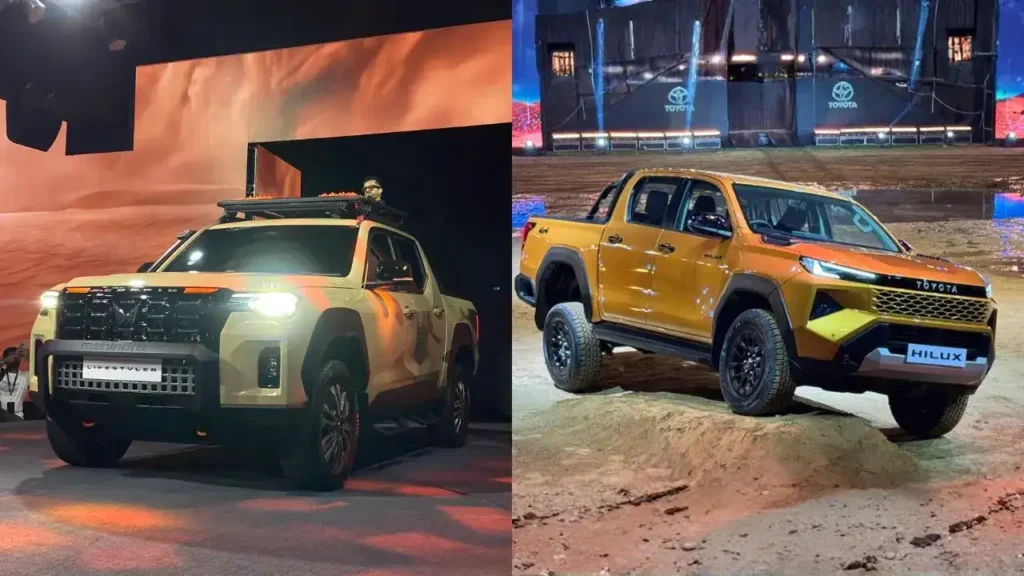
The Mahindra Scorpio Lifestyler and Toyota Hilux are entering an increasingly interesting phase of competition in India’s lifestyle-pickup segment.
The Scorpio Lifestyler is positioned as a newer, feature-rich alternative based on the Scorpio-N platform, while the new Hilux continues Toyota’s established focus on durability, capability and ruggedness.
In the specific equipment comparison highlighted here, the Mahindra gets three features that the India-spec Hilux misses: rear disc brakes, automatic climate control and 18-inch alloy wheels. Recent reporting confirms the India-spec Hilux uses rear drums, manual air conditioning and 17-inch wheels.
Those features give the Scorpio Lifestyler a clear advantage in terms of cabin convenience, visual presence and braking hardware.
However, the Hilux retains important strengths in power, four-wheel-drive capability and its established global reputation.
Ultimately, the Scorpio Lifestyler’s biggest opportunity could be to offer a more accessible entry into the lifestyle-pickup segment while packing in features that many buyers associate with premium SUVs.
With its India launch expected in April 2027, the real comparison will begin when Mahindra confirms final prices, variants, specifications and equipment. Until then, these three features provide an early indication of how Mahindra intends to challenge one of the most established names in the pickup market.