A Party at the Crossroads
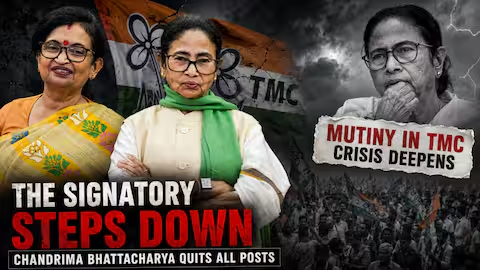
The internal crisis within the Trinamool Congress (TMC) has reached a decisive and potentially irreversible moment. In a dramatic development that underscores the scale of the party’s collapse following its historic electoral defeat, senior leader Chandrima Bhattacharya has resigned from all party posts, including her crucial role as the official signatory of the party.
Her resignation, conveyed through a formal letter addressed directly to TMC chairperson Mamata Banerjee, is not merely another defection. It represents a symbolic unravelling of the party’s institutional backbone and marks one of the gravest internal challenges the Trinamool Congress has faced since its founding in 1998.
With the party already reeling from a crushing defeat in the West Bengal Assembly elections, Bhattacharya’s decision has intensified fears of an existential crisis—one that threatens the TMC’s organisational coherence, legislative relevance, and political future.
Table of Contents
From Inner Circle to Exit: Who Is Chandrima Bhattacharya?
For years, Chandrima Bhattacharya was not just another leader within the Trinamool Congress. She was widely regarded as a trusted lieutenant in Mamata Banerjee’s inner circle—an administrator, strategist, and institutional stabiliser during both political victories and turbulent phases.
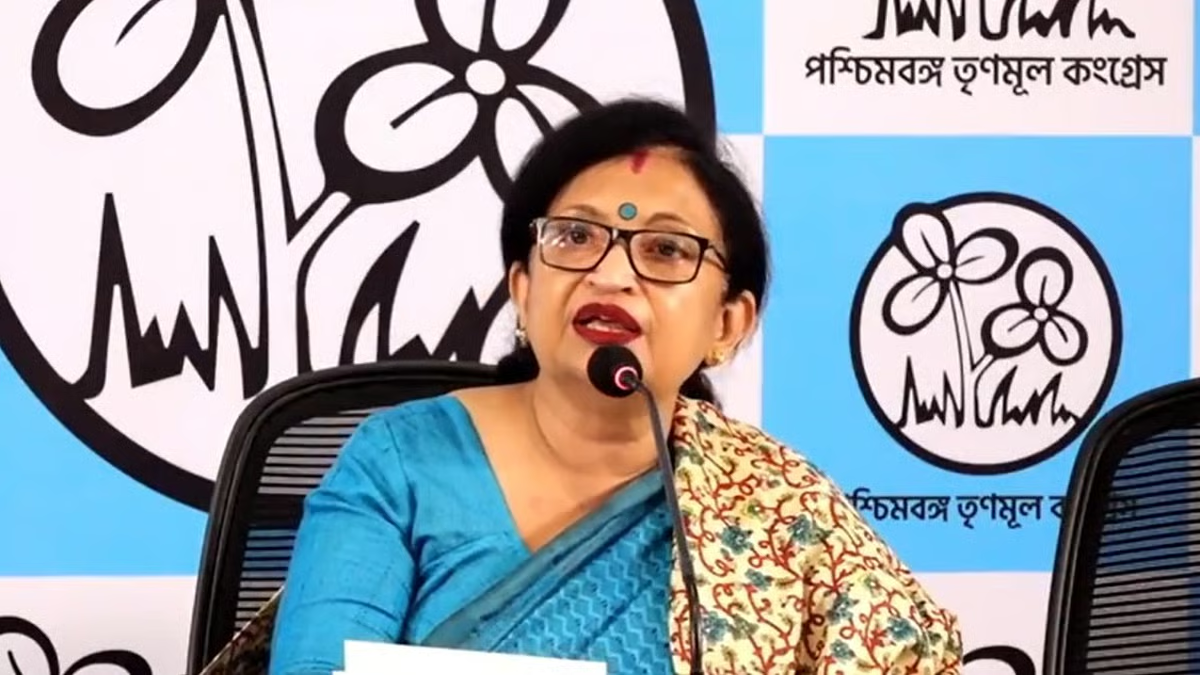
Her role as the party’s authorised signatory gave her immense functional importance. The position placed her at the heart of the party’s administrative machinery, overseeing critical documentation, financial approvals, and organisational compliance. Such roles are rarely entrusted to anyone outside the most trusted core of leadership.
Her sudden withdrawal from all responsibilities therefore carries both symbolic weight and practical consequences, signalling not just political dissent but institutional paralysis.
Electoral Defeat That Triggered the Fallout
Chandrima Bhattacharya’s resignation follows her personal electoral defeat in the Dum Dum Uttar constituency, where she secured 76,880 votes but lost by a margin of 26,404 votes to BJP candidate Sourav Sikdar.
This loss was not an isolated setback. It came amid one of the most dramatic electoral routs in West Bengal’s political history. The ruling TMC was comprehensively defeated by the Bharatiya Janata Party (BJP), which swept an unprecedented 207 of the 293 Assembly seats, decisively ending the party’s long dominance in the state.
For a leader so closely associated with the organisational and administrative core of the TMC, the twin blows of personal defeat and systemic collapse appear to have proven decisive.
A Letter That Signals More Than Resignation
chandrima bhattacharya , According to sources familiar with the matter, Chandrima Bhattacharya’s letter to Mamata Banerjee was concise but unambiguous. She expressed her decision to step away from all leadership roles, including her responsibilities as the party’s signatory.
While the letter reportedly avoided public confrontation or ideological criticism, its implications were unmistakable: the erosion of trust within the party’s highest ranks and a growing belief among senior leaders that the TMC, in its current form, may no longer be politically viable.
Political observers note that such resignations often precede wider fragmentation, particularly in parties that suffer sudden and total electoral collapse.
An Unprecedented Wave of Defection and Rebellion
Bhattacharya’s exit is not an isolated incident but rather the culmination of a broader rebellion engulfing the Trinamool Congress across multiple layers of power.
Legislature in Revolt
Within the West Bengal Assembly, a majority of the remaining TMC legislators have reportedly rebelled against the party leadership. Many have pledged allegiance to rebel legislator Ritabrata Banerjee, effectively stripping Mamata Banerjee of her control over the legislative wing.
This rebellion has rendered the party numerically weak and politically fragmented inside the Assembly, severely limiting its ability to function as a coherent opposition.
Parliament Sees the Exodus Begin
The crisis has spilled over into Parliament as well. Several veteran members of the Rajya Sabha have resigned not only from their parliamentary positions but also from the party itself.
According to party insiders, these resignations may represent only the beginning of a larger parliamentary exodus, raising serious concerns about the TMC’s future relevance at the national level.
Lok Sabha Splintering Deepens the Crisis
Perhaps most alarming for the TMC leadership is the splintering within its Lok Sabha contingent. A significant rebel faction led by senior MP Kakoli Ghosh Dastidar has applied for recognition as an independent group.
This faction has openly declared its allegiance to the ruling National Democratic Alliance (NDA), effectively crossing ideological and political lines.
Among the prominent names associated with this rebellion are Saayoni Ghosh, former Indian cricketer Yusuf Pathan, and former footballer Prasun Banerjee—figures once projected as faces of the party’s outreach beyond traditional politics.
Collapse at the Grassroots Level
The crisis is not confined to legislative chambers. At the organisational and municipal level, panic and disarray have become widespread.
- National leader Jyotipriya Mallick, currently in jail, has resigned from the National Working Committee of the party.
- Over 100 municipal councillors across multiple districts have resigned from their posts in recent weeks.
This wave of resignations has severely weakened the party’s grassroots network, which once formed the backbone of its electoral machinery.
Political analysts warn that without local organisational control, rebuilding the party—even in opposition—will be extraordinarily difficult.
The Signatory Vacuum: Administrative Paralysis Ahead
Among all the setbacks facing the Trinamool Congress, Chandrima Bhattacharya’s resignation as the authorised signatory poses one of the most immediate operational challenges.
The signatory role is essential for:
- Managing party finances
- Approving official correspondence
- Ensuring legal and administrative continuity
Her exit creates what insiders describe as “mathematical and operational paralysis”, potentially freezing key administrative functions at a time when the party needs restructuring the most.
Mamata Banerjee’s Greatest Political Test
For Mamata Banerjee, this moment represents perhaps the greatest challenge of her political career. Since founding the Trinamool Congress in 1998, she has navigated electoral defeats, political isolation, and powerful adversaries. However, never before has the party faced such a simultaneous collapse across electoral, legislative, parliamentary, and organisational fronts.
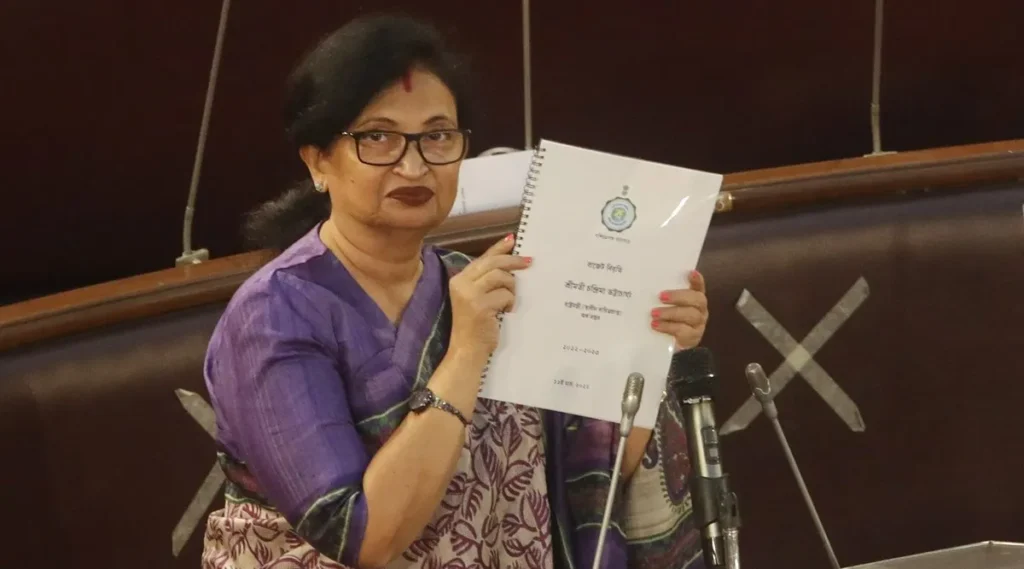
Chandrima Bhattacharya’s departure—given her loyalty, proximity, and administrative importance—cuts particularly deep.
Is This the Beginning of the End?
Whether the Trinamool Congress can survive this phase remains an open question. Some political observers believe the party may still reinvent itself through structural reforms and leadership reshuffles. Others argue that the scale of defection and loss of institutional control indicates a terminal decline.
What is clear is that Chandrima Bhattacharya’s resignation is not just another headline—it is a turning point that encapsulates the party’s present turmoil and uncertain future.
A Party in Freefall
The resignation of Chandrima Bhattacharya marks a defining chapter in the ongoing unravelling of the Trinamool Congress. From legislative rebellion and parliamentary defections to grassroots collapse and administrative paralysis, the party stands at the edge of political irrelevance.
Chandrima bhattacharya, As West Bengal enters a new political era, the fate of the TMC will depend on whether it can arrest this downward spiral—or whether history will record this moment as the point of no return.