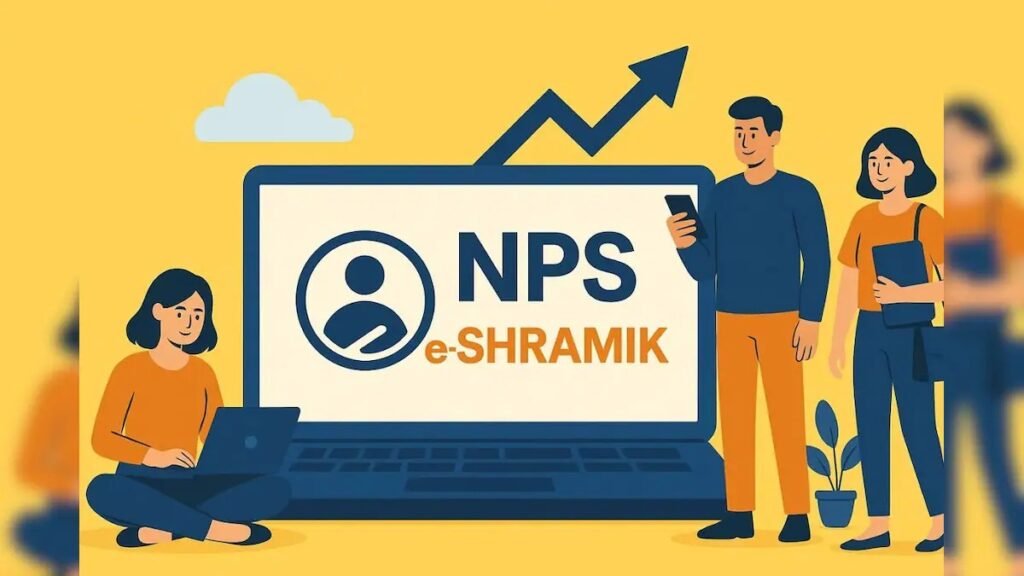
NPS e-Shramik, The Pension Fund Regulatory and Development Authority (PFRDA) has introduced a flexible retirement savings framework for India’s growing community of platform and gig workers, allowing them to contribute towards the National Pension System (NPS) without a fixed minimum or maximum contribution threshold.
Known as the NPS e-Shramik model, the framework was introduced in October 2025 to provide gig and platform workers with an organised route to build long-term retirement savings despite having irregular incomes and employment arrangements. The model is designed to address a major gap between workers in the formal sector, who generally have access to structured retirement benefits, and gig workers, whose earnings can fluctuate significantly from month to month.
Under the model, contributions can be made by the platform aggregator, the platform service partner, or jointly by both. The flexibility is intended to make NPS more accessible to workers such as delivery partners and other individuals whose income depends on assignments, orders, rides or other platform-based work.
Table of Contents
What Is the NPS e-Shramik Model?
The NPS e-Shramik model is a platform-oriented framework under the National Pension System designed specifically to accommodate the working and income patterns of gig and platform workers.
Unlike traditional salaried employment, gig work generally does not guarantee a fixed monthly salary. A delivery worker, driver, home-service provider or other platform worker may earn different amounts depending on the number of assignments completed, working hours, seasonal demand and the number of platforms through which they operate.
This irregular income can make conventional retirement savings difficult.
The NPS e-Shramik framework attempts to address that challenge by allowing contributions to be adjusted according to the worker’s circumstances.
The model does not prescribe a fixed minimum or maximum contribution amount. Instead, the platform aggregator and platform service provider can determine an appropriate contribution mechanism.
According to PFRDA’s framework, this approach is aligned with the existing Corporate Model and is intended to provide flexibility while encouraging systematic retirement savings.

No Fixed Minimum or Maximum Contribution
One of the key features of NPS e-Shramik is the absence of a regulatory minimum or maximum contribution threshold.
This is particularly relevant for gig workers because their income may not follow a predictable monthly pattern.
For example, a worker who earns less during a particular month may contribute a smaller amount, while a worker earning more during a high-demand period can potentially contribute more.
The flexibility reduces the pressure of maintaining a fixed contribution regardless of income.
However, PFRDA has clarified that while it does not impose a minimum or maximum contribution threshold, the platform aggregator or platform service partner can establish a minimum contribution for each instance of credit into an individual pension account.
The PFRDA circular gives an example of Rs 99 per month per contribution as a possible minimum determined by the relevant platform arrangement.
This distinction is important. The absence of a regulatory minimum does not necessarily mean that every platform must accept contributions of any amount. Instead, platforms have the flexibility to establish operational contribution levels suited to their systems.
Who Can Contribute to the NPS Account?
The contribution structure under the NPS e-Shramik model is designed to accommodate different arrangements between platforms and workers.
Contributions can be made:
- Entirely by the platform aggregator
- Entirely by the platform service partner
- Jointly by the platform aggregator and the worker
This flexibility gives platforms the option of developing contribution arrangements that suit their business models.
For workers, it also creates the possibility of building retirement savings without having to shoulder the entire contribution burden themselves.
If a platform chooses to contribute on behalf of its workers, that contribution can become an additional component of the worker’s long-term financial security.
Why NPS e-Shramik Matters for Gig Workers
India’s gig economy has expanded significantly with the growth of app-based transportation, food delivery, e-commerce, logistics and home-service platforms.
Gig workers often have greater flexibility than employees in traditional jobs, but that flexibility can come with reduced access to conventional social-security benefits.
A salaried employee may receive structured retirement benefits or participate in employer-supported savings arrangements. A gig worker, by contrast, generally has to make independent arrangements for retirement.
This creates a long-term financial challenge.
The NPS e-Shramik model attempts to provide an organised retirement savings mechanism while preserving the flexibility that characterises gig employment.
Rather than requiring workers to fit their income into a rigid contribution schedule, the model allows contributions to reflect changing earnings.
Workers Can Build Their Retirement Corpus Over Time
The central objective of NPS is long-term retirement savings. Under the e-Shramik model, workers can continue building a pension corpus until retirement by contributing according to their income and financial capacity.
This can be particularly useful for workers whose earnings vary throughout the year.
A worker may make contributions during periods of higher income and adjust contributions during weaker periods, subject to the operational rules of the platform through which the account is linked.
Over a long working life, even relatively small contributions can potentially accumulate into a meaningful retirement corpus through regular savings and investment returns.
The model therefore encourages workers to begin saving early rather than waiting until they have a stable or higher income.
NPS Account Portability Between Platforms
Another important feature is portability.
Gig workers frequently change platforms, work for multiple companies or shift between different service providers. A retirement savings system that requires a completely new account every time a worker changes platforms could discourage participation.
The NPS e-Shramik model allows a worker to shift or port an individual pension account from one platform aggregator to another.
Workers can also move from a Platform Service Provider scheme launched by pension funds to the Common Scheme.
This portability is particularly important for gig workers because their employment relationship is often less permanent than that of conventional employees.
The retirement account can therefore remain connected to the worker rather than being permanently tied to one platform.
One Aggregator Link at a Time
The model also recognises that gig workers may simultaneously work for multiple platforms.
However, an individual pension account can be linked to only one aggregator at a time if a worker is employed with two or more platforms simultaneously.
This is an operational limitation within the framework.
Nevertheless, the broader portability provisions provide workers with flexibility when their primary platform changes or when they decide to move their pension account from one aggregator to another.

Withdrawal Rules Under NPS e-Shramik
The exit and withdrawal provisions for the Platform Service Provider model follow the All Citizen Model under the PFRDA (Exit and Withdrawals) Regulations, 2015.
These provisions are designed to preserve the long-term retirement objective of NPS while allowing subscribers access to their accumulated wealth under specified conditions.
For a non-government subscriber exiting at the normal exit point, the treatment depends on the size of the accumulated pension wealth.
If the total accumulated amount is more than Rs 8 lakh, the subscriber can withdraw up to 80% as a lump sum, while the remaining 20% must be used to purchase an annuity.
If the accumulated pension wealth is Rs 8 lakh or less, the subscriber can withdraw the entire amount as a lump sum.
The structure is intended to ensure that larger retirement savings continue to generate a stream of income through annuity arrangements.
Premature Exit Has Stricter Conditions
The rules are more restrictive when a subscriber exits the system before the normal exit point.
In the case of premature exit, the worker can withdraw 20% as a lump sum, while the remaining 80% is required to be used for purchasing an annuity.
The comparatively higher annuity requirement reflects the long-term purpose of NPS.
The pension system is primarily designed to create retirement income rather than function as a short-term savings account. Restricting premature access to the accumulated corpus helps preserve savings for later years.
At the same time, the NPS framework provides provisions for partial withdrawals for specified purposes, subject to applicable eligibility conditions.
PFRDA Offers Incentive for New NPS Accounts
To encourage participation among gig workers, PFRDA has also provided an incentive of up to Rs 100 for each new NPS account.
The incentive is aimed at supporting Points of Presence (PoPs) in promoting NPS adoption and helping create awareness among platform service partners.
PoPs play an important role in onboarding subscribers and providing access to NPS-related services.
Under the framework, PoPs are not permitted to charge workers a fee during the onboarding stage.
This is intended to reduce the initial financial barrier for gig workers considering participation in the retirement savings system.
Awareness and Financial Literacy Remain Important
The success of NPS e-Shramik will depend not only on the availability of the product but also on workers understanding how it operates.
Many gig workers may be unfamiliar with pension products, investment-linked retirement savings and annuity requirements.
Consequently, awareness initiatives will be important in explaining issues such as contribution flexibility, investment choices, account portability, withdrawal conditions and the long-term nature of NPS.
The PFRDA incentive for PoPs is partly aimed at supporting these awareness and onboarding efforts.
Platforms could also play an important role by integrating pension contributions into existing worker payment systems and making information about retirement savings easily accessible.
Role of Platform Aggregators Could Be Crucial
The participation of platform aggregators is likely to be a key factor in the success of the NPS e-Shramik model.
Aggregators have direct access to large communities of gig workers and can potentially facilitate automatic or periodic contributions.
They can also decide whether to contribute themselves, encourage workers to contribute or develop a shared contribution model.
A platform-supported contribution mechanism could make retirement savings easier for workers who might otherwise postpone or overlook long-term financial planning.
However, the model’s success will ultimately depend on whether workers and platforms participate consistently.
Flexible Contributions Address Irregular Income
The biggest strength of the model is arguably its recognition that gig workers do not have the same income patterns as salaried employees.
A fixed monthly contribution may be difficult for a worker whose earnings fluctuate based on demand, working hours or the number of assignments completed.
By allowing contributions without a PFRDA-prescribed minimum or maximum, NPS e-Shramik provides greater flexibility.
At the same time, workers need to recognise that flexibility should not result in consistently inadequate retirement savings.
The absence of a mandatory minimum can make participation easier, but workers may still need to establish their own regular savings discipline to build a sufficient retirement corpus.
A Potential Step Towards Wider Social Security
The introduction of NPS e-Shramik comes at a time when India’s labour market is undergoing a significant transformation.
Platform-based work has created new earning opportunities while also challenging traditional definitions of employment and social security.
For gig workers, retirement planning is particularly important because income during working years may not automatically translate into financial security after they stop working.
An organised pension mechanism can help bridge this gap.
The NPS e-Shramik model does not eliminate all challenges associated with gig-worker social security, but it provides a structured avenue for long-term retirement savings while accommodating changing employment relationships.
What the NPS e-Shramik Model Means for Workers
For gig and platform workers, the model offers several notable advantages:
Flexible contributions: Workers are not subject to a PFRDA-prescribed minimum or maximum contribution threshold.
Multiple contribution options: Contributions can come from the worker, platform or both.
Portability: Workers can shift their NPS account between platform aggregators.
Long-term corpus building: Contributions can accumulate towards retirement.
Access to partial withdrawals: Withdrawals are possible for specified purposes subject to eligibility conditions.
Onboarding support: PFRDA provides incentives to encourage new account creation, while PoPs do not charge workers during onboarding.
These features collectively attempt to make retirement planning more compatible with the realities of platform-based work.
NPS e-Shramik
The NPS e-Shramik model represents an effort to extend organised retirement savings to India’s expanding gig and platform workforce without imposing the rigid contribution structures that may not suit irregular incomes.
With no PFRDA-mandated minimum or maximum contribution threshold, workers can potentially adjust their savings according to their financial circumstances, while platform aggregators can develop contribution mechanisms suited to their operations. Contributions may be made by workers, platforms or both.
The portability of individual pension accounts is another important feature, particularly for workers who frequently change platforms. At the same time, the NPS withdrawal framework retains safeguards intended to ensure that retirement savings are primarily used for long-term financial security.
As India’s gig economy continues to grow, the challenge will be to ensure that flexibility does not come at the expense of adequate retirement preparedness. Greater participation by platform companies, consistent worker contributions, effective awareness campaigns and accessible onboarding will all be important to the model’s success.
For millions of workers whose earnings do not follow the traditional salary structure, NPS e-Shramik could provide a pathway towards building a retirement corpus while retaining the flexibility that defines gig employment.