A Composed Start to Root’s Second Stint
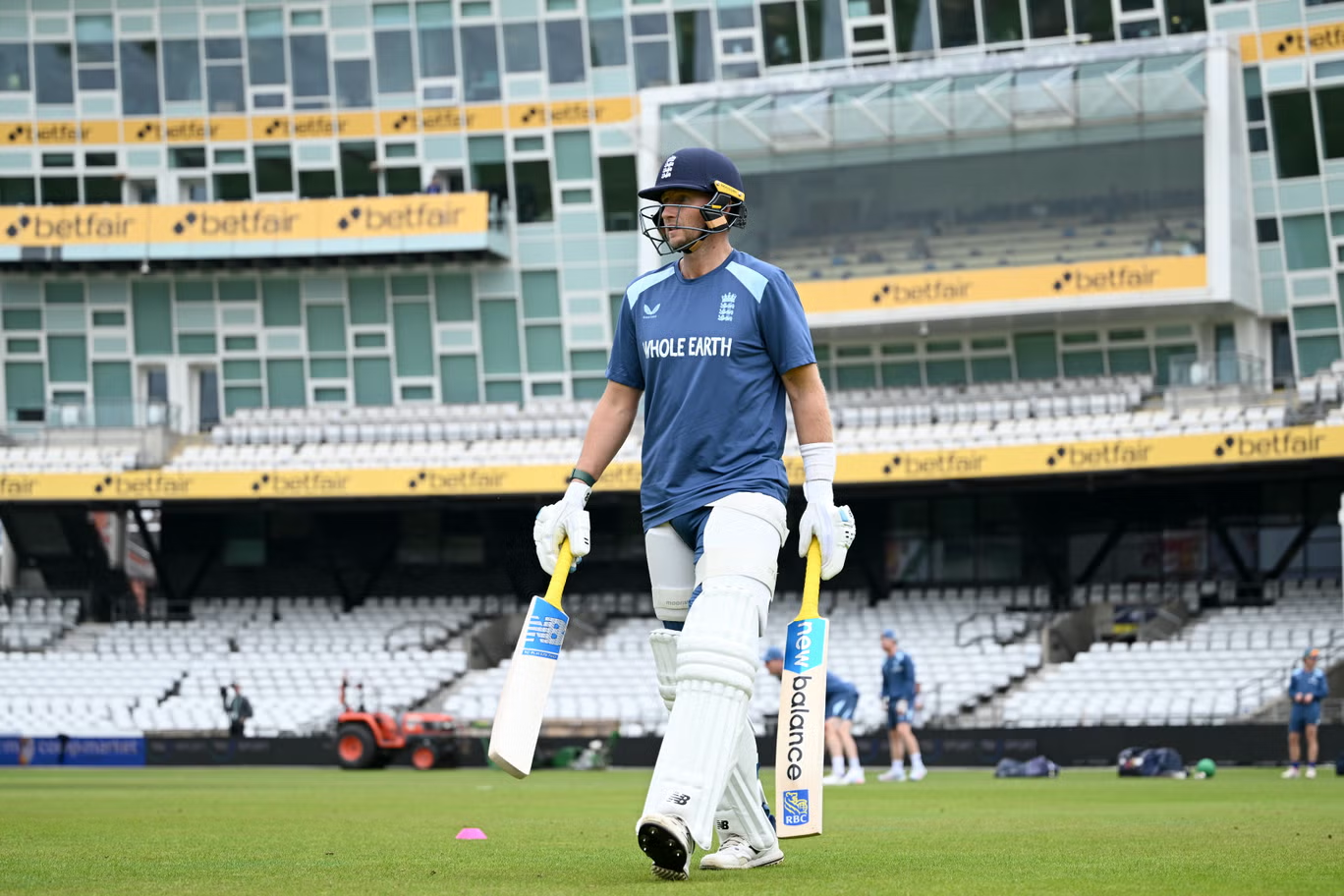
Joe Root marked his return as England’s Test captain with a composed performance as England dismissed Pakistan for 171 on the opening day at Headingley.
With Ben Stokes unavailable and Harry Brook also considered a potential successor, Joe Root’s appointment represented a return to a role he had previously held for several years. Rather than attempting to replicate Stokes’ highly expressive leadership style, the 35-year-old appeared determined to establish his own approach based on observation, measured decisions and clear communication.
That calmness was evident throughout England’s opening day. Joe Root worked closely with Brook and his bowling attack while allowing his players enough freedom to execute their own plans.
The result was an encouraging beginning to a new chapter for England.

Table of Contents
Joe Root and Brook Put Partnership Ahead of Rivalry
One of the most notable aspects of Joe Root’s return was his relationship with Harry Brook.
Both Yorkshire batters had been viewed as candidates to replace Stokes as captain. Brook, who has already demonstrated leadership qualities in white-ball cricket, could have been disappointed after Joe Root was chosen.
Instead, the two appeared to complement each other.
Brook offered tactical input early in the innings, suggesting a change to the field as Shan Masood came to the crease. Joe Root accepted the recommendation, demonstrating that his captaincy would not be based on having complete control over every decision.
Brook’s position in the slips also gave him an excellent view of the developing situation, allowing him to contribute observations to Joe Root and the bowlers.
The partnership between the two Yorkshiremen could become an important feature of England’s new era.
Mid-Off Becomes Joe Root’s Command Centre
Joe Root also made an important tactical change to his positioning.
Rather than spending most of his time in the slips, where he has taken more than two-thirds of his 218 Test catches, Joe Root stationed himself at mid-off.
The position allowed him to remain closer to his bowlers and communicate directly with them between deliveries.
It also meant that Joe Root could control the ball once an over had finished, ensuring that the game moved through his hands before the next bowler began.
The tactic has previously been used by Stokes and former England captain Michael Vaughan, another influential figure in Joe Root’s development.
For Joe Root, however, the move appeared less about copying his predecessors and more about finding a practical way to stay involved in the game.
Robinson Provides the Perfect Start
England received an ideal beginning when Ollie Robinson struck with the first ball of the match.
Robinson ultimately became the standout performer with the ball, finishing with an impressive 5-51.
His performance was particularly significant because the fast bowler has experienced difficult periods during the Stokes-Brendon McCullum era.
Questions over fitness, consistency and attitude had previously affected his place in the side. His return to prominence under Joe Root therefore carried an additional layer of significance.
Robinson also has leadership experience of his own as captain of Sussex, making him one of the more experienced members of England’s pace group.
His controlled bowling was exactly what Joe Root needed.
While other members of the attack took time to settle, Robinson maintained pressure through accuracy and movement. He repeatedly challenged Pakistan’s batters around the outside edge before changing his angle of attack.
His dismissal of Shan Masood with an inswinger that trapped the batter lbw underlined his ability to adapt during an innings.
Joe Root Gives Bowlers Freedom
One of the clearest differences between Joe Root and Stokes was the amount of space given to the bowlers.
Stokes was known for his highly interactive leadership, constantly speaking to players and encouraging them during matches.
Joe Root, by contrast, appeared more restrained.
He would communicate briefly with Robinson before an over and then allow the bowler to work through his own plans.
That approach seemed to suit Robinson.
The seamer later indicated that Joe Root communicated field changes clearly while allowing him to continue bowling according to his preferred strategy.
This balance could prove important for England’s young pace attack.
With Robinson joined by Jofra Archer, Gus Atkinson and Josh Tongue, England possess considerable pace-bowling potential, but the group is still developing as a unit.
Joe Root’s experience could therefore provide the structure required without placing unnecessary pressure on individual bowlers.
Archer Struggles as Robinson Takes Responsibility
Not everything went according to plan for England.
Jofra Archer, one of the most highly anticipated members of the attack, struggled to find his rhythm with the new ball. After two expensive and wayward overs, Root did not hesitate to remove him from the attack.
The decision demonstrated that Root was prepared to make difficult calls rather than simply relying on reputations.
Archer’s presence gives England a potentially match-changing weapon, but the first day showed that Root will need to manage his pace attack carefully.
Robinson’s performance consequently became even more important.
While Archer searched for consistency and Tongue and Atkinson took time to settle, Robinson provided the control that kept Pakistan under pressure.

Pakistan’s Middle-Order Resistance Tests England
England’s dominance was briefly threatened when Imam-ul-Haq and Abdullah Shafique built a partnership of 91 runs.
For more than 23 overs, England struggled to find a breakthrough.
The partnership created a reminder that Root’s calm approach will face considerably greater tests during the series.
Without Stokes, England have lost not only their captain but also a proven all-rounder capable of changing matches with both bat and ball.
Root was forced to bat earlier than expected after England’s bowlers finally broke Pakistan’s resistance.
A loose drive from Imam gave Tongue the breakthrough England needed, ending the partnership and reopening the innings.
Root Chooses Control Over Chaos
The tactical contrast between Root and Stokes was particularly visible in England’s field settings.
Stokes often embraced aggressive and unconventional fields, sometimes deploying multiple slips and attacking positions in situations where other captains might have preferred defensive options.
Root took a more traditional approach.
He generally retained three slips and avoided excessive experimentation, although he did provide Tongue with three slips and two leg slips for a hat-trick opportunity after tea.
The strategy reflected Root’s broader philosophy: apply pressure through consistency rather than constantly searching for spectacular tactical moves.
That does not mean England will necessarily become defensive under Root.
Instead, his first day suggested that attacking cricket can be built on a foundation of discipline and patience.
Robinson’s Five-Wicket Haul Highlights England’s Pace Potential
Robinson’s 5-51 was arguably the biggest positive of the day for England.
His performance showed that the bowling attack does not necessarily need every bowler to operate at extreme pace to be effective.
Robinson’s average speed at Headingley was around 78.4mph, considerably below the speeds associated with some of England’s other quicks.
Yet his accuracy, movement and ability to repeatedly challenge Pakistan’s batters proved decisive.
That is particularly relevant for Root, who will need bowlers capable of maintaining pressure over long spells.
The England captain’s approach appeared to recognise that.
Rather than constantly changing fields or demanding aggression, Root allowed Robinson to build pressure through sustained accuracy.
A New England Era Begins With Measured Leadership
Root’s return comes after a turbulent period in English Test cricket.
The transition away from Stokes naturally brings questions about whether England can maintain their aggressive identity while adapting to a different captain.
Root himself acknowledged before the match that he could not simply attempt to become another Stokes.
That distinction was visible at Headingley.
Where Stokes often led through emotion and relentless energy, Root’s first day was defined by control.
He observed the game carefully, communicated with his players and made changes when required.
His relationship with Brook also offered encouragement for England.
Rather than creating a division between two potential leaders, the pair worked together, combining Brook’s tactical observations with Root’s experience.
Plenty of Challenges Remain
Despite the positive start, England’s first day does not provide all the answers.
Pakistan’s resistance through Imam and Shafique demonstrated how quickly momentum can shift.
England’s bowling attack also has several unanswered questions. Archer needs rhythm, Tongue and Atkinson must continue developing their consistency, while Robinson will need to maintain his fitness and form.
Most importantly, Root no longer has Stokes’ ability to influence a match in multiple disciplines.
That places additional responsibility on England’s specialist batters and bowlers.
Root himself will also be expected to contribute heavily with the bat.
His leadership return therefore comes alongside the continued importance of his role as one of England’s most experienced run-scorers.

Root’s Calm Could Define England’s New Chapter
The opening day at Headingley offered an early indication of what England under Root’s second captaincy might look like.
It is unlikely to be a carbon copy of the Stokes era.
Instead, Root appears to be bringing a quieter, more calculated style of leadership—one built around trusting his players while remaining ready to intervene when necessary.
His positioning at mid-off, his communication with Robinson, his willingness to respond to Brook’s tactical suggestions and his decision to remove Archer after an ineffective spell all pointed towards a captain who is comfortable allowing the game to develop rather than trying to force every moment.
For England, that could be exactly what is required after a period of considerable upheaval.
The first day at Headingley was only the beginning, and tougher challenges will inevitably follow. But with Root providing stability, Brook contributing ideas and Robinson producing a five-wicket performance, England’s new era began with something that had been missing for some time: a sense of calm and control.