Government e-Marketplace (GeM) is set to enter its second decade with a renewed focus on artificial intelligence, wider last-mile access, sustainable procurement and deeper integration with government institutions, Commerce and Industry Minister Piyush Goyal said on Monday.
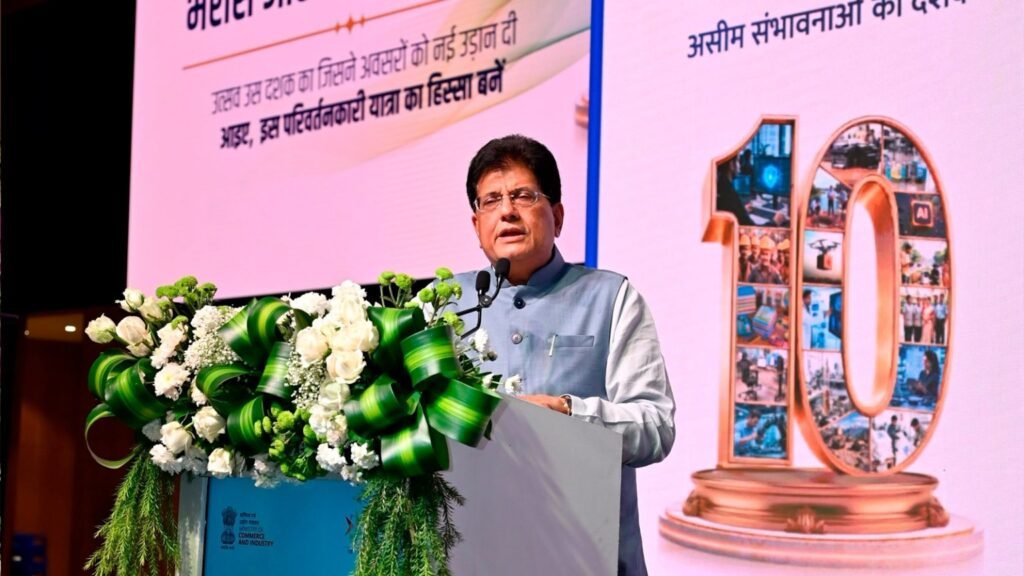
Addressing the 10th Foundation Day celebrations of GeM at Bharat Mandapam in New Delhi, Goyal outlined a broad roadmap aimed at transforming the public procurement platform into a more user-friendly, technology-driven and inclusive ecosystem.
The minister said the next phase of GeM should focus not merely on expanding the platform’s scale but also on improving the quality and efficiency of public procurement. Greater use of technology and artificial intelligence, he said, can help government buyers and sellers make better-informed decisions while improving transparency, competitiveness and cost-effectiveness.
Launched on August 9, 2016, under the Ministry of Commerce and Industry, GeM has grown from a digital marketplace for government purchases into one of the country’s largest public procurement platforms. Over the past decade, it has connected government organisations with millions of sellers and facilitated procurement worth more than ₹20 lakh crore.
Table of Contents
GeM Identifies Five Priorities for Its Next Decade
At the Foundation Day event, Piyush Goyal identified five major areas that will shape GeM’s development in the coming decade.
These include expanding last-mile access, increasing the use of artificial intelligence, integrating more government entities into the platform, improving access to credit and promoting sustainable procurement. The government also plans to strengthen outreach to universities and encourage greater participation from young innovators.
The priorities reflect an effort to make public procurement more accessible to businesses while simultaneously making the purchasing process smarter for government organisations.
Expanding GeM’s Last-Mile Reach
One of the key priorities highlighted by Goyal was improving access to GeM for enterprises that may face difficulties using digital platforms.
The minister called for the expansion of Suvidha Kendras across districts. These centres are intended to provide services such as seller registration, catalogue creation, training and grievance redressal.
For smaller enterprises, particularly those with limited digital capabilities, such support can play an important role in helping them participate in government procurement.
The expansion of such facilities could also help bridge the gap between India’s rapidly expanding digital economy and businesses operating in areas where access to digital infrastructure, technical expertise or online procurement systems remains limited.
By strengthening its physical support network alongside its digital infrastructure, GeM aims to make participation in public procurement more inclusive.
AI to Play a Bigger Role in Government Procurement
Artificial intelligence emerged as one of the most important themes in Goyal’s vision for GeM‘s second decade.
The minister called for greater deployment of AI-based tools for areas such as price intelligence, price validation and marketplace integrity.
Public procurement involves large volumes of transactions across thousands of product and service categories. Using data and AI could help government buyers identify appropriate prices, compare offerings and make more informed purchasing decisions.
AI-driven procurement intelligence could also help identify unusual pricing patterns and strengthen mechanisms designed to maintain the integrity of the marketplace.
The broader objective is to move towards a procurement system that is increasingly data-driven and predictive, rather than relying primarily on conventional processes.
For sellers, greater use of technology could also make the marketplace more transparent by helping them understand demand patterns and pricing dynamics.
However, the effectiveness of AI-based procurement will depend on the quality of data, transparency of algorithms and appropriate safeguards to ensure that automated systems complement rather than complicate the procurement process.
Building a Seamless National Public Procurement Ecosystem
Another major priority is to bring more government institutions into the GeM ecosystem.
Goyal called for deeper integration of state governments, public sector enterprises, panchayats and cooperatives so that public procurement can evolve into a more seamless national ecosystem.
At present, procurement requirements vary considerably across different levels of government. Greater integration could potentially allow more organisations to access the same digital marketplace and benefit from standardised processes.
A broader procurement ecosystem could also increase the number of buyers and sellers participating on the platform, potentially improving competition and creating additional opportunities for Indian enterprises.
The integration of panchayats and cooperatives could be particularly significant because these institutions represent procurement requirements at the grassroots level.
Focus on Credit Access for Sellers
Access to finance remains an important challenge for many small businesses, particularly when they have to wait for payments after fulfilling government orders.
Goyal therefore emphasised the need to scale up credit-related initiatives associated with GeM, including GeM Sahay and linkages with the Trade Receivables Discounting System (TReDS).
Such initiatives are designed to help eligible businesses improve access to working capital and manage cash-flow requirements.
For micro and small enterprises, timely access to finance can be critical for accepting larger orders and maintaining operations. Easier access to credit against receivables could therefore help businesses participate more confidently in government procurement.
The focus on financing also aligns with the broader objective of making government procurement a more predictable and accessible market for Indian enterprises.
Sustainable Procurement to Become a Mainstream Priority
Sustainability is another area expected to receive greater attention as GeM enters its second decade.
Goyal called for sustainable procurement practices to be mainstreamed across the platform.
Government procurement represents a significant portion of economic activity, and purchasing decisions made by public institutions can influence demand across entire industries. Greater emphasis on sustainable products and services could therefore encourage businesses to develop environmentally responsible offerings.
Mainstreaming sustainable procurement could involve greater awareness among buyers, improved visibility for sustainable products and stronger consideration of environmental factors in purchasing decisions.
The move also reflects the increasing importance of sustainability in public policy, business and supply-chain management.
Universities and Young Innovators to Be Brought Into GeM
The government also wants universities to become more closely connected with GeM.
Goyal said universities should be brought into the ecosystem to encourage young innovators and attract new buyers and enterprises.
India’s universities and educational institutions are home to research, innovation and emerging entrepreneurial talent. Greater participation could create opportunities for startups and young innovators to showcase products and solutions to government buyers.
It could also expose students and entrepreneurs to the requirements of public procurement and encourage them to develop solutions for government and public-sector needs.
The proposed expansion could consequently strengthen the connection between innovation, entrepreneurship and public procurement.
GeM Crosses ₹20 Lakh Crore in Cumulative Procurement
The scale of GeM‘s growth over the past decade is reflected in its procurement numbers.
According to the government, the platform has facilitated more than ₹20 lakh crore in cumulative procurement through over 3.78 crore orders.
The platform currently has more than 25 lakh sellers and over 1.37 lakh buyer organisations, demonstrating the extent to which digital procurement has expanded since GeM’s launch in 2016.
The growth also highlights the increasing role of online platforms in transforming government purchasing processes.
Instead of functioning solely as a marketplace, GeM has increasingly become an important component of India’s broader digital governance and public procurement infrastructure.
MSEs Account for a Major Share of GeM Procurement
Micro and Small Enterprises (MSEs) have emerged as one of the major groups benefiting from participation in GeM.
More than 12.28 lakh MSEs have fulfilled government orders worth over ₹9 lakh crore through the platform. This represents approximately 45.6 per cent of GeM’s cumulative gross merchandise value (GMV).
The figures underline the importance of the platform for smaller businesses seeking access to government demand.
Traditionally, small enterprises can face challenges in reaching large institutional buyers. A centralised digital marketplace can reduce some of those barriers by providing businesses with a common platform through which they can participate in government procurement opportunities.
The strong contribution of MSEs also supports the government’s wider objective of expanding market access for smaller Indian enterprises.
Women-Led Enterprises and Startups Gain Ground
The participation of women-led enterprises has also increased through GeM.
According to government data, more than 2.24 lakh women-led MSEs have fulfilled over 50 lakh orders, with the total value exceeding ₹1 lakh crore.
The platform has also enabled 42,242 startups to secure government orders worth more than ₹65,633 crore.
These numbers point to the role that digital public procurement can play in creating new market opportunities for emerging businesses.
For startups, government contracts can provide not only revenue but also an opportunity to demonstrate their products and services at scale. Increased participation can also encourage entrepreneurs to develop solutions specifically addressing public-sector requirements.
GeM Launches Five-Digit Helpdesk Number 14550
As part of its 10th Foundation Day celebrations, GeM launched a nationwide five-digit short code, 14550, for helpdesk services.
The number is mapped to GeM’s existing helpdesk infrastructure and is intended to provide buyers, sellers and other stakeholders with a simple and easily recognisable channel for support and official communication.
The launch is particularly relevant as the platform continues to expand its user base.
With millions of sellers and a large number of government buyers using the marketplace, efficient customer support and grievance redressal mechanisms will remain important to maintaining trust and ensuring smooth transactions.
The new short code is expected to make it easier for stakeholders to access support through a dedicated channel.
Commemorative ‘My Stamp’ Released
A customised ‘My Stamp’ was also launched to commemorate GeM’s 10th Foundation Day.
The commemorative stamp highlights GeM’s contribution to digital governance, ease of doing business and the participation of Indian enterprises in public procurement.
The initiative marks a decade of the platform’s evolution from its initial launch into a nationwide procurement ecosystem.
Buyers and Sellers Felicitated at Foundation Day Event
The 10th Foundation Day celebrations brought together government buyers, sellers, entrepreneurs, policymakers and other stakeholders associated with the development of GeM.
Exemplary buyers from Central ministries and departments as well as State government departments were felicitated during the event. Leading sellers were also recognised for their contribution to strengthening India’s public procurement ecosystem.
The event included the screening of a film documenting GeM’s 10-year journey and its expansion across the country.
GeM CEO Mihir Kumar said the platform’s growth was reflected not only in its scale but also in its continued efforts to respond to the evolving requirements of buyers and sellers.
From Digital Marketplace to Intelligent Procurement Platform
The next decade could mark a significant shift in the way GeM operates.
During its first decade, the platform’s primary focus was on establishing a centralised digital marketplace and expanding participation among government buyers and businesses. Its second decade is expected to place greater emphasis on the quality, intelligence and accessibility of procurement.
The increased use of AI could make purchasing decisions more data-driven, while integration with more government bodies could expand the platform’s reach. Credit initiatives could help smaller businesses manage working capital, while sustainable procurement could influence the kinds of products and services purchased by public institutions.
At the same time, expanding Suvidha Kendras could help ensure that the benefits of digital procurement reach enterprises that may otherwise struggle to participate.
Together, these measures indicate an attempt to build a procurement ecosystem that is not only larger but also smarter, more inclusive, transparent and sustainable.
What GeM’s Next Decade Could Mean for Indian Businesses
For Indian businesses, particularly MSEs and startups, the expansion of GeM could create a larger and more accessible institutional market.
Government procurement represents substantial demand across sectors, ranging from technology and professional services to manufacturing, infrastructure-related products and everyday supplies.
By increasing participation, improving access to credit and using technology to provide better procurement intelligence, GeM could help businesses understand and respond to government demand more effectively.
For government buyers, the objective is to create a system that makes procurement faster, more competitive and more cost-effective while maintaining transparency.
The challenge now will be to ensure that technological expansion translates into practical improvements for users.
GeM’s Second Decade Begins With Technology and Inclusion
As GeM enters its second decade, the government’s roadmap reflects a broader transformation in India’s approach to public procurement.
With cumulative procurement crossing ₹20 lakh crore, more than 25 lakh sellers and over 1.37 lakh buyer organisations, the platform has already established itself as a major pillar of India’s digital procurement infrastructure.
The next phase will focus on taking that ecosystem further through artificial intelligence, last-mile access, financial support, sustainable procurement, institutional integration and innovation.
Piyush Goyal’s vision places technology at the centre of this transformation, but it also emphasises inclusion. From district-level Suvidha Kendras to women-led MSEs, startups, universities and grassroots institutions, the objective is to expand participation while making the procurement experience simpler and more predictable.
If successfully implemented, the next decade could see GeM evolve from a large-scale digital marketplace into a more intelligent, integrated and inclusive national public procurement ecosystem—one that delivers greater value for government buyers while opening new opportunities for Indian enterprises.