The latest phase of the E20 fuel war, the debate surrounding India’s transition to 20 percent ethanol-blended petrol has intensified, with sharp political exchanges between the Opposition and the Central Government over the impact of the policy on vehicles, consumers, and the country’s long-term energy strategy. The latest phase of the E20 fuel war was triggered after Congress leader Priyank Kharge alleged that the nationwide shift to E20 fuel amounted to a “forced experiment” on millions of vehicle owners, while the Centre firmly rejected the accusation and dismissed claims that Union Road Transport and Highways Minister Nitin Gadkari had admitted as much before the Supreme Court.
The disagreement has once again brought ethanol-blended fuel into the national spotlight. While the government describes the transition as a carefully planned reform aimed at reducing fuel imports, lowering emissions, and supporting farmers, critics argue that questions remain over vehicle compatibility, consumer awareness, and the pace of implementation.
The E20 fuel war has therefore evolved beyond a political disagreement, becoming a broader discussion about balancing environmental goals with consumer interests and technological preparedness.
Table of Contents
Why the E20 Fuel Policy Matters
India is among the world’s largest consumers of petroleum products, importing a substantial share of its crude oil requirements. According to official government data, the country imports nearly 85 percent of its crude oil, making fuel security an important economic and strategic concern.
To reduce dependence on imported crude, successive governments have promoted ethanol blending in petrol. Ethanol is an alcohol-based biofuel produced primarily from sugarcane, maize, damaged food grains, and other agricultural feedstocks. When blended with petrol, it can help reduce fossil fuel consumption while lowering certain vehicle emissions.
The government’s long-term target is to increase ethanol blending across the country, with E20 fuel containing 20 percent ethanol and 80 percent petrol.
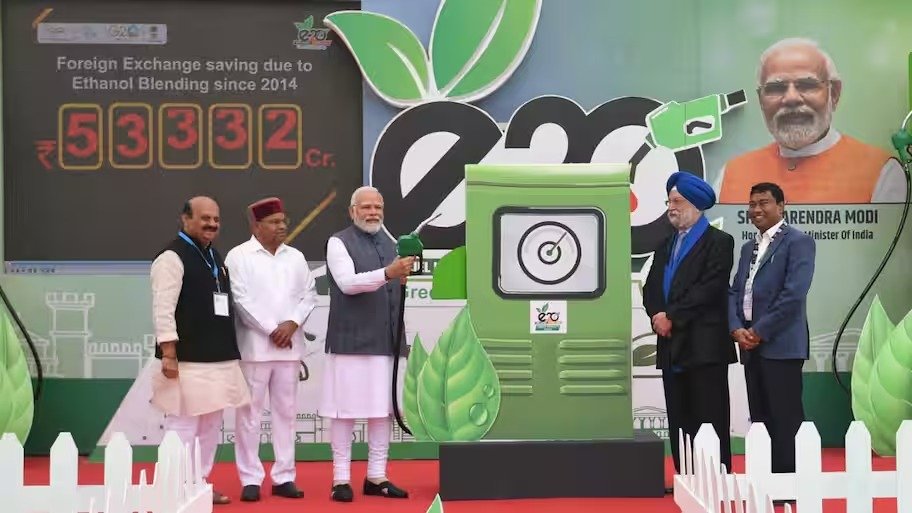
Officials argue that higher blending levels can reduce foreign exchange expenditure on crude oil imports, create additional income opportunities for farmers, E20 Fuel War encourage domestic biofuel production, and contribute to India’s climate commitments.
Congress Raises Concerns in E20 Fuel War
The latest political controversy began after Congress leader Priyank Kharge criticised the E20 rollout and accused the government of pushing ahead without adequately addressing concerns regarding vehicle performance.
Kharge described the transition as a “forced experiment” on Indian motorists and alleged that millions of vehicle owners could face unnecessary repair costs if their vehicles were not designed to operate efficiently on E20 fuel.
He also referred to reports suggesting that Union Minister Nitin Gadkari had acknowledged before the Supreme Court that the transition involved an experimental process.
According to the Congress leader, consumers deserved greater transparency regarding vehicle compatibility, possible maintenance costs, and the practical implications of switching to higher ethanol blends.
His remarks quickly intensified the ongoing E20 fuel war, attracting widespread political attention and generating debate on social media as well as among automobile owners.
Centre Rejects the Allegations
The Central Government strongly rejected the claims made during the E20 fuel war.
Government sources denied reports suggesting that the Union Road Transport and Highways Minister had admitted before the Supreme Court that the ethanol blending programme was merely an experiment.
Officials maintained that the policy is based on years of scientific research, extensive testing, and consultations with automobile manufacturers, fuel companies, and technical experts.
The government emphasised that India’s ethanol blending programme has been implemented in a phased manner rather than being introduced suddenly.
Authorities also reiterated that automobile manufacturers have been given sufficient time to develop vehicles compatible with higher ethanol blends, while oil marketing companies have gradually expanded E20 fuel availability across different regions.
Understanding E20 Fuel
The E20 fuel war has highlighted widespread public curiosity about what E20 fuel actually means.
The “E” represents ethanol, while the number indicates the percentage of ethanol blended into petrol.
Thus, E20 fuel contains:
- 20 percent ethanol
- 80 percent petrol
Earlier blending programmes included E5 and E10 fuel, which contained five percent and ten percent ethanol respectively.
The gradual increase in blending percentages allows vehicle manufacturers and fuel suppliers to adapt their technologies over time.
Experts note that ethanol possesses different chemical properties compared to conventional petrol. It burns more cleanly and has a higher oxygen content, but it also absorbs moisture more readily and contains lower energy content per litre than pure petrol.
Because of these characteristics, engine components, fuel systems, and calibration may require modifications for optimal long-term performance in vehicles regularly using higher ethanol blends.
Impact on Vehicle Owners
Much of the E20 fuel war centres on concerns about vehicle compatibility.
Automobile manufacturers have already introduced several models certified for E20 fuel, particularly newer vehicles produced in recent years.
However, older vehicles that were designed before higher ethanol blending became part of national policy may require closer attention.
Experts generally advise vehicle owners to follow manufacturer recommendations regarding approved fuel types rather than relying solely on public debate.
Industry associations have repeatedly stated that many modern vehicles can safely operate on E20 fuel if they are specifically certified for it.
At the same time, automotive engineers acknowledge that prolonged use of higher ethanol blends in incompatible engines could potentially affect certain fuel system components over extended periods.
This is one of the reasons why manufacturers have gradually upgraded fuel lines, seals, engine mapping, and material compatibility in newer vehicles.
Economic Benefits Behind the Policy
Despite the political disagreement, the government’s broader objective remains reducing India’s dependence on imported crude oil.
India spends billions of dollars annually on crude oil imports, making international oil price fluctuations a significant economic challenge.
Increasing ethanol production within the country can help reduce import bills while simultaneously creating additional demand for agricultural produce.
Sugar mills and ethanol producers have particularly benefited from the expansion of blending programmes, providing farmers with additional market opportunities.
Industry analysts note that ethanol production has become an important component of India’s biofuel strategy, contributing to rural employment and strengthening domestic energy security.
Environmental Perspective
Environmental experts have generally welcomed greater use of biofuels as part of a diversified energy strategy.
Since ethanol is produced from renewable agricultural sources, blending it with petrol can help reduce certain greenhouse gas emissions when compared with conventional fossil fuels.
However, specialists also point out that environmental benefits depend upon sustainable agricultural practices, efficient production methods, and responsible management of water and land resources used in ethanol production.
Therefore, while ethanol blending offers several environmental advantages, it is not viewed as a complete replacement for broader efforts aimed at improving fuel efficiency and expanding electric mobility.
Automobile Industry Response
The automobile industry has spent the past several years preparing for higher ethanol blending standards.
Manufacturers have redesigned engines, upgraded fuel delivery systems, and improved component durability to ensure compatibility with E20 fuel.
Several leading automobile companies now produce vehicles specifically certified for E20 fuel, while ongoing research continues to improve engine efficiency under higher ethanol blends.
Industry experts have repeatedly emphasised that vehicle owners should refer to official manufacturer guidance before assuming compatibility, especially in the case of older vehicles.
The transition has therefore involved coordination among automobile companies, oil marketing firms, fuel suppliers, and regulatory authorities over multiple years.
E20 Fuel War Highlights Broader Energy Debate
Beyond the political exchanges, the E20 fuel war reflects a larger national conversation about India’s future energy strategy.
As the country seeks to reduce dependence on imported fossil fuels while meeting climate commitments and supporting domestic agriculture, biofuels have become an increasingly important policy priority.
The differing views expressed by political leaders underline the challenges involved in implementing large-scale energy transitions that affect millions of consumers. While supporters view ethanol blending as a strategic investment in energy security and environmental sustainability, critics continue to call for greater transparency regarding vehicle compatibility, consumer awareness, and implementation timelines.
With the Centre standing firmly behind its ethanol blending programme and the Opposition continuing to question aspects of its rollout, the E20 fuel war is likely to remain an important policy and political issue as India advances its long-term energy transition.