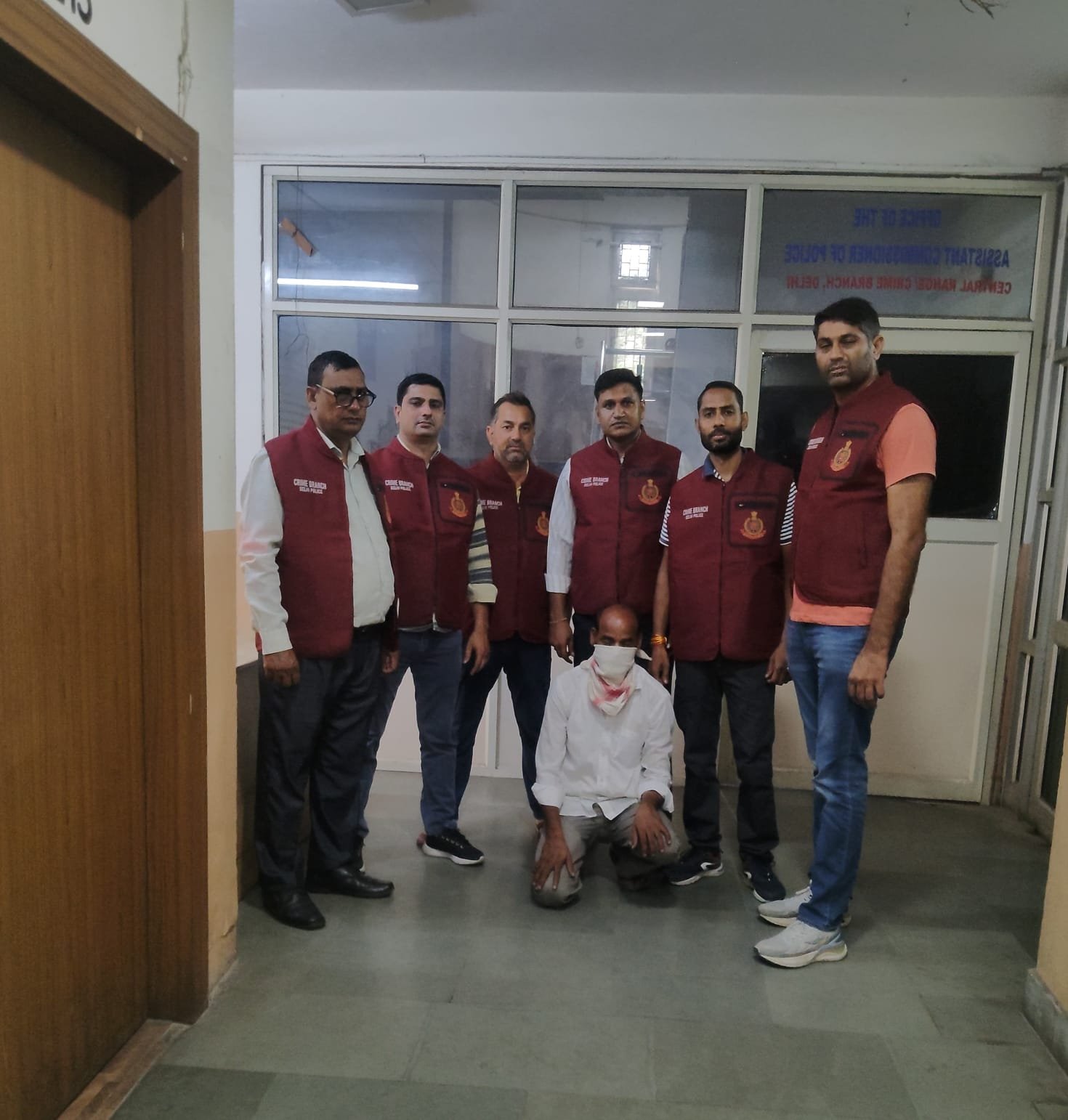
The Delhi Police Crime Branch has cracked a nearly three-decade-old Murder Case, bringing to an end one of the longest-running investigations involving a fugitive who had successfully evaded law enforcement for almost 29 years. The arrest of the accused from Lucknow, Uttar Pradesh, demonstrates that even after decades, serious crimes remain under active scrutiny and that investigators continue to pursue justice regardless of how much time has passed.
The breakthrough came after the Crime Branch reopened the Murder Case, re-examined old evidence, gathered fresh intelligence, and carried out extensive fieldwork despite the absence of modern digital records from the time the crime was committed. The operation eventually led officers to the accused, who had allegedly spent years changing his identity and moving across multiple cities to stay out of the reach of law enforcement agencies.
The successful resolution of this Murder Case reflects the determination, patience, and investigative skills of the Delhi Police Crime Branch, which refused to let an old file remain forgotten. Instead, investigators treated the case with renewed urgency, proving that justice can still prevail even after several decades.
Table of Contents
Accused Arrested After Nearly Three Decades
The accused has been identified as Mohammad Faheem alias Ali Bhai, who was wanted in connection with a Murder Case registered at Rajouri Garden Police Station in 1997. Following the crime, he allegedly disappeared and remained untraceable for years despite police efforts to locate him.
Since he failed to appear before the court during the legal proceedings, he was declared a Proclaimed Offender (PO) in the same year. A proclaimed offender is an accused person who deliberately avoids arrest and ignores court proceedings, leading the court to officially declare them absconding under the law.
For almost 29 years, the accused managed to remain outside the reach of investigators by relocating frequently and reportedly assuming different identities. Such long periods of absconding often make a Murder Case significantly more difficult to solve because witnesses become harder to locate, records age, and physical evidence may no longer be available.
Despite these challenges, the Delhi Police Crime Branch continued to pursue the matter, eventually locating and arresting the accused from the Thakurganj area of Lucknow on July 3, 2026.
Murder Case Dates Back to March 1997
According to officials from the Crime Branch, the Murder Case began with the recovery of a body from a room in TC Camp, Raghubir Nagar, on March 14, 1997.
The deceased was later identified as Sharif Hasan Khan, aged 58, a native of Faizabad, now officially known as Ayodhya, in Uttar Pradesh. He had been working at a garment shop in Delhi’s Rajouri Garden area and had reportedly been living in the city for employment.
Police investigations at the time revealed that Mohammad Faheem had also arrived in Delhi in search of work and was known to Sharif Hasan Khan. Their acquaintance eventually became central to the Murder Case as investigators attempted to reconstruct the events leading up to the victim’s death.
The investigation found that both men had interacted shortly before the crime, providing police with an important lead that later formed the basis of the prosecution’s case.
Dispute Over Money Allegedly Led to the Crime
Investigators believe the incident stemmed from a financial disagreement between the accused and the victim.
According to the Crime Branch, an argument reportedly broke out on March 13, 1997, over money. During the confrontation, the accused allegedly attacked Sharif Hasan Khan with an iron rod multiple times. Police further alleged that after the assault, the victim was strangled with a rope.
Investigators stated that after committing the crime, the accused allegedly attempted to conceal the offence by placing the victim’s body inside a wooden divan storage box before fleeing the location.
The concealment of the body delayed the discovery of the full circumstances surrounding the crime and added another layer of complexity to the Murder Case. However, once the body was recovered and the investigation began, police gradually pieced together the sequence of events using available evidence and witness statements.
Why the Investigation Became So Challenging
One of the biggest reasons this Murder Case remained unresolved for so many years was the period in which it occurred.
The crime took place in 1997, when digital policing systems, facial recognition software, extensive surveillance networks, online identity databases, and mobile phone tracking technologies were either unavailable or in their infancy in India.
Unlike modern investigations, officers could not rely on CCTV footage collected from multiple locations, digital financial transactions, Aadhaar-linked records, smartphone location histories, or integrated national databases.
As the years passed, locating the accused became increasingly difficult because he reportedly changed his identity several times while moving across different states.
The lack of recent photographs further complicated the search. Investigators had to rely heavily on traditional policing methods, including intelligence gathering, local verification, and human informants rather than technological tools.
These factors turned the investigation into one of the more demanding long-pending Murder Case probes handled by the Crime Branch.
Fresh Investigation Revived the Murder Case
Rather than allowing the file to remain among unresolved historical cases, the Delhi Police Crime Branch decided to reopen the Murder Case with renewed focus.
Investigators reviewed available records, revisited earlier findings, and carefully examined every piece of information collected during the original investigation. Officers also gathered fresh intelligence to determine whether the accused was still alive and whether he maintained any contact with his native village.
Police activated their local intelligence network and deployed informants in areas connected to the accused. This traditional policing approach proved highly effective.
During the renewed investigation, officers received information suggesting that although the accused had been living under different identities, he occasionally returned to his native village.
This critical lead encouraged investigators to intensify surveillance and monitor his possible movements.
Intelligence Network Leads Police to Lucknow
After weeks of careful monitoring, investigators reportedly established that the accused was present in Lucknow.
His movements were traced to the Chowk Kotwali area, following which the Crime Branch conducted further verification to avoid any possibility of mistaken identity.
Once sufficient evidence and credible intelligence were gathered, a police team travelled to Uttar Pradesh and carried out a targeted operation in the Thakurganj locality on July 3, 2026.
The operation ended successfully with the arrest of Mohammad Faheem without allowing him another opportunity to escape.
The arrest marked a significant breakthrough in the long-pending Murder Case and demonstrated the value of patient intelligence gathering, careful planning, and coordination between different police units.
Accused Allegedly Confessed During Interrogation
According to police officials, the accused admitted his involvement in the Murder Case during interrogation.
He allegedly stated that the killing occurred following a dispute over money with Sharif Hasan Khan.
Police further said that after committing the offence, he fled Delhi and initially reached Nagpur before moving between several cities, including Mumbai, Lucknow, and Nagpur.
During these years, investigators believe he continuously altered his identity to avoid detection by law enforcement agencies.
Authorities are expected to complete all remaining legal formalities before presenting the accused before the appropriate court to face trial in the long-pending Murder Case.
As with any criminal proceeding, the allegations and confession will ultimately be examined through the judicial process, where the prosecution will present its evidence before the court.
Importance of Solving Cold Murder Cases
Cases like this underline the importance of reopening unsolved investigations, especially those involving serious offences such as murder.
Across the world, law enforcement agencies periodically revisit old Murder Case files because advances in investigative techniques, fresh intelligence, or renewed witness cooperation often provide new opportunities to solve crimes that once appeared impossible to crack.
Even when modern forensic tools are unavailable, experienced investigators frequently succeed by combining historical records with fresh intelligence collected through field operations.
The resolution of such cases also sends a strong message that fleeing justice for years does not guarantee permanent freedom. Individuals accused of serious offences may still be traced through persistent investigation, intelligence networks, and coordinated police efforts.
Long-pending Murder Case investigations require exceptional patience, institutional memory, and commitment from investigating officers, particularly when records are decades old and evidence is limited.
Delhi Police’s Persistence Brings Long-Awaited Breakthrough
The successful arrest in this Murder Case stands as a testament to the professionalism and unwavering commitment of the Delhi Police Crime Branch. Despite the passage of nearly three decades, investigators refused to treat the case as forgotten history. Instead, they invested time, manpower, and intelligence resources to ensure that the accused was finally brought before the law.
The operation highlights the strength of traditional policing methods, including human intelligence, local verification, and meticulous surveillance, which remain invaluable even in an era dominated by technology. By overcoming the absence of digital records, recent photographs, and modern investigative tools, the Crime Branch demonstrated remarkable perseverance and investigative excellence.
For the victim’s family and for society, solving this Murder Case reinforces confidence in the criminal justice system. It serves as a reminder that serious crimes continue to receive attention regardless of how much time has passed and that dedicated police work can eventually uncover the truth, even after 29 years.