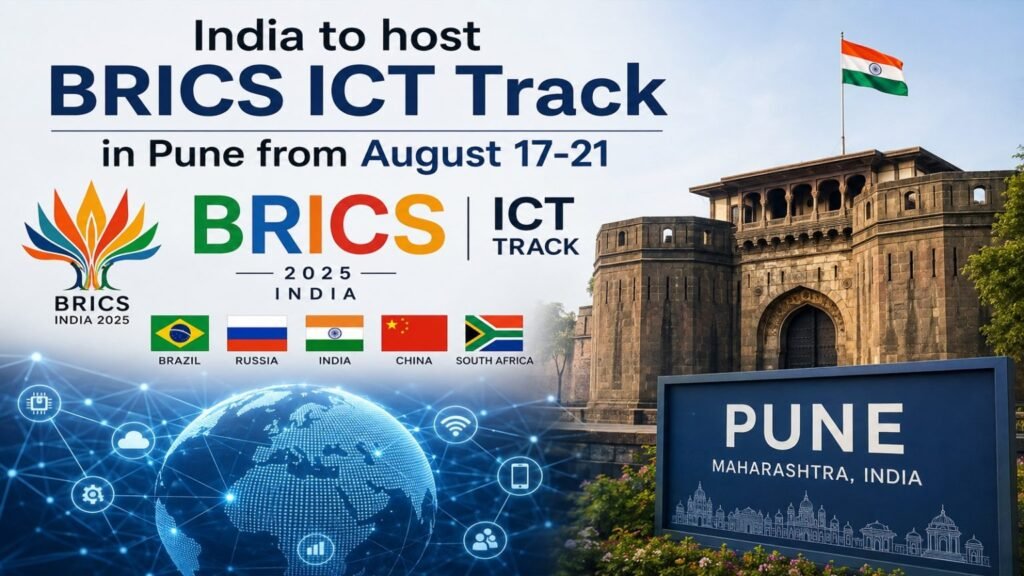
India is set to host the BRICS ICT Track in Pune from August 17 to 21, 2026, bringing together Communications Ministers, senior government officials, policymakers and technology experts from BRICS member countries to strengthen international cooperation in information and communication technologies (ICTs).
The five-day programme is being organised by the Department of Telecommunications (DoT) as part of India’s BRICS Chairship for 2026. It will focus on advancing cooperation in emerging technologies, cybersecurity, digital skills, connectivity and innovation while promoting the development of secure, inclusive, sustainable and resilient digital ecosystems.
Held under the theme “Innovate, Cooperate and Transform (ICT) for a Resilient Future,” the programme is expected to provide an important platform for BRICS nations to exchange policy experiences, identify areas of technological cooperation and discuss challenges emerging from the rapid digital transformation of economies and societies.
The Pune programme will comprise three major events — the 7th BRICS Working Group Meeting for Cooperation in ICTs, the Digital BRICS Forum and Expo, and the 12th BRICS Communications Ministers Meeting.
Table of Contents
BRICS ICT Track: What to Expect in Pune
The BRICS ICT Track is designed to strengthen collaboration among member countries on issues that are becoming increasingly important to the global digital economy.
Digital connectivity, artificial intelligence, cybersecurity, next-generation communication technologies and digital public infrastructure are transforming how governments, businesses and citizens interact. At the same time, the expansion of digital services has created new challenges related to online safety, cybersecurity, privacy, digital skills and the resilience of critical infrastructure.
Against this backdrop, the Pune meetings will seek to develop common approaches and encourage cooperation among BRICS countries.
The programme will also examine how technology can contribute to sustainable and inclusive economic development, particularly by expanding access to digital services and strengthening digital capabilities across societies.
BRICS ICT Working Group Meeting from August 17 to 19
The five-day programme will begin with the 7th BRICS ICT Working Group Meeting, scheduled to take place from August 17 to 19.
The working group will serve as a key platform for detailed discussions among officials and experts from BRICS countries. Delegates are expected to deliberate on ways to create ICT ecosystems that support universal, meaningful, affordable, sustainable and resilient connectivity.
The discussions will extend beyond simply expanding internet access. The focus is also expected to be on ensuring that digital connectivity is reliable, secure and accessible to different sections of society.
A major area of discussion will be the development of trusted, secure and human-centric digital environments. As digital technologies become more deeply integrated into everyday life, ensuring that people can use digital platforms safely and responsibly has emerged as an important policy priority.
The working group will also discuss digital skills and capacity development, recognising the need to equip citizens and workers with the skills required to participate effectively in increasingly digital economies.
Artificial Intelligence, Cybersecurity and Emerging Technologies on Agenda
Emerging technologies are expected to feature prominently during the BRICS ICT discussions.
Artificial intelligence (AI) has become a major driver of technological and economic change, with applications ranging from public services and healthcare to education, manufacturing and communications. BRICS countries are expected to explore areas where greater cooperation in AI and other emerging technologies can support innovation while addressing issues surrounding security, trust and responsible deployment.
Next-generation communications will also be an important area of discussion. Advances in communications networks are essential for supporting connected devices, digital services, smart infrastructure and emerging technologies that require high-speed and reliable connectivity.
Another important priority will be Digital Public Infrastructure (DPI). India has emerged as a prominent example of large-scale digital public systems, and discussions within the BRICS framework could provide an opportunity for member countries to share experiences and explore potential areas of cooperation.
Cybersecurity will remain another critical component of the ICT agenda. As governments, businesses and citizens become increasingly dependent on digital networks, protecting communications infrastructure and digital services from cyber threats has become essential to maintaining economic and social stability.
The working group is also expected to address child online protection, highlighting the importance of creating safer digital environments for younger users.
Focus on Startups, Innovation and Entrepreneurship
Innovation and entrepreneurship will form another significant part of the BRICS ICT agenda.
The participating countries are expected to discuss ways to strengthen innovation, startups and entrepreneurship in the ICT sector. Startups play an important role in developing emerging technologies and introducing new digital products and services, while supportive policy frameworks can help innovative businesses scale across domestic and international markets.
Greater cooperation among BRICS economies could create opportunities for knowledge sharing, technology partnerships and collaboration between innovation ecosystems.
For developing and emerging economies in particular, strengthening domestic technology capabilities can contribute to job creation, economic growth and greater technological self-reliance.
Digital BRICS Forum and Expo on August 20
The Digital BRICS Forum and Expo will take place on August 20.
The event will provide a platform for showcasing cooperation in emerging digital technologies and highlighting approaches to building resilient ICT ecosystems.
The forum will feature thematic discussions on cybersecurity and trustworthy ICTs, including child online protection. These discussions are expected to examine the importance of trust and safety as digital services become increasingly central to communication, commerce and public administration.
Another focus will be the development of sustainable and resilient digital and ICT ecosystems.
The inclusion of an expo alongside the forum is expected to provide an opportunity to showcase technological developments and solutions related to the broader digital transformation agenda.
The event will therefore complement the technical and policy discussions of the working group by providing a platform for demonstrating innovation and highlighting the practical applications of emerging technologies.

BRICS Communications Ministers Meeting on August 21
The programme will conclude with the 12th BRICS Communications Ministers Meeting on August 21.
India will be represented by Union Communications and Development of North Eastern Region Minister Jyotiraditya M. Scindia.
Communications Ministers from BRICS countries are expected to review the priorities discussed throughout the ICT Track and explore ways to deepen cooperation in several strategic areas.
These include sustainable and resilient ICT ecosystems, cybersecurity and trustworthy ICT, digital skilling and capacity building, and innovation, startups and entrepreneurship.
The ministerial meeting is expected to provide political direction to the broader ICT cooperation agenda and help translate discussions held by officials and experts into areas for continued collaboration among BRICS members.
Who Are the BRICS Members?
BRICS currently comprises 11 emerging and developing economies: Brazil, China, Egypt, Ethiopia, India, Indonesia, Iran, Russia, Saudi Arabia, South Africa and the United Arab Emirates.
The expansion of the grouping has increased the diversity and geographic reach of BRICS and brought a wider range of economic and technological perspectives into its discussions.
The ICT Track provides one avenue through which these countries can cooperate on shared challenges associated with digital transformation.
While individual BRICS countries have different levels of technological development and different regulatory environments, many face common challenges, including expanding connectivity, strengthening cybersecurity, developing digital skills and ensuring that technological growth remains inclusive and sustainable.
Why Digital Cooperation Matters for BRICS Countries
Technology has become an increasingly important component of economic development and international cooperation.
Reliable communications infrastructure supports businesses, public services, education, healthcare, financial services and government administration. As economies become more dependent on digital networks, disruptions to ICT infrastructure can have consequences extending well beyond the technology sector.
This makes digital resilience an increasingly important policy objective.
Resilient digital ecosystems require not only physical infrastructure and advanced communication networks but also cybersecurity capabilities, skilled professionals, effective policies and cooperation between governments and technology stakeholders.
The BRICS ICT Track’s emphasis on resilience therefore reflects a broader shift in the global technology agenda towards building digital systems that can withstand disruptions while remaining accessible and trustworthy.

India’s BRICS Chairship and Technology Agenda
The hosting of the ICT Track in Pune is part of India’s broader efforts under its 2026 BRICS Chairship to strengthen international cooperation in technology and digital development.
India’s emphasis on digital innovation and digital public infrastructure has become an important part of its engagement in international technology discussions. Through the BRICS framework, India is seeking to work with partner countries on areas where cooperation can support inclusive and sustainable digital growth.
The Ministry of Communications said the Pune programme reflects India’s commitment to promoting digital innovation and technology-led, sustainable and inclusive growth, while working with BRICS partners to build a resilient digital future.
The choice of Pune also places the programme in a major Indian technology and industrial ecosystem. Maharashtra’s technology sector, startup environment and growing digital infrastructure provide a relevant setting for discussions centred on innovation and emerging technologies.
Building a More Inclusive Digital Future
One of the broader themes running through the BRICS ICT Track will be the need to ensure that technological progress benefits people across different communities and economies.
Digital transformation can create significant opportunities, but unequal access to infrastructure, devices, skills and digital services can also deepen existing inequalities.
This makes affordable connectivity and digital capacity building central to the discussion.
The emphasis on universal and meaningful connectivity indicates a broader approach in which access to technology is considered alongside affordability, quality, security and the ability of people to use digital services effectively.
Digital skills will similarly be important. As AI, automation and advanced communications technologies reshape workplaces, governments and institutions face the challenge of preparing citizens for new forms of employment and economic participation.
Cybersecurity and Trust at the Centre of Digital Transformation
The expansion of digital ecosystems has also increased the importance of cybersecurity.
Government systems, financial networks, communications infrastructure and private-sector platforms all rely heavily on secure digital technologies. Cyber incidents can disrupt essential services, compromise sensitive information and undermine confidence in digital systems.
Consequently, the focus on trustworthy ICT and cybersecurity is expected to remain a central element of the Pune discussions.
The inclusion of child online protection further broadens the agenda from infrastructure security to the safety and wellbeing of digital users.
Creating trusted digital environments requires cooperation among governments, technology companies, civil society and other stakeholders. International cooperation can help countries share experiences, strengthen capabilities and develop approaches to emerging digital risks.
Pune to Become a Key Platform for BRICS Digital Cooperation
The BRICS ICT Track in Pune will bring together a wide range of policymakers and technology stakeholders over five days, covering technical discussions, thematic forums and ministerial-level engagement.
Beginning with the ICT Working Group Meeting on August 17, followed by the Digital BRICS Forum and Expo on August 20 and the Communications Ministers Meeting on August 21, the programme will provide multiple levels of engagement on the future of digital cooperation.
With AI, next-generation communications, Digital Public Infrastructure, cybersecurity, digital skills, startups and digital resilience among the key areas under discussion, the Pune programme is expected to address some of the most important issues shaping the global technology landscape.
As India leads the BRICS ICT Track under its 2026 Chairship, the programme will also provide an opportunity to strengthen partnerships among emerging and developing economies and explore how technology can support sustainable and inclusive growth.
The central message of the five-day programme — “Innovate, Cooperate and Transform (ICT) for a Resilient Future” — reflects the growing importance of international collaboration in navigating the opportunities and challenges created by rapid digital transformation.