Union Home Minister Amit Shah has offered to respond to questions from the Opposition as Parliament’s Monsoon Session continues to face repeated disruptions, with the government and Opposition locked in a standoff over the handling of protests by students. The Opposition has been demanding a statement from Shah on the alleged police action against demonstrators, while the government has maintained that it is ready for a discussion under parliamentary rules.
The deadlock has affected proceedings in both Houses, with repeated adjournments and several legislative measures being taken up amid protests. Reports on August 11 said Opposition MPs continued to demand Amit Shah’s presence and answers, while the government argued that the matter could be discussed if normal proceedings were restored.
The latest development has placed the focus squarely on whether the two sides can find common ground before the Monsoon Session concludes.
Table of Contents
Parliament Deadlock Deepens
The confrontation has continued for several days, with Opposition members raising slogans and entering the Well of the House during protests. The central demand has been for the Home Minister to address allegations concerning police action against protesting students.

The disruption has had a direct effect on parliamentary business. On August 11, several Bills were passed in the Lok Sabha without substantive debate amid continuing Opposition protests.
The situation has created a familiar parliamentary dilemma: the Opposition wants the government to address an issue it considers urgent, while the government wants legislative business and structured discussion to proceed.
The dispute has therefore moved beyond the original student protest issue and developed into a broader argument over parliamentary functioning, accountability and the right of lawmakers to demand answers from ministers.
Amit Shah Offers to Answer Questions
The government’s position has been that it is prepared to discuss the student protest issue in Parliament and that Amit Shah will respond.
Parliamentary Affairs Minister Kiren Rijiju said the government was ready to discuss the matter, with Amit Shah expected to reply. The offer, however, has not immediately ended the impasse.
The Opposition has continued to insist that Amit Shah himself should address the House. Opposition leaders have argued that the Home Minister’s direct response is necessary because the allegations concern matters under the Home Ministry’s broader administrative responsibilities.
The disagreement is consequently not simply about whether a discussion should take place. It is also about the terms, timing and circumstances under which that discussion should happen.
Opposition Demands Statement on Student Protests
The immediate issue behind the confrontation is the alleged use of force against protesting students.
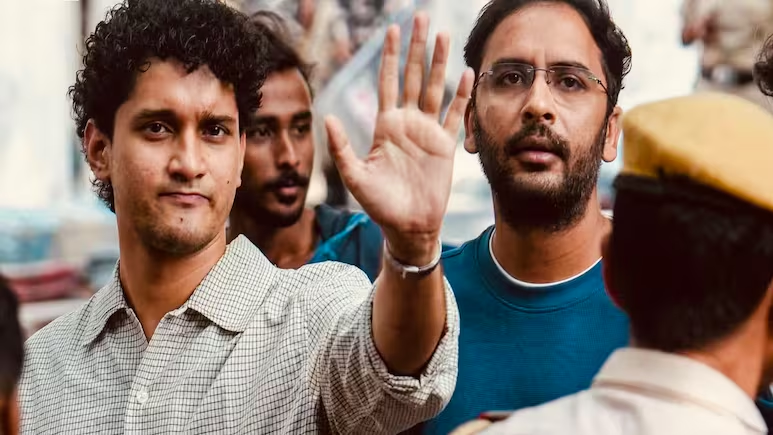
Opposition MPs have demanded clarification regarding the police action during a student protest at Jantar Mantar. Reports have described the Opposition as seeking accountability from the Home Minister over the alleged use of force against demonstrators.
Congress leaders have maintained that their position has remained consistent from the beginning of the dispute. Congress president Mallikarjun Kharge said the Opposition was not changing its demands and continued to seek a statement from Amit Shah.
The Opposition has also linked its demand to other issues, including allegations concerning donations to the Ram temple in Ayodhya. The government and Opposition remain divided over whether these matters should be discussed together or separately.
Government Says Discussion Is Possible
The government has attempted to distinguish between its willingness to discuss the student protest and the broader demands being raised by Opposition parties.
According to reports, the Centre has offered a discussion on the student protests, with Amit Shah prepared to respond, but has sought an environment in which parliamentary proceedings can continue normally.
This position has produced a procedural disagreement.
The government argues that Parliament needs to function according to its established rules. The Opposition, meanwhile, argues that continued disruption is a consequence of the government’s refusal to first provide the answers it is seeking.
As a result, each side has placed responsibility for the continuing deadlock on the other.
Why Amit Shah’s Role Matters
As Union Home Minister, Amit Shah occupies one of the most important positions in the Union government. The Home Ministry deals with a wide range of internal security and policing-related matters, although policing itself is primarily a state subject under India’s constitutional framework.
His proposed response therefore carries significant political importance.
A statement by Amit Shah could potentially clarify the government’s position on the allegations and provide an official explanation of what happened during the student demonstrations. It could also give the government an opportunity to respond directly to accusations raised by Opposition parties.
At the same time, the Opposition sees the demand for Amit Shah’s statement as an accountability issue. Its leaders want the minister to answer questions in the House rather than leaving the matter to political exchanges outside Parliament.
Parliamentary Affairs Minister Defends Government Position
Kiren Rijiju has been one of the government’s principal voices in the dispute.
He has said that the government is ready to discuss the student protests and that Amit Shah would respond.
The government’s approach reflects its broader effort to separate the question of discussion from the question of disruption.
The Centre has argued that Parliament should be allowed to function and that issues can be debated through established procedures. The Opposition has countered that its protests are necessary to draw attention to what it considers an important public issue.
This disagreement over parliamentary procedure has become one of the defining features of the current session.
Legislative Business Continues Amid Protests
Despite the deadlock, Parliament has continued to transact some legislative business.
On August 11, the Lok Sabha passed two Bills amid Opposition protests, including legislation concerning the proposed renaming of Kerala as “Keralam” and an amendment relating to the National Cooperative Development Corporation. Reports said the Bills were passed without debate because of the continuing disruptions.
The passage of legislation without substantial debate has itself become a point of political contention.
For the government, continuing legislative work is important because Parliament’s primary function is to consider and pass legislation. For the Opposition, however, proceedings conducted amid protests raise questions about whether adequate discussion and scrutiny are taking place.
The situation illustrates how prolonged disruption can affect not only political messaging but also the legislative process.
Opposition Says Its Position Has Not Changed
Mallikarjun Kharge has rejected suggestions that the Opposition has shifted its position during the standoff.
According to reports, Kharge said the Opposition had maintained the same position from the beginning and continued to seek a statement from Amit Shah regarding the alleged police action against students.
This is significant because the government has sought to frame the continuing disruption as a result of Opposition unwillingness to accept its offer of discussion.
The Opposition’s response is that a discussion must address its core demands and that the Home Minister needs to provide direct answers.
The two sides therefore remain separated by both substantive and procedural disagreements.
The Wider Political Context
The Parliament standoff comes against a broader backdrop of political disagreements during the Monsoon Session.
Other contentious matters have included the Foreign Contribution Regulation Act, delimitation and issues connected with the functioning of Parliament.
The accumulation of multiple disputes has made it more difficult to isolate one issue from the broader political confrontation.
For the ruling National Democratic Alliance, maintaining legislative momentum remains a priority. For Opposition parties, forcing the government to respond to issues they consider important is an essential part of parliamentary politics.
The current deadlock reflects this larger struggle over how the session should proceed.
What Amit Shah’s Response Could Mean
If Amit Shah addresses the House, his response could become a major political moment in the remaining part of the session.
A detailed statement could potentially clarify the government’s understanding of the events surrounding the student protests. It could also provide an opportunity for Opposition MPs to raise questions and seek further explanations.
However, a statement alone may not automatically resolve the deadlock.
The Opposition has raised multiple demands, and reports indicate that some of them remain linked to other issues. The government, meanwhile, has insisted on restoring orderly proceedings.
The success of any effort to break the impasse will therefore depend on whether both sides agree on the format and scope of the discussion.
Parliament’s Role in Resolving Disagreements
Parliament is designed to provide a forum where disagreements between the government and Opposition can be debated.
Questions, discussions, statements, debates and committee scrutiny are among the mechanisms through which lawmakers can seek information and hold the executive accountable.
At the same time, parliamentary rules are intended to ensure that debates take place in an orderly manner.
The current confrontation highlights the tension between these two principles. Opposition parties want the government to respond to their concerns, while the government wants those concerns to be raised through a functioning House.
Finding a balance between protest and parliamentary functioning remains central to resolving the present situation.
Student Protests Remain at the Centre
Although the political confrontation has expanded, the original issue remains the student protests.
For students and job aspirants, the controversy is connected to concerns about recruitment examinations, government employment and the handling of demonstrations.
The political debate over the issue can sometimes overshadow the concerns of the students themselves. A parliamentary discussion could potentially bring greater attention to the specific allegations and allow the government to explain the steps being taken.
The outcome will therefore be closely watched not only by political parties but also by students and young people following the controversy.
What Happens Next?
With the Monsoon Session nearing its conclusion, pressure is growing on both sides to find a way forward.
Recent reports indicate that the deadlock had continued into August 12, with Parliament’s session approaching its final day.
The government could continue offering a structured discussion on the student protests, while Opposition parties may maintain their demand for Amit Shah’s direct intervention.
Whether the two sides reach an agreement will determine how much legislative business can be completed and whether the student protest issue receives a detailed parliamentary discussion.
The coming proceedings could therefore be crucial for determining whether the standoff ends through negotiation or continues until the close of the session.
The Parliament deadlock has entered a critical phase, with Union Home Minister Amit Shah at the centre of the dispute over the Opposition’s demand for answers concerning alleged police action against protesting students.
The government has maintained that it is ready to discuss the issue and that Amit Shah can respond, while the Opposition continues to insist on a direct statement and accountability.
The continuing disagreement has already affected parliamentary proceedings, with repeated disruptions and some Bills being passed without substantive debate.
Ultimately, the immediate challenge is to restore Parliament’s ability to function while ensuring that concerns raised by Opposition lawmakers receive a meaningful response. A direct statement from the Home Minister could provide clarity, but resolving the wider standoff will require agreement on how the different issues should be discussed.
As the Monsoon Session reaches its final stage, all eyes are now on whether the government and Opposition can move from confrontation to discussion and allow Parliament to address the issues at the heart of the dispute.