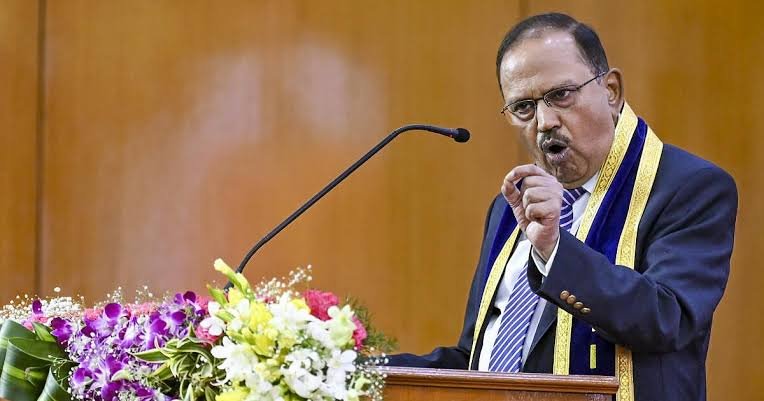
National Security Advisor Ajit Doval has spoken publicly about the thinking behind Operation Sindoor, describing the mission’s central objective and stressing that India’s willingness to show restraint should not be mistaken for weakness.
In his first interview since the operation, featured in Discovery’s upcoming two-part docuseries “Declassified: Operation Sindoor,” Doval said the objective had been clearly defined: to destroy enemy camps, particularly those associated with those responsible for the April 22, 2025, Pahalgam terror attack. He also said India is prepared to take risks and respond forcefully when national security requires it.
The comments provide a rare public insight into the strategic thinking surrounding the operation and come more than a year after Operation Sindoor began in May 2025.
Table of Contents
Ajit Doval Reveals Operation Sindoor’s Objective
According to Ajit Doval, the mission was not conceived as an open-ended military campaign. Its objective was defined around the destruction of enemy camps, particularly those linked to the Pahalgam attack.

The Pahalgam attack on April 22, 2025, had killed 26 people and triggered a major deterioration in India-Pakistan relations. India subsequently launched Operation Sindoor on May 7, targeting what the government described as terrorist infrastructure in Pakistan and Pakistan-occupied Jammu and Kashmir.
Ajit Doval’s comments underline the distinction between targeting terrorism and pursuing a broader military confrontation.
The operation, as described by Indian authorities, focused on terrorist infrastructure rather than being framed as a conventional war between the two countries.
‘India Can Hit Hard’: Ajit Doval’s Strong Message
One of the most significant parts of Ajit Doval’s remarks was his warning against interpreting India’s tolerance or restraint as weakness.
He said India could take risks and “hit hard” regardless of the consequences, presenting the statement as a broader message about the country’s national-security posture.
The statement is significant because Ajit Doval has generally spoken about national security in strategic rather than political terms. His latest remarks therefore offer an indication of how the government views deterrence following Operation Sindoor.
The message is essentially that restraint can be a strategic choice rather than an inability to respond.
What Was Operation Sindoor?
Operation Sindoor was launched by India on May 7, 2025, following the Pahalgam terror attack.
According to the Press Information Bureau, the operation was conceived to punish the perpetrators and planners of the attack and destroy the infrastructure supporting cross-border terrorism. Indian authorities said intelligence was used to identify terrorist facilities before the strikes.
The government subsequently said nine terrorist camps were targeted.
Official accounts have described the operation as limited and precise, with an emphasis on avoiding unnecessary escalation and civilian casualties. The government’s stated objective was to strike terror infrastructure rather than expand the confrontation into a wider conflict.
This distinction has remained central to India’s public explanation of Operation Sindoor.
The Pahalgam Attack and the Decision to Respond
The background to Operation Sindoor lies in the Pahalgam attack of April 22, 2025.
The attack became a major national-security crisis, with 26 people killed. Indian authorities subsequently linked the attack to Pakistan-based terrorist networks and said the perpetrators and their support infrastructure needed to be held accountable.
The response marked another stage in India’s evolving approach to cross-border terrorism.
Rather than limiting its response to diplomatic protests, India used military force against identified terror infrastructure. The government presented this as part of a broader policy of making terrorist attacks carry a direct cost for those responsible.
Why Ajit Doval’s Interview Matters
Ajit Doval’s latest interview is significant because it provides a first-hand account from one of India’s most senior national-security officials.
The Discovery documentary brings together senior military and national-security leadership to discuss the decisions and events surrounding Operation Sindoor. According to the broadcaster’s description, the programme includes first-hand accounts from people involved in overseeing India’s response.
For the public, such accounts can provide additional context about the decision-making process behind a major national-security operation.
Ajit Doval’s participation is particularly notable because he has been India’s National Security Advisor since 2014 and has played a prominent role in the country’s security policymaking.
An 88-Hour Military Confrontation
Operation Sindoor subsequently developed into a broader military confrontation between India and Pakistan that lasted nearly 88 hours, according to current reports.
After India’s initial strikes, Pakistan launched attacks against India, followed by Indian counter-actions. The confrontation eventually halted on May 10, 2025, after the two sides reached an understanding to stop military action.
The episode demonstrated how quickly a limited response to terrorism can develop into a wider security crisis between two nuclear-armed neighbours.
It also highlighted the importance of controlling escalation once military operations begin.
Precision and Restraint Were Central Themes
Indian officials have repeatedly described Operation Sindoor in terms of precision and controlled use of force.
In an earlier public discussion, Ajit Doval said nine intended terrorist targets were hit and emphasised the role of India’s indigenous defence capabilities.
The government’s later descriptions have similarly stressed accurate intelligence, coordinated military action and the objective of limiting the operation to terrorist infrastructure.
This approach was also discussed by Chief of Defence Staff General Anil Chauhan in a 2026 interview. He described Operation Sindoor as a multi-domain operation involving the three armed services as well as cyber and information elements, while emphasising the importance of knowing when to escalate and when to disengage.

Operation Sindoor and India’s Changing Security Approach
The operation has increasingly been presented by Indian officials as evidence of a changing approach to national security.
Defence Minister Rajnath Singh has described Operation Sindoor as demonstrating India’s defence preparedness and the ability of the armed forces to conduct a coordinated response. In July 2026, he said the operation reflected improvements in India’s defence ecosystem and readiness.
Another Defence Ministry statement described the operation as a short-duration, deep-penetration and high-impact mission that demonstrated the country’s collective military resolve.
These statements suggest that Operation Sindoor is now being viewed not simply as an isolated military episode but as an important case study in India’s evolving defence doctrine.
Indigenous Defence Technology Also Played a Role
Another important aspect of the discussion around Operation Sindoor has been India’s growing emphasis on domestic defence technology.
Ajit Doval previously praised indigenous systems used during the operation, including the BrahMos missile and the Integrated Air Command and Control System.
The government has subsequently highlighted the operation while discussing the expansion of India’s domestic defence industry.
According to the Defence Ministry, India is seeking to increase domestic defence production and exports while investing in new technologies, including artificial intelligence and autonomous systems.
The larger objective is to reduce dependence on foreign suppliers and build greater technological self-reliance.
A Message About Deterrence
At the heart of Ajit Doval’s remarks is the concept of deterrence.
In simple terms, deterrence means convincing a potential adversary that aggressive action will carry serious consequences.
Ajit Doval’s statement that India’s generosity and tolerance should not be interpreted as weakness fits into this broader framework.
The message is not simply about military strength. It is also about communicating the ability and willingness to respond when national security is threatened.
This is particularly important in India’s relationship with Pakistan, where previous terrorist attacks have repeatedly produced periods of heightened military tension.
The Importance of Escalation Control
While Ajit Doval’s “hit hard” statement has attracted attention, the wider record of Operation Sindoor also highlights the importance of restraint.
General Anil Chauhan said in his 2026 interview that one of the lessons from the operation was understanding when and how to stop. He argued that modern technology can make precision military action easier, but knowing when to disengage remains a crucial strategic challenge.
That observation provides important context to Ajit Doval’s remarks.
A strong national-security posture does not necessarily mean continuous escalation. It can also involve deciding the limits of an operation and ending military action once its stated objectives have been met.
‘Declassified: Operation Sindoor’ to Offer More Details
Doval’s comments come as Discovery prepares to release “Declassified: Operation Sindoor,” a two-part documentary featuring senior figures involved in India’s national-security and military decision-making.
The series is scheduled to premiere on Saturday at 9 pm on Discovery and its streaming platform, according to reports.
The documentary is expected to provide a broader account of the decisions taken during the operation and the events that unfolded during the 88-hour confrontation.
Doval’s interview is therefore likely to attract considerable attention because public information about the highest-level decision-making surrounding the operation has been relatively limited.
What Ajit Doval’s Remarks Tell Us
The central message emerging from Doval’s interview is straightforward: India viewed Operation Sindoor as a targeted response to terrorism, with a clearly defined objective, while also seeking to demonstrate that the country possesses the capability and willingness to respond forcefully when necessary.
His comments also reinforce several themes that Indian officials have repeatedly emphasised since 2025:
- Clear objectives rather than open-ended military action
- Targeted responses against terrorism
- Deterrence as a component of national security
- Precision and intelligence-led operations
- Indigenous defence capabilities
- Escalation control and strategic restraint
Together, these elements form an important part of the government’s public explanation of Operation Sindoor.
Final Takeaway
Ajit Doval’s first interview since Operation Sindoor has brought renewed attention to the strategic thinking behind India’s response to the Pahalgam terror attack.
His revelation that the operation’s objective was to destroy enemy camps, particularly those responsible for the attack, provides a clearer picture of how the mission was defined. His warning that India’s tolerance should not be mistaken for weakness adds a broader deterrence message to that explanation.
The comments should also be viewed alongside the wider official record of Operation Sindoor, which emphasises targeted action, intelligence, military coordination and escalation control. The subsequent 88-hour confrontation showed the risks involved when tensions between two nuclear-armed neighbours rise rapidly.
As “Declassified: Operation Sindoor” brings together first-hand accounts from India’s military and national-security leadership, Doval’s remarks offer an important glimpse into the thinking behind one of India’s most consequential recent security operations. The documentary may provide further context on how the decisions were made and how India’s leadership sought to balance a forceful response with control over escalation.