The Supreme Court of India has expressed serious concern over a recent Patna High Court order that held forcibly removing a woman’s salwar and pressing her chest did not amount to an attempt to rape. The issue came before the apex court during proceedings on July 14, prompting the bench to take note of the observations while hearing a related matter concerning judicial approaches in sexual offence cases.
The development has once again brought into focus the manner in which courts interpret offences involving sexual violence, particularly at the preliminary stages of criminal proceedings. During the hearing, the Supreme Court also approved a comprehensive handbook intended to guide judges across the country on the appropriate language, reasoning, and sensitivity required while deciding sexual offence cases.
Table of Contents
Legal experts believe the latest proceedings reinforce the judiciary’s commitment to ensuring that cases involving women and children are adjudicated with greater care, consistency, and awareness of the legal principles governing sexual offences.
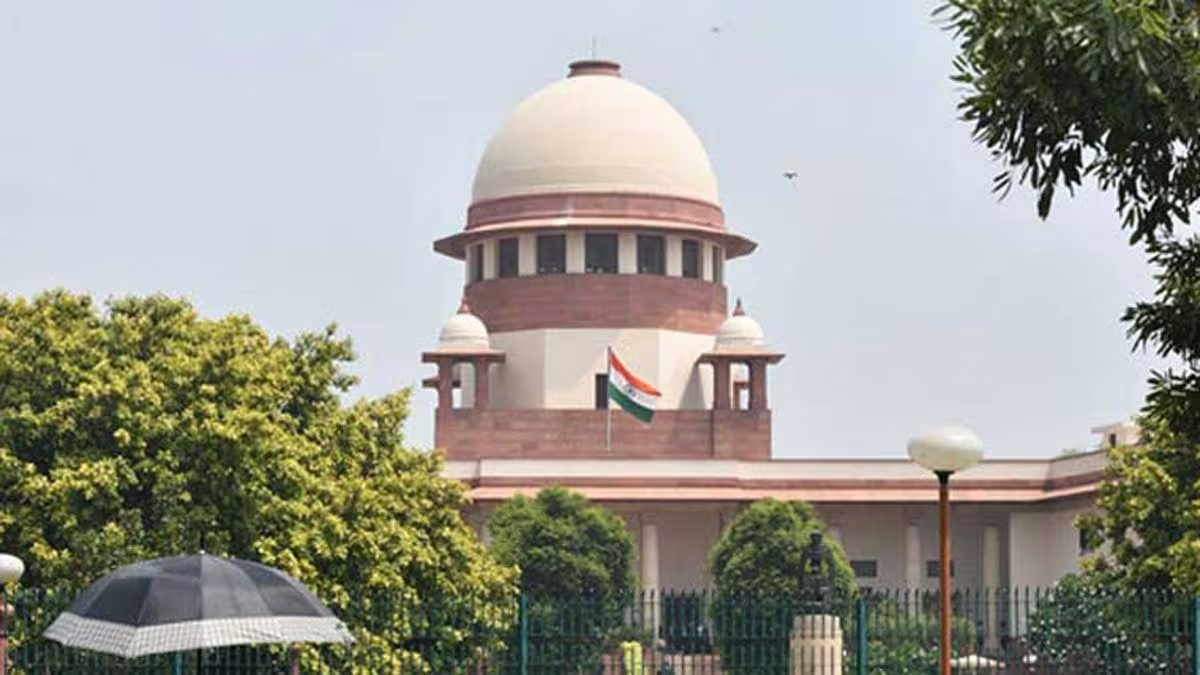
Supreme Court Takes Serious Note of Patna High Court Order
The issue arising from the Patna High Court order was brought before the Supreme Court by Senior Advocate Shobha Gupta, who referred to a recent order of the Patna High Court while addressing an ongoing matter involving judicial treatment of sexual offence cases.
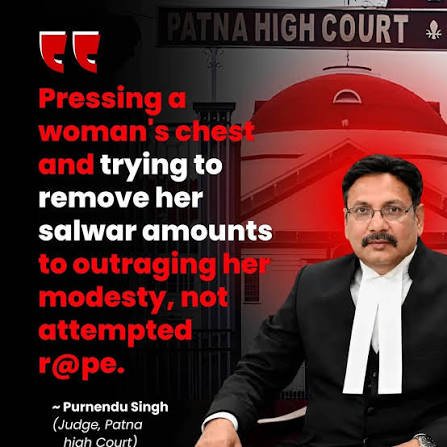
According to submissions made before the bench, the Patna High Court had observed that forcibly removing a woman’s salwar and pressing her chest would not constitute an attempt to rape. The observation immediately drew attention because of its potential implications for the interpretation of offences involving sexual assault and attempted rape under Indian criminal law.
The Supreme Court bench expressed concern over the Patna High Court reasoning over the reasoning reflected in the order and indicated that the matter deserved careful consideration.
Bench Led by Chief Justice of India Heard the Matter
The proceedings were heard by a bench comprising:
- Chief Justice of India Surya Kant
- Justice Joymalya Bagchi
- Justice V. Mohana
During the hearing, Advocate H.S. Phoolka also supported the submissions made by Senior Advocate Shobha Gupta.
Gupta informed the court that Patna High Court observations similar to earlier controversial rulings had continued to emerge that despite previous observations made by the Supreme Court in similar matters, comparable judicial interpretations had continued to emerge in recent months.
Her submission suggested that greater judicial consistency was required while dealing with cases involving allegations of sexual violence.
Earlier Allahabad High Court Case Forms Important Background
The Patna High Court controversy follows another case that had already prompted intervention by the Supreme Court earlier this year.
In February, the apex court took suo motu cognisance of an order passed by the Allahabad High Court involving an alleged sexual assault on a minor girl.
In that case, the High Court had reportedly held that:
- Grabbing a minor girl’s breasts,
- Tearing the string of her pyjama,
- Attempting to drag her beneath a culvert,
did not amount to an attempt to rape.
Instead, the incident had been treated as a lesser offence under the Protection of Children from Sexual Offences (POCSO) Act.
The ruling generated widespread legal discussion and criticism regarding the interpretation of criminal intent in sexual offence cases.
Supreme Court Set Aside Earlier High Court Order
While examining the Allahabad High Court judgment, the Supreme Court also reflected on concerns raised by the recent Patna High Court order, the Supreme Court disagreed with its reasoning.
The apex court subsequently set aside the order and emphasized that judicial reasoning in sexual offence cases must reflect both legal principles and the realities faced by victims.
Recognizing broader concerns, the court directed the National Judicial Academy to prepare detailed guidelines for judges handling such cases.
The objective was to improve consistency in judicial reasoning while promoting greater sensitivity toward survivors of sexual offences.
Fresh Judicial Guidelines Approved
During the July 14 hearing arising from concerns over the Patna High Court order, the Supreme Court formally approved, the Supreme Court formally approved the report prepared by an expert committee constituted for this purpose.
The report contains detailed guidance regarding:
- Appropriate terminology.
- Language to avoid.
- Judicial sensitivity.
- Gender-neutral reasoning where applicable.
- Respectful treatment of survivors.
- Avoidance of stereotypes.
- Consistent legal analysis.
The handbook is intended to assist judges while writing judgments involving allegations of sexual offences.
According to the court, careful use of language is essential because judicial observations often influence not only individual cases but also broader legal understanding.
Chief Justice Highlights Need for Better Judicial Research
During the hearing concerning the Patna High Court observations, the Chief Justice observed that adequate legal research had often been lacking in certain judgments dealing with sexual offence cases.
The observation underscored the importance of:
- Proper examination of statutory provisions.
- Careful analysis of evidence.
- Consistent interpretation of legal precedents.
- Awareness of victim-centric jurisprudence.
Legal commentators note that judicial language can significantly affect public confidence in the justice system, making precise reasoning especially important in sensitive criminal matters.
Handbook to Be Used Across India
Following the concerns raised over the Patna High Court ruling, the Supreme Court directed, the Supreme Court directed that the newly approved handbook be circulated widely throughout the judicial system.
According to the court’s directions, the handbook will be:
- Uploaded on the websites of all High Courts.
- Shared with District Courts.
- Distributed to judicial academies.
- Provided to law universities.
- Made available to law departments.
The objective is to promote uniform standards in the adjudication of sexual offence cases throughout the country.
Police Also Directed to Follow Appropriate Language
The Supreme Court extended the scope of the guidelines beyond the judiciary.
Police departments across India have also been directed to adopt appropriate terminology while preparing:
- First Information Reports (FIRs).
- Charge sheets.
- Investigation records.
- Official documentation relating to sexual offences.
Experts believe that respectful and legally accurate language at every stage of the criminal justice process contributes to a fairer and more sensitive handling of victims’ complaints.
National Judicial Academy’s Role
The National Judicial Academy plays an important role in judicial education across India.
Following the Supreme Court’s earlier directions, experts were tasked with preparing practical guidance that would assist judges in:
- Drafting judgments.
- Using appropriate language.
- Avoiding insensitive expressions.
- Applying gender-sensitive reasoning.
- Maintaining judicial neutrality.
The newly approved handbook represents the outcome of that exercise.
Supreme Court’s Directions Going Forward
The Supreme Court’s observations in the present matter highlight its continued emphasis on ensuring greater judicial sensitivity in sexual offence cases. Along with taking note of the Patna High Court order, the apex court has directed that the newly approved handbook be circulated across High Courts, District Courts, judicial academies, law universities, and police departments. The initiative aims to promote consistent judicial language and careful handling of cases involving sexual offences across the country.