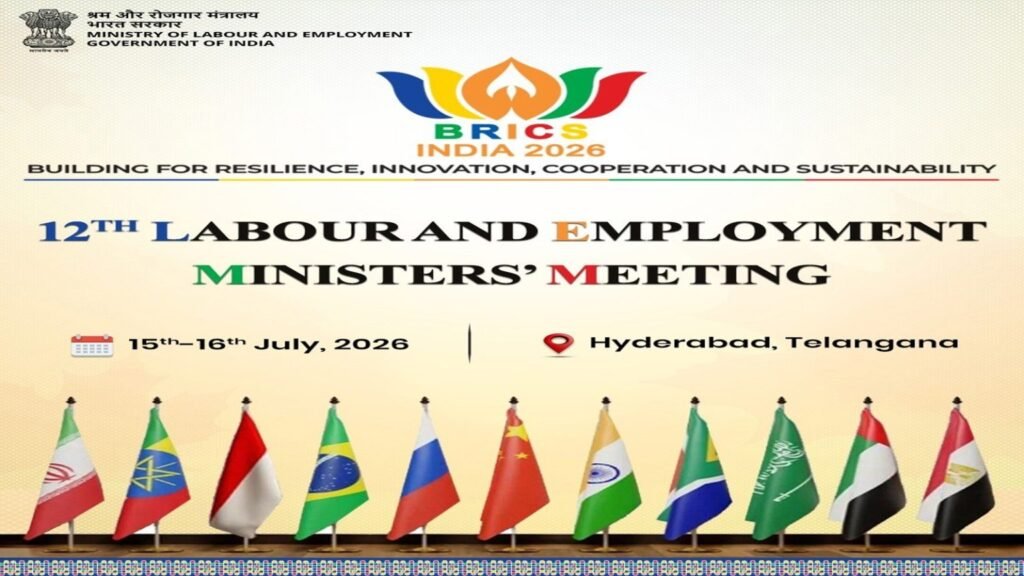
BRICS will take centre stage in Hyderabad as India hosts the 12th BRICS Labour and Employment Ministers’ Meeting (LEMM) on July 15 and 16. The high-level gathering brings together labour ministers, senior government officials, and policy experts from BRICS member nations to discuss some of the most pressing challenges shaping the future of global employment. From strengthening social protection systems to improving workforce participation, expanding skill development, and using digital technology to support workers, the meeting reflects the growing importance of labour cooperation within the BRICS framework.
The event is among the major ministerial engagements taking place under India’s BRICS Chairship in 2026 and carries the theme, “Building for Resilience, Innovation, Cooperation and Sustainability (BRICS).” Union Labour and Employment Minister Mansukh Mandaviya will chair the two-day ministerial session, where participating countries are expected to exchange policy experiences and identify practical solutions for creating more inclusive and resilient labour markets.
Table of Contents
Why the BRICS Meeting Matters
Over the past two decades, BRICS has evolved from an economic grouping into an influential platform for cooperation across multiple sectors, including trade, finance, healthcare, education, climate action, technology, and employment.
Labour and employment have become particularly significant because every BRICS nation is experiencing rapid changes in its workforce. Automation, artificial intelligence, digital platforms, remote work, demographic shifts, and economic transformation are changing how people work and the skills they require.
The Hyderabad meeting offers BRICS countries an opportunity to address these shared challenges collectively rather than individually. By exchanging successful policy models and innovative ideas, member nations hope to improve employment opportunities while ensuring workers remain protected during economic transitions.
Hyderabad Becomes the Centre of International Labour Dialogue
The choice of Hyderabad as the venue reflects India’s growing reputation as a centre for innovation, technology, and policy discussions.
Before the ministerial meeting, the city hosted the Third BRICS Employment Working Group (EWG) Meeting on July 13 and 14. During these discussions, officials from member countries reviewed national experiences and exchanged ideas across several labour-related priority areas.
The Employment Working Group serves as the technical platform where experts prepare recommendations before they are presented to labour ministers for final discussion and approval.
The recommendations developed during these meetings will help shape future cooperation among BRICS countries in labour and employment policies.
Four Major Areas Will Dominate the Discussions
One of the key strengths of this year’s BRICS Labour and Employment Ministers’ Meeting is its clear focus on practical issues affecting millions of workers.
The ministers will primarily discuss four important areas.
Strengthening Social Protection
The first priority is expanding social security systems and improving access to welfare benefits.
Many workers, particularly those in informal employment, often lack adequate health insurance, pensions, unemployment support, or workplace protection. BRICS countries are expected to exchange successful models for extending social protection to larger sections of society.
Improving labour market formalisation is also a key objective. Formal employment provides workers with legal protections, better wages, retirement benefits, and safer working conditions.
Countries will discuss policies that encourage businesses and workers to move from informal arrangements into formal employment systems.
Increasing Women’s Participation in the Workforce
The second major topic focuses on enhancing women’s participation in economic activities.
Although female workforce participation has improved in many countries, significant challenges remain, including unequal opportunities, wage gaps, limited childcare support, workplace discrimination, and barriers to career advancement.
The BRICS meeting will explore policies that promote gender inclusion, improve workplace equality, encourage entrepreneurship among women, and increase access to skill development programmes.
Participating countries are expected to share successful initiatives that have helped improve women’s employment in both urban and rural sectors.
Skills Development for a Changing Economy
The third priority area centres on employability and workforce skills.
Technological change is transforming industries at an unprecedented pace. Many traditional jobs are evolving while entirely new occupations continue to emerge in sectors such as artificial intelligence, robotics, renewable energy, cybersecurity, advanced manufacturing, and digital services.
Recognising these changes, BRICS countries will discuss strategies for skills mapping, vocational education, reskilling programmes, and lifelong learning initiatives.
Skills mapping helps governments identify future labour market demands and prepare workers with the competencies employers will require over the coming years.
Experts believe that continuous learning has become essential as technological innovation shortens the lifespan of many professional skills.
The discussions are expected to explore ways educational institutions, governments, and industries can work together to prepare future workforces more effectively.
Digital Technologies and the Rise of Platform Workers
One of the most closely watched discussions during the BRICS meeting will involve digital technologies and platform-based employment.
Digital platforms have transformed employment opportunities worldwide. Millions of workers now earn incomes through app-based services, online freelancing, e-commerce, delivery platforms, transportation services, and digital marketplaces.
While these opportunities offer flexibility and income generation, they also raise important questions regarding worker rights, social security, insurance, healthcare, and legal protections.
The Hyderabad meeting aims to identify policy approaches that balance innovation with worker welfare.
Member countries are expected to discuss frameworks that extend social protection and employment benefits to gig workers while supporting continued digital innovation.
The objective is to ensure that technological progress creates inclusive growth without leaving vulnerable workers behind.
Sharing Best Practices Across BRICS Nations
An important feature of every BRICS ministerial meeting is the exchange of national experiences.
Each member country has introduced different labour reforms based on its own economic conditions, workforce size, industrial structure, and technological development.
The Hyderabad discussions provide an opportunity to examine successful initiatives related to labour market reforms, employment generation, vocational training, digital governance, social insurance, and worker welfare.
Rather than adopting identical policies, participating countries can adapt successful practices to suit their own domestic requirements.
This exchange of knowledge strengthens cooperation while encouraging innovation in public policy.
Draft Declaration to Guide Future Cooperation
One of the major outcomes expected from the meeting is the adoption of a joint ministerial declaration.
Officials from the BRICS Employment Working Group have already completed discussions on a draft declaration, which will now be presented before labour ministers for consideration.
The declaration is expected to outline common priorities, future areas of cooperation, and shared commitments related to labour market reforms, skills development, digital employment, social protection, and inclusive economic growth.
Although each BRICS nation has different labour market conditions, the declaration seeks to establish common principles that support cooperation in addressing future employment challenges.
Responding to Rapid Global Economic Changes
The timing of this BRICS meeting is particularly significant.
Around the world, labour markets are undergoing rapid transformation due to artificial intelligence, automation, global economic uncertainty, demographic shifts, climate transition, and changing business models.
Governments increasingly recognise that traditional employment policies alone may not be sufficient to address these evolving challenges.
The Hyderabad meeting therefore focuses not only on present-day employment concerns but also on preparing workers for future industries.
Policy discussions are expected to examine how labour markets can remain flexible while protecting workers’ rights and ensuring economic competitiveness.
India’s Growing Leadership Within BRICS
Hosting the Labour and Employment Ministers’ Meeting reflects India’s expanding role within BRICS and its commitment to strengthening international cooperation.
As Chair of BRICS in 2026, India has placed considerable emphasis on resilience, innovation, sustainability, and inclusive development.
The Hyderabad meeting aligns with these priorities by promoting stronger labour institutions, better workforce planning, expanded social protection, and modern skills development.
India’s experience with digital public infrastructure, skill development programmes, labour reforms, and expanding social security coverage is expected to contribute significantly to the discussions.
The meeting also highlights India’s growing influence in shaping international conversations around employment, economic development, and workforce transformation.
Building More Inclusive Labour Markets
As economies become increasingly interconnected, labour policies can no longer be viewed in isolation. The 12th BRICS Labour and Employment Ministers’ Meeting aims to strengthen collaboration among member countries by encouraging policy innovation, sharing practical experiences, and developing common approaches to emerging workforce challenges.
With discussions covering social security, labour market formalisation, women’s workforce participation, digital employment, gig workers, and future-ready skills, the Hyderabad meeting is expected to play an important role in shaping how BRICS countries prepare their workforces for an increasingly digital and rapidly changing global economy.