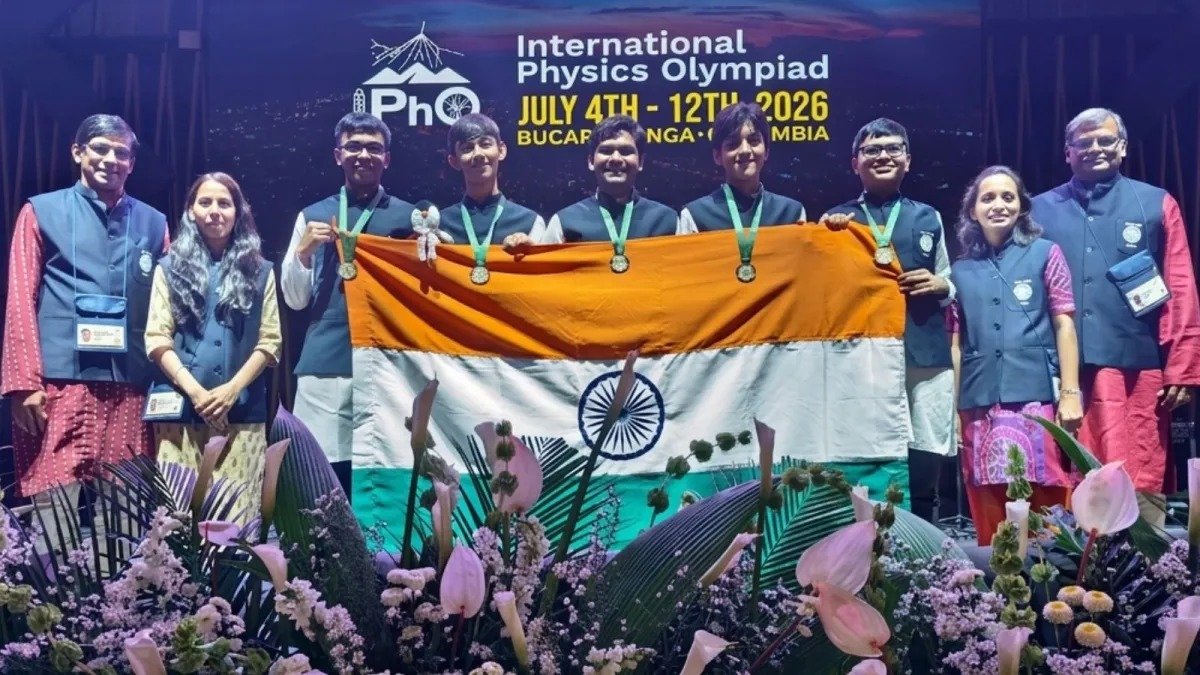
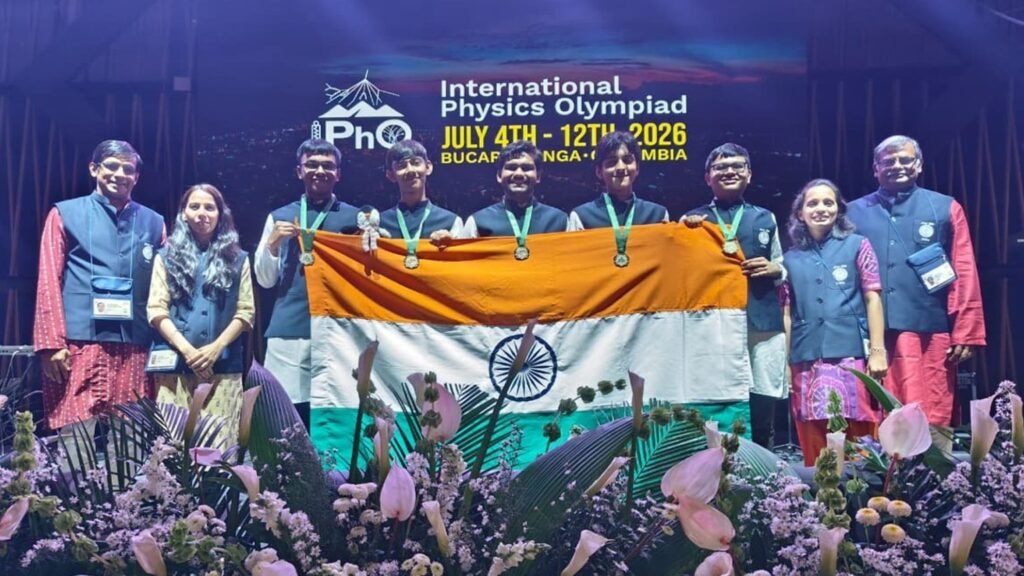
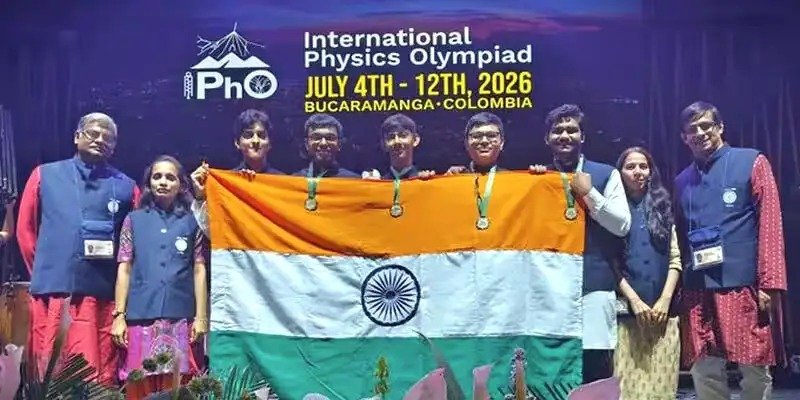
International Physics Olympiad 2026 has become a landmark moment for Indian science education, with the country’s five-member contingent delivering an extraordinary performance by winning five gold medals and helping India secure the joint World No. 1 position. Competing against some of the brightest young minds from across the globe, the Indian team showcased exceptional scientific ability, problem-solving skills, and academic excellence at one of the world’s most prestigious science competitions.
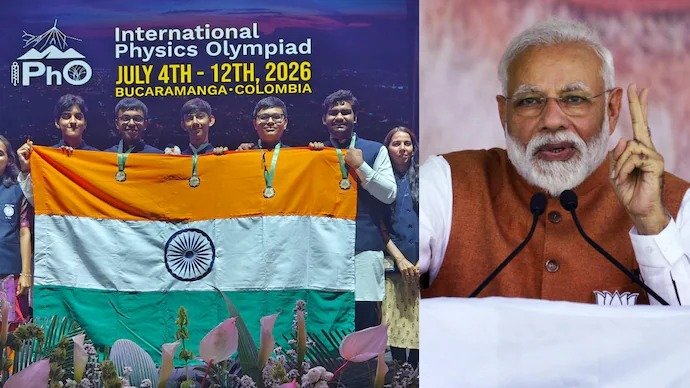
Prime Minister Narendra Modi congratulated the students for their remarkable achievement, describing their success as a reflection of India’s growing scientific talent and the limitless potential of the country’s youth. The achievement further strengthens India’s reputation in international science competitions and highlights the effectiveness of the country’s Olympiad training ecosystem.
Held in Bucaramanga, Colombia, the 56th edition of the International Physics Olympiad brought together 381 students from 87 countries, making it one of the most competitive global events for pre-university physics students.
Table of Contents
India Secures Historic Global Ranking
The International Physics Olympiad is widely regarded as the highest-level international competition for school students passionate about physics. Every participating country selects only its best-performing students through an extensive national selection process, making the competition extremely challenging.
India’s performance this year was historic for multiple reasons.
For the first time, every member of the Indian contingent secured a gold medal, enabling the country to jointly claim the World No. 1 position alongside China, Kazakhstan, Russia, South Korea, and Taiwan.
Sharing the top global ranking with countries that have long dominated international science competitions represents a significant milestone for India’s academic community.
The result also reflects India’s consistent investment in science education and talent development over the past decade.
Prime Minister Narendra Modi Congratulates the Winners
Soon after the results were announced, Prime Minister Narendra Modi congratulated the students through a message shared on social media.
Praising their outstanding performance at the International Physics Olympiad, the Prime Minister said the achievement demonstrated the immense capability of India’s young generation and their growing interest in science and research.
He also highlighted that Indian students have consistently performed exceptionally well in recent editions of the Olympiad, reflecting the country’s sustained progress in nurturing scientific talent.
The Prime Minister’s message recognised not only the medal winners but also the broader ecosystem of teachers, mentors, trainers, and institutions that prepare students for such demanding international competitions.
Meet India’s Gold Medal Winners
The five students who represented India at the International Physics Olympiad come from different parts of the country, reflecting the nationwide reach of India’s Olympiad programme.
The gold medal winners are:
- Kanishk Jain from Pune, Maharashtra
- Riddhesh Anant Bendale from Indore, Madhya Pradesh
- Rishit Garg from Dwarka, New Delhi
- Shresth Suraiya from Mumbai, Maharashtra
- Svarit Joshi from Ahmedabad, Gujarat
Each of these students successfully cleared multiple stages of India’s highly competitive Olympiad selection process before earning the opportunity to represent the country internationally.
Winning gold at the International Physics Olympiad requires exceptional conceptual understanding, analytical reasoning, mathematical ability, and the capacity to solve complex scientific problems under strict examination conditions.
What Makes the International Physics Olympiad So Prestigious?
Established in 1967, the International Physics Olympiad is one of the oldest and most respected global science competitions for secondary school students.
Every year, participating countries send carefully selected teams consisting of their highest-performing physics students.
Unlike conventional school examinations, the International Physics Olympiad focuses on advanced scientific thinking rather than memorisation.
Participants are required to solve challenging theoretical and experimental problems that test their understanding of mechanics, electricity, magnetism, optics, thermodynamics, quantum physics, modern physics, and advanced mathematical applications.
The examination often involves concepts normally taught at undergraduate university level, making the competition extremely demanding.
Students are evaluated on their logical reasoning, creativity, precision, and ability to apply scientific principles to unfamiliar situations.
Competition Against the World’s Brightest Students
The scale of the International Physics Olympiad illustrates the significance of India’s achievement.
This year’s competition featured 381 students representing 87 countries from every continent.
Many participating nations have highly developed science education systems with decades of experience in Olympiad preparation.
Countries such as China, South Korea, Russia, Taiwan, and Kazakhstan have traditionally maintained strong records in international science competitions through specialised training programmes and advanced research-oriented education.
India’s ability to match these countries at the highest level demonstrates the growing maturity of its own scientific training ecosystem.
India’s Consistent Olympiad Success
The latest achievement is not an isolated success.
India has steadily improved its performance at the International Physics Olympiad over the past decade.
Remarkably, every Indian participant during the last ten years has secured a podium finish, highlighting the consistency of the country’s preparation system.
This sustained success reflects long-term investment in identifying talented students at an early stage and providing them with world-class scientific training.
Rather than relying on individual brilliance alone, India’s Olympiad programme has developed a systematic pipeline for nurturing scientific excellence.
HBCSE Plays a Central Role
Behind India’s success at the International Physics Olympiad stands the Homi Bhabha Centre for Science Education (HBCSE).
The institution functions as a National Centre of the Tata Institute of Fundamental Research (TIFR) under the Department of Atomic Energy.
HBCSE serves as India’s official nodal agency for all international science Olympiads.
Its responsibilities extend far beyond selecting students.
The organisation identifies talented students through nationwide examinations, conducts multiple stages of evaluation, organises orientation camps, provides intensive academic training, and prepares students for the demanding international competitions.
This comprehensive approach has enabled India to consistently perform well across Physics, Mathematics, Chemistry, Biology, Astronomy, and Junior Science Olympiads.
How Students Reach the International Physics Olympiad
Representing India at the International Physics Olympiad involves an extremely rigorous selection process.
Students first compete in national-level examinations involving thousands of participants from schools across the country.
Only the highest-performing candidates advance to successive rounds, where they undergo increasingly difficult theoretical and practical assessments.
The final shortlisted students attend specialised orientation and training camps conducted by HBCSE.
These camps focus on advanced physics concepts, experimental techniques, laboratory skills, scientific reasoning, and international examination standards.
By the time students reach the International Physics Olympiad, they have already undergone months of intensive preparation under expert mentors.
Importance of Physics Education
Achievements at competitions such as the International Physics Olympiad have significance beyond winning medals.
Physics forms the foundation of numerous modern technologies, including semiconductors, artificial intelligence hardware, renewable energy systems, aerospace engineering, quantum computing, medical imaging, telecommunications, and advanced manufacturing.
Countries that invest in physics education often develop stronger research ecosystems capable of driving technological innovation and economic growth.
Encouraging young students to pursue scientific excellence therefore contributes to the development of future researchers, engineers, entrepreneurs, and innovators.
Many former Olympiad participants eventually join leading universities, research laboratories, technology companies, and scientific institutions around the world.
Building India’s Scientific Future
India has placed increasing emphasis on strengthening science, technology, engineering, and mathematics (STEM) education in recent years.
Initiatives promoting scientific research, innovation, startup ecosystems, semiconductor manufacturing, space technology, and artificial intelligence all require a strong foundation of skilled scientists and engineers.
Competitions such as the International Physics Olympiad help identify exceptional talent capable of contributing to these national priorities.
They also inspire younger students to pursue careers in science by demonstrating that Indian students can compete successfully with the world’s best.
Such achievements create positive role models for future generations interested in scientific research.
Global Recognition for Indian Talent
The success at the International Physics Olympiad also enhances India’s international academic reputation.
Consistent medal-winning performances demonstrate that Indian students possess the intellectual capability to compete successfully in highly demanding global academic environments.
International science competitions often serve as indicators of a country’s educational quality, research culture, and long-term scientific potential.
By sharing the World No. 1 ranking with some of the strongest science education systems globally, India has reinforced its position as an emerging scientific powerhouse.
The remarkable performance in Bucaramanga reflects not only the dedication of five exceptionally talented students but also the strength of India’s evolving science education ecosystem. With every participant returning home with a gold medal, the International Physics Olympiad 2026 stands as one of the country’s most significant achievements in global academic competition, further showcasing the growing capabilities of India’s young scientific talent on the international stage.