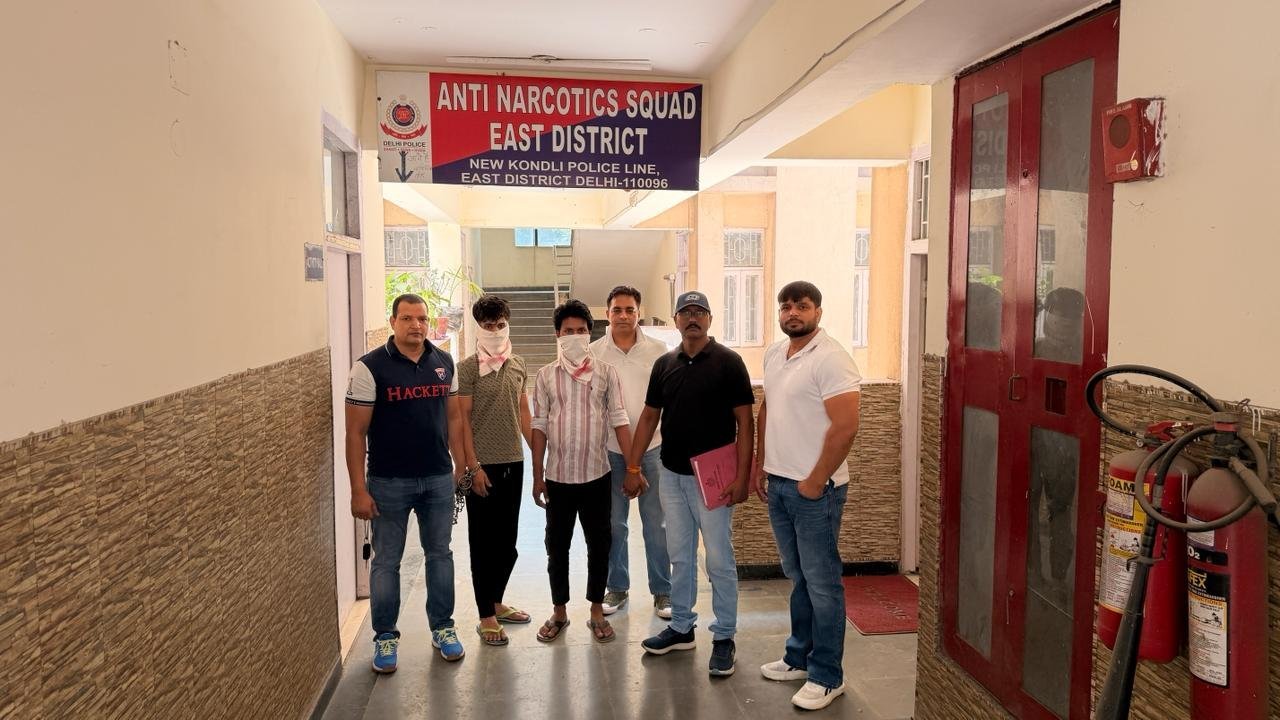
Drug Syndicate operations running between Delhi and Uttar Pradesh suffered a major setback after the Anti-Narcotics Squad of Delhi Police East District busted an inter-state narcotics network and arrested three alleged drug traffickers, including a Bareilly-based source supplier.
In a carefully coordinated operation conducted under the ongoing anti-drug campaign, police recovered 195.56 grams of smack/heroin valued at nearly Rs. 25 lakh in the international illicit market along with a Yamaha scooty allegedly used for transportation of the narcotic substance.
The breakthrough is being viewed as a significant success for East District Police in its continuous crackdown against organized narcotics trafficking in the national capital. Investigators believe the arrested individuals were part of a wider Drug Syndicate operating across Delhi and Uttar Pradesh, supplying psychotropic substances through a chain involving source suppliers, carriers, and local peddlers.
The operation also highlights how modern policing techniques, technical surveillance, field intelligence, and coordinated interstate raids are increasingly helping law enforcement agencies dismantle organized drug trafficking networks before they expand deeper into urban areas.
Police officials stated that the operation was conducted under the zero-tolerance policy against drugs, with special focus on targeting supply chains instead of merely arresting street-level peddlers. Investigators emphasized that stopping the original source of narcotics is critical in breaking the cycle of illegal drug distribution.
Table of Contents
Anti-Narcotics Squad Intensified Campaign Against Drug Syndicate
According to officials, East District Police has been running a sustained drive against narcotics trafficking, drug peddling, and illegal psychotropic substance distribution in Delhi. A dedicated Anti-Narcotics Squad team was constituted specifically to identify suppliers, carriers, and interstate operators linked to organized Drug Syndicate networks.
The team comprised SI Rahul, SI Vikas, ASI Arun, HC Ashok, HC Devesh, HC Vikrant, W/HC Anamika, and Ct. Kaushal under the close supervision of Inspector Arun Kumar, Incharge Anti-Narcotics Squad East, and overall guidance of ACP OPS East Pawan Kumar.
Investigators began working extensively on human intelligence gathering by activating local informers and monitoring suspicious narcotics movement patterns. Police officials say intelligence-based policing has become essential in narcotics investigations because drug trafficking networks rarely operate openly and usually rely on coded communication, hidden transportation routes, and layered supply systems.
Unlike ordinary street crimes, a Drug Syndicate often functions through multiple interconnected links where suppliers, transporters, and peddlers operate separately to reduce exposure. This makes identifying the original source one of the most difficult aspects of narcotics investigations.
The East District Anti-Narcotics Squad reportedly focused specifically on tracing these deeper supply connections rather than limiting the operation to local recoveries.
Secret Information Led Police to Major Drug Syndicate Breakthrough
The operation gained momentum during the intervening night of May 14 and 15, 2026, when the Anti-Narcotics Squad received a secret input regarding an individual named Sarvesh who was allegedly involved in supplying smack in Delhi.
Police received information that the accused would arrive near Ghazipur Dumping Yard on Ghazipur Murga Mandi Road for further supply of narcotics.
Acting swiftly on the intelligence, the Anti-Narcotics Squad laid a trap near the location and successfully apprehended the suspect. The accused was identified as Sarvesh, a 22-year-old resident of Shahjahanpur district in Uttar Pradesh.
During his search, police recovered 73.11 grams of smack, categorized as an intermediate quantity under the NDPS Act.
Following the recovery, FIR No. 180/2026 dated May 15, 2026, was registered under Sections 21, 61, and 85 of the NDPS Act at PS Ghazipur, Delhi.
Officials stated that the arrest of Sarvesh became the first major breakthrough in exposing the Drug Syndicate structure operating between Uttar Pradesh and Delhi.
Interrogation Revealed Organized Supply Chain
During interrogation, accused Sarvesh allegedly disclosed critical information regarding the narcotics network. Investigators learned that he used to procure smack from a source identified as Abrar, a resident of Bareilly district in Uttar Pradesh.
Sarvesh further revealed that the narcotics were being supplied to a receiver and local drug peddler named Sahil, a resident of Mukandpur, Bhalswa Dairy area of Delhi.
Police officials stated that Sarvesh admitted to previously delivering narcotics consignments to Sahil as part of the organized Drug Syndicate operation.
The disclosure helped investigators understand the layered structure of the narcotics chain, where suppliers from Uttar Pradesh allegedly transported narcotics to local Delhi-based peddlers who further distributed them in smaller quantities within urban localities.
Experts say such multi-layered narcotics distribution systems are commonly used by organized Drug Syndicate networks to reduce direct exposure of major suppliers and create operational distance between source and street-level distribution.
Trap Near Jahangirpuri Metro Station Led to Second Arrest
After obtaining crucial information from Sarvesh, the Anti-Narcotics Squad intensified the operation and immediately launched efforts to apprehend receiver and alleged drug peddler Sahil.
On May 15, 2026, the police team laid another trap near Jahangirpuri Metro Station in Delhi.
Acting on the instance of accused Sarvesh, police successfully apprehended Sahil, aged 24 years, a resident of Main Janta Vihar, Mukandpur, Bhalswa Dairy.
During the search operation, police recovered an additional 92.45 grams of smack from his possession. A Yamaha scooty bearing registration number DL8SDN****, allegedly used for transportation of narcotics, was also recovered.
Investigators believe the scooty played an important role in discreet movement of narcotics within Delhi NCR. Two-wheelers are frequently used in narcotics transportation because they allow quick movement through crowded urban roads while attracting minimal suspicion.
Police officials stated that the second recovery strengthened evidence regarding the existence of a functioning Drug Syndicate supplying psychotropic substances within Delhi.
Police Focused on Arresting the Main Source
One of the most important aspects of the operation was the decision by investigators to continue the crackdown until the original source supplier was apprehended.
Police officials clearly stated during investigation that unless the source of psychotropic substances was arrested, the inflow of narcotics into Delhi would continue.
This approach reflects a broader shift in anti-narcotics policing strategies where law enforcement agencies increasingly target entire supply chains instead of only arresting local peddlers.
Senior officers of the Anti-Narcotics Squad reportedly briefed the team intensively and directed immediate action to trace the Bareilly-based source supplier identified as Abrar.
Investigators conducted multiple raids in Delhi NCR and Uttar Pradesh using technical surveillance, location tracking, interrogation inputs, and human intelligence.
The operation eventually led police teams to the Badaun-Bareilly Road area near Village Bhamora in Bareilly district, Uttar Pradesh.
Bareilly-Based Source Supplier Arrested
In a major breakthrough, police succeeded in arresting accused Abrar, aged 40 years, who was allegedly functioning as the main source supplier within the Drug Syndicate.
During his search, police recovered an additional 30 grams of smack.
Officials believe Abrar played a key role in supplying narcotics to carriers and local distributors operating in Delhi.
The arrest of a source-level supplier is considered highly significant in narcotics investigations because it disrupts the upstream supply mechanism of the Drug Syndicate. Law enforcement agencies often struggle to reach source operators because they remain insulated from direct street-level transactions.
Investigators say organized narcotics operations generally function through carefully maintained chains where suppliers avoid direct interaction with consumers.
The arrest of Abrar therefore represents more than just an individual apprehension. Police believe it may help uncover broader interstate narcotics connections and supply routes operating between Uttar Pradesh and Delhi NCR.
Drug Syndicate Operated Through Profit-Driven Network
During detailed interrogation, police found that all three accused were allegedly driven primarily by financial gain.
Investigators stated that accused Sahil initially began purchasing small quantities of smack for personal consumption before gradually entering illegal distribution for monetary profit. Police revealed that Sahil had earlier also been arrested in an NDPS-related case.
As profits increased, the accused allegedly became more deeply involved in organized narcotics trade.
According to investigators, Sahil started purchasing larger quantities of smack from Sarvesh and then selling smaller pouches at higher prices within Delhi NCR.
Police officials believe the Drug Syndicate specifically targeted urban areas where demand for narcotics remains high and addiction vulnerabilities are frequently exploited for illegal earnings.
Accused Sarvesh allegedly acted as the middle-level supplier connecting Delhi-based peddlers with the Uttar Pradesh source network.
Meanwhile, Abrar reportedly functioned as the primary supplier responsible for arranging the narcotics from the Bareilly-Badaun region.
The structured chain indicates a coordinated Drug Syndicate model where each accused had a specific operational role.
Rising Threat of Interstate Drug Syndicate Networks
The operation once again highlights the growing challenge posed by interstate Drug Syndicate networks in major metropolitan cities like Delhi.
Experts say narcotics trafficking has increasingly evolved into a sophisticated organized crime activity involving layered distribution systems, interstate transportation, digital communication, and localized street distribution.
Drug Syndicate groups frequently use smaller carriers and local peddlers to avoid exposing source operators directly to law enforcement agencies.
Police officials across India have repeatedly warned that narcotics trafficking not only damages public health but also contributes to broader criminal activity including organized gangs, extortion, theft, violence, and illegal financial networks.
The rise in synthetic and heroin-based substance distribution in urban areas has become a major concern for anti-narcotics agencies.
According to experts, young individuals struggling with addiction are often manipulated into becoming part of Drug Syndicate operations as carriers or local distributors in exchange for financial benefits or substance access.
This creates a cycle where addiction and organized crime become interconnected.
Delhi Police Intensifying Anti-Drug Operations
The latest crackdown reflects the aggressive anti-drug strategy currently being implemented by Delhi Police under its zero-tolerance campaign against narcotics.
Police officials stated that continuous operations are being conducted to identify carriers, suppliers, and local peddlers involved in psychotropic substance distribution.
The Anti-Narcotics Squad of East District has particularly focused on combining human intelligence with technical surveillance to identify hidden trafficking routes and supply chains.
The professionalism and persistence shown by the police team in this case have drawn appreciation because interstate narcotics investigations are often lengthy, risky, and technically challenging.
Tracking source suppliers across state borders requires coordination, intelligence gathering, and sustained field operations.
The successful dismantling of this Drug Syndicate demonstrates how coordinated police efforts and intelligence-led investigations can effectively target organized narcotics trafficking networks operating across Delhi NCR and neighboring states.