
TTFI loses recognition with immediate effect after failing to hold elections on time; IOA asked to establish an ad hoc committee to oversee Indian table tennis
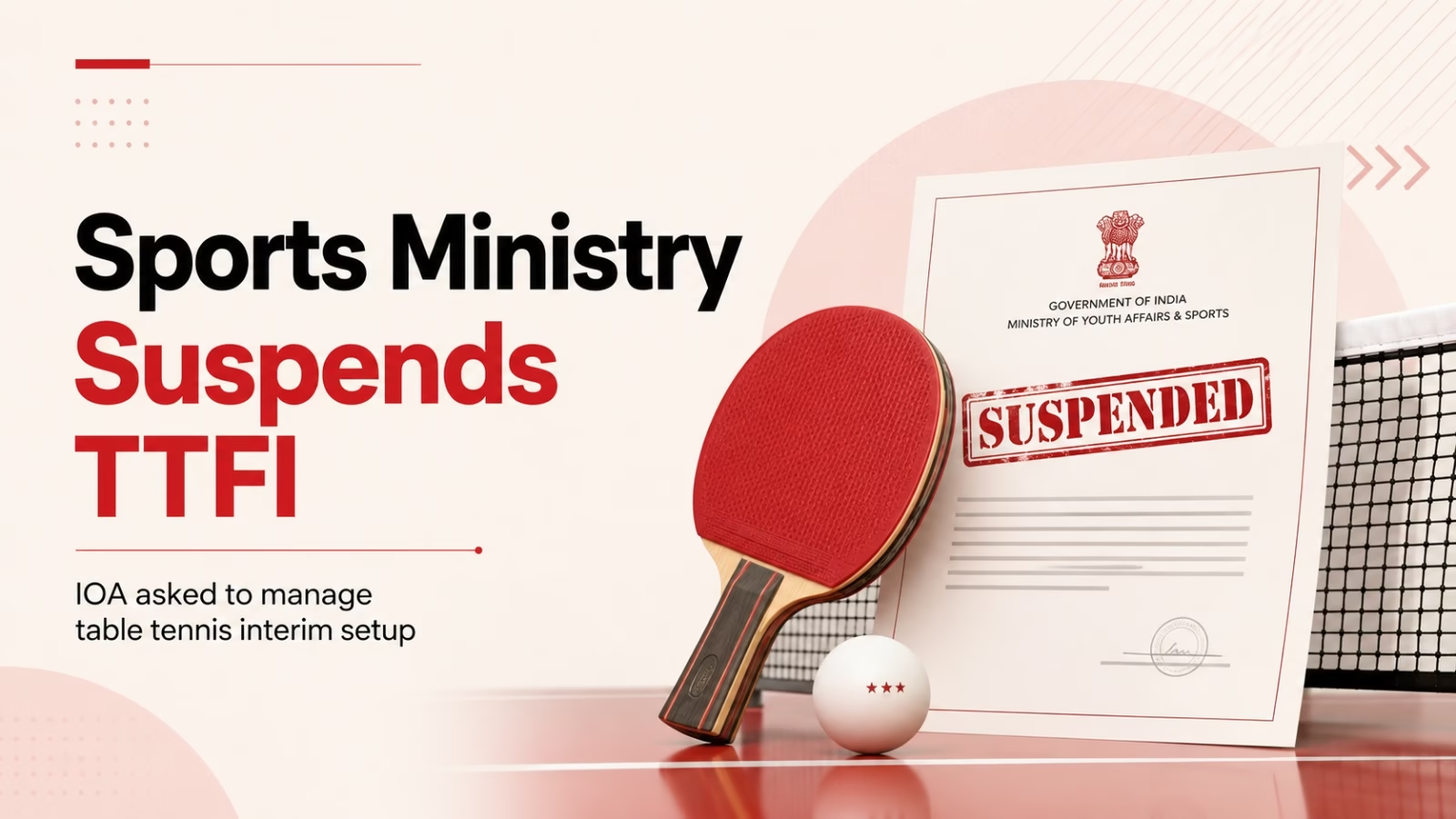
Table Tennis Federation of India (TTFI) has had its recognition suspended by the Ministry of Youth Affairs and Sports with immediate effect, citing governance and administrative failures within the national governing body. The decision places the federation under an interim arrangement at a crucial time for Indian table tennis, with the Indian Olympic Association (IOA) instructed to work with the international governing body to establish an ad hoc committee until a compliant governance structure is restored.
The ministry’s action followed the TTFI’s failure to conduct elections within the prescribed timeframe and what officials described as an unsatisfactory response to a show-cause notice. The move has created fresh uncertainty around the administration of Indian table tennis and comes only weeks before the country’s paddlers are due to compete at the 2026 Asian Games.
The suspension is not an isolated development for the federation. TTFI has been dealing with internal disagreements, disputes among senior office-bearers and questions surrounding its decision-making processes. A Delhi High Court judgment earlier in 2026 also highlighted serious factionalism within the organisation and ordered an independent inquiry into its functioning.
Table of Contents
Sports Ministry Cites Governance Deficiencies
The immediate reason for the suspension is the Table Tennis Federation of India’s failure to meet governance requirements laid down for recognised national sports federations.
According to the ministry’s order, the Table Tennis Federation of India did not conduct its elections within the stipulated period. The federation was subsequently given an opportunity to respond to a show-cause notice, but the ministry was not satisfied with the explanation provided.
The ministry’s action reflects the principle that recognition as a national sports federation is conditional on compliance with the government’s governance framework.
The National Sports Development Code of India, 2011, contains provisions covering issues such as elections, tenure of office-bearers and the functioning of national sports bodies. Compliance with those requirements is an important part of maintaining official recognition.
The latest decision therefore goes beyond a disagreement over an individual appointment or selection decision. It relates to the wider institutional functioning of the Table Tennis Federation of India and whether its governance structure meets the standards expected from a recognised national sporting body.
IOA Asked to Form Ad Hoc Committee
With the Table Tennis Federation of India’s recognition suspended, the Sports Ministry has asked the Indian Olympic Association to step in and oversee the administration of the sport through an interim mechanism.
The ministry has said the IOA, in consultation with the International Table Tennis Federation (ITTF), should take appropriate steps to create an internal regulatory arrangement, including the constitution of an ad hoc committee. The committee is intended to function until a properly constituted governance structure is restored within the Table Tennis Federation of India.
The arrangement is designed to ensure that the suspension does not bring the administration of Indian table tennis to a complete standstill.
The interim committee would effectively provide a temporary structure for handling administrative responsibilities while the Table Tennis Federation of India works towards restoring compliance.
The involvement of the IOA and consultation with the ITTF are also significant because Indian table tennis operates within both national and international sporting structures.
Suspension Comes Ahead of Asian Games
The timing of the decision adds to its significance.
The Sports Ministry suspended the Table Tennis Federation of India’s recognition roughly five weeks before India’s table tennis players are scheduled to compete at the 2026 Asian Games.
The Asian Games are one of the most important multi-sport competitions for Indian athletes, and table tennis has become an increasingly important discipline for the country.
The immediate administrative challenge will therefore be to ensure that preparations for the continental competition are not disrupted by the Table Tennis Federation of India’s governance problems.
Athletes and coaches will need stability around selection, travel, preparation and competition arrangements. The interim administrative mechanism will be expected to maintain continuity while the broader governance dispute is addressed.
For the players, the priority remains performance. However, uncertainty within the governing body can create additional complications if administrative responsibilities are not clearly assigned.
TTFI Has Faced Internal Factionalism
The latest suspension follows a period of considerable internal conflict within the Table Tennis Federation of India.
The Delhi High Court, in a judgment delivered on May 11, 2026, dealt with a dispute involving then Secretary General Kamlesh Mehta and the federation.
The court set aside the order that had suspended Mehta from his position, finding that the process had not satisfied basic principles of natural justice. At the same time, the court noted the seriousness of the allegations made by senior office-bearers against one another and observed that there appeared to be two factions within the federation competing for control, power and influence.
The court ultimately appointed former Supreme Court judge Justice Krishna Murari as an inquiry authority to examine the conduct and functioning of the Table Tennis Federation of India, including its office-bearers.
The judgment illustrates how internal differences had moved beyond ordinary organisational disagreements and become a matter requiring judicial scrutiny.
Kamlesh Mehta Dispute Added to Governance Concerns
The dispute involving Kamlesh Mehta became one of the most visible episodes in the Table Tennis Federation of India’s recent internal problems.
Mehta, a former Indian table tennis player and Olympic representative, had been suspended by the federation in January 2026 pending an inquiry. He challenged the decision in the Delhi High Court.
The court eventually set aside the suspension because of procedural concerns but also made clear that the allegations surrounding the federation’s functioning warranted further investigation.
The court’s observations were significant because they highlighted the extent of the disagreement at the Table Tennis Federation of India’s highest levels.
The judgment pointed to allegations involving the president and secretary general and described the existence of apparent factions within the organisation.
That backdrop is relevant to the Sports Ministry’s latest decision because it indicates that the governance concerns were not limited to the failure to conduct elections.
Meghna Ahlawat and TTFI Leadership
The federation is headed by Meghna Ahlawat, who became its first woman president following the 2022 elections.
Those elections were themselves held after earlier legal intervention involving the Table Tennis Federation of India.
The Delhi High Court’s 2026 judgment noted that fresh elections to TTFI’s executive committee were held on December 5, 2022, under the supervision of retired Justice Vineet Saran. Mehta was elected secretary general, while Ahlawat became president.
The subsequent disputes between senior officials demonstrate that conducting elections is only one part of ensuring effective governance.
A federation also requires functioning institutions, clear responsibilities, transparent decision-making and cooperation among its office-bearers.
The current suspension indicates that the government believes those requirements have not been adequately fulfilled.
Manika Batra Selection Controversy
Table Tennis Federation of India’s governance problems have also intersected with athlete-selection debates.
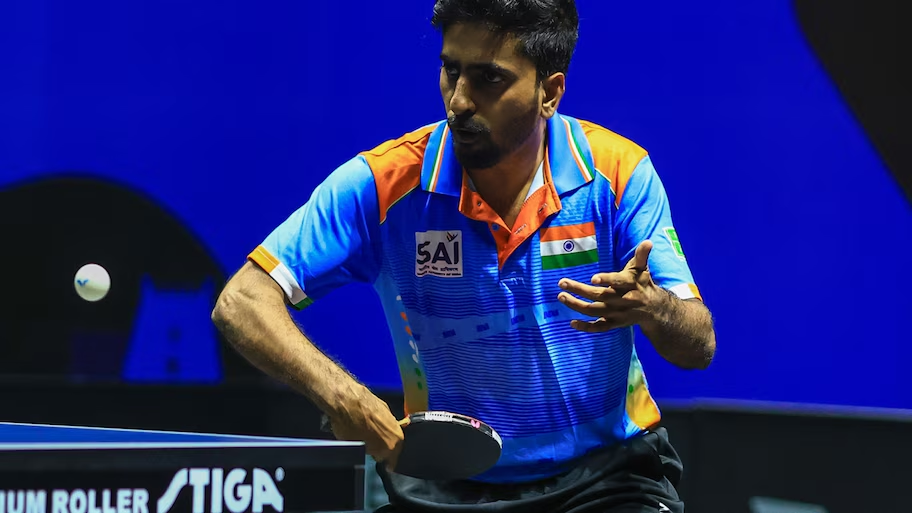
Earlier in 2026, prominent Indian player Manika Batra raised concerns over her exclusion from India’s Asian Games squad. She expressed disappointment and sought clarification regarding the selection process involving the Table Tennis Federation of India.
Table Tennis Federation of India subsequently defended the selection decision, stating that due process had been followed and that the squad had been selected according to its established criteria.
According to the material provided, the federation’s selection policy allocated 50 per cent weightage to national rankings, 40 per cent to world rankings and 10 per cent to the discretion of the selection committee.
Selection controversies are especially sensitive in elite sport because they directly affect athletes’ participation in major international competitions.
For Table Tennis Federation of India, such disputes have added to wider questions about transparency and decision-making.
What the Suspension Means for Indian Table Tennis
The suspension of recognition changes the administrative structure under which Indian table tennis will operate.
Rather than Table Tennis Federation of India functioning normally as the recognised national sports federation, an interim mechanism involving the IOA will oversee the sport.
The immediate objective is continuity.
Players need to continue training and preparing for competitions. Coaches need clarity about schedules and selection matters. International commitments must also continue to be managed.
The ad hoc arrangement is therefore intended to provide stability while Table Tennis Federation of India addresses the governance shortcomings that led to the suspension.
At the same time, the temporary nature of the arrangement means it is not a permanent solution. The ultimate objective remains the restoration of a properly constituted federation.
Why Governance Matters in National Sports Federations
National sports federations play a role far beyond organising tournaments.
They are responsible for selecting teams, coordinating international participation, supporting athletes, appointing coaches and managing the administrative structures through which a sport operates.
Poor governance can therefore have consequences for players even when those players have no involvement in internal disputes.
Delays in elections, disagreements between office-bearers and uncertainty over authority can make it harder for athletes to receive consistent administrative support.
That is why the Sports Ministry’s recognition framework places emphasis on governance requirements.
The suspension of Table Tennis Federation of India demonstrates that compliance is not merely a procedural exercise. It can directly affect the administration of an entire sport.
A Difficult Period for Indian Table Tennis
The suspension comes at a difficult moment for Indian table tennis.
The country has developed a stronger presence internationally in recent years, with Indian players competing successfully at major global and continental events.
Maintaining that momentum requires a stable administrative environment.
The latest developments, however, have shifted attention from the sporting arena to the governance of Table Tennis Federation of India.
The Sports Ministry’s intervention signals that the problems within the Table Tennis Federation of India have reached a point where direct administrative action is considered necessary.
For the federation, the immediate challenge will be to restore an acceptable governance structure while ensuring that the interests of athletes remain protected.
What Happens Next?
The next stage will involve the establishment of the ad hoc committee by the Indian Olympic Association in consultation with the ITTF.
The interim body will administer the sport while the governance structure is being addressed.
At the same time, the broader questions surrounding Table Tennis Federation of India’s functioning will remain relevant.
The ministry’s order makes clear that recognition will remain suspended until a compliant governance structure is restored.
That means Table Tennis Federation of India will need to address the issues that resulted in the suspension rather than simply manage the immediate administrative consequences.
The earlier Delhi High Court order appointing an independent inquiry authority also means that questions around Table Tennis Federation of India’s internal functioning remain subject to further examination.
Athletes Remain at the Centre of the Issue
Despite the administrative conflict, athletes remain the most important stakeholders in Indian table tennis.
Players preparing for major competitions need confidence that selections are made transparently, training programmes are supported and international participation is organised effectively.
The current situation makes those priorities particularly important.
A successful interim arrangement will need to ensure that administrative uncertainty does not spill over into athletes’ preparation.
The upcoming Asian Games add urgency because the competition is approaching quickly.
A Test of Indian Sports Governance
The suspension of TTFI recognition is ultimately a test of how India’s sports governance system responds when a national federation fails to meet expected standards.
The government’s decision demonstrates that recognition comes with responsibilities.
At the same time, the transition to an ad hoc administrative structure will need to be managed carefully so that athletes and international commitments do not suffer.
For TTFI, the path back to recognition will depend on restoring a governance structure that satisfies the required standards.
For Indian table tennis, the immediate priority will be maintaining stability and protecting the preparations of its athletes.
The latest intervention therefore represents both a setback for the federation and an opportunity to address long-standing structural issues.
Until a compliant governance system is restored, Indian table tennis will operate under interim administration — with the country’s players, coaches and supporters hoping that the focus can soon return from federation disputes to success at the table.