
Rath Yatra in Puri, Odisha, witnessed an extraordinary display of civic discipline, spiritual compassion, and rapid community synchronization as thousands of attending pilgrims seamlessly united to form a massive human chain, carving out an emergency rescue corridor for an ambulance trapped in a sea of lakhs of devotees.
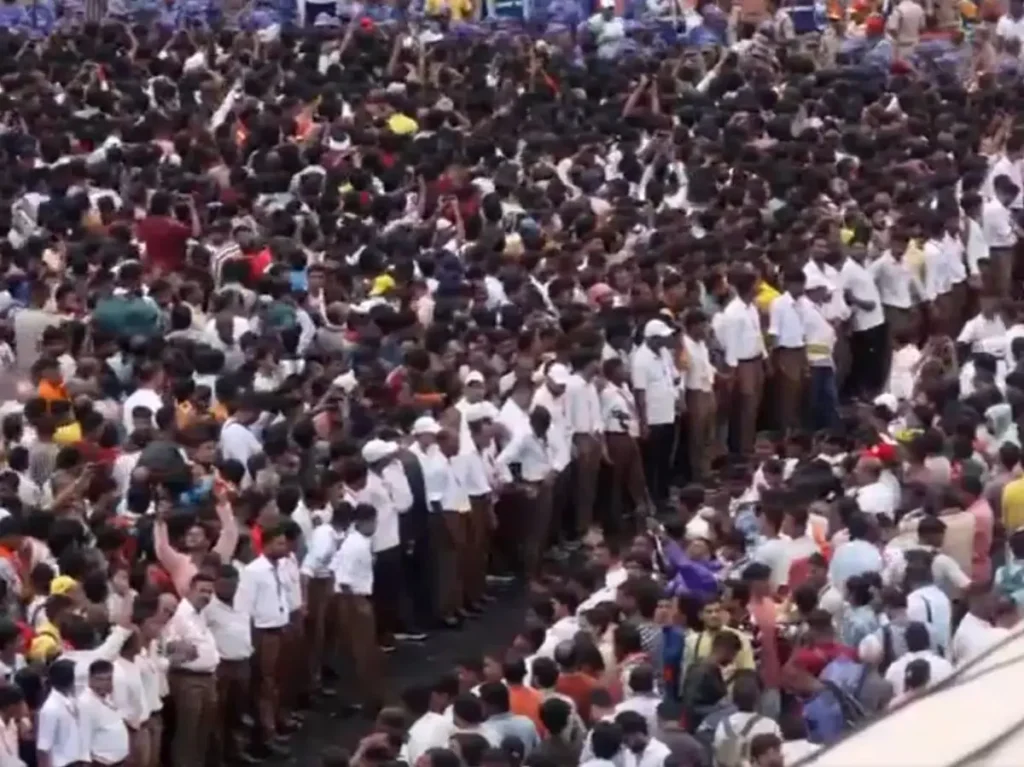
The incident, captured in a video that has since gone viral across major social media platforms, occurred on the iconic Bada Danda (the Grand Road) during the height of the chariot pulling festival. The footage features an inspiring narrative of collective responsibility, showing hundreds of volunteers and thousands of ordinary pilgrims interlocking hands, shifting back incrementally, and creating a perfectly clear passage for an emergency medical vehicle within a matter of moments.
The remarkable act has earned widespread commendation from administrative bodies, socio-cultural organizations, and millions of netizens worldwide, serving as a powerful testament to human empathy prevailing over dense crowd logistics.
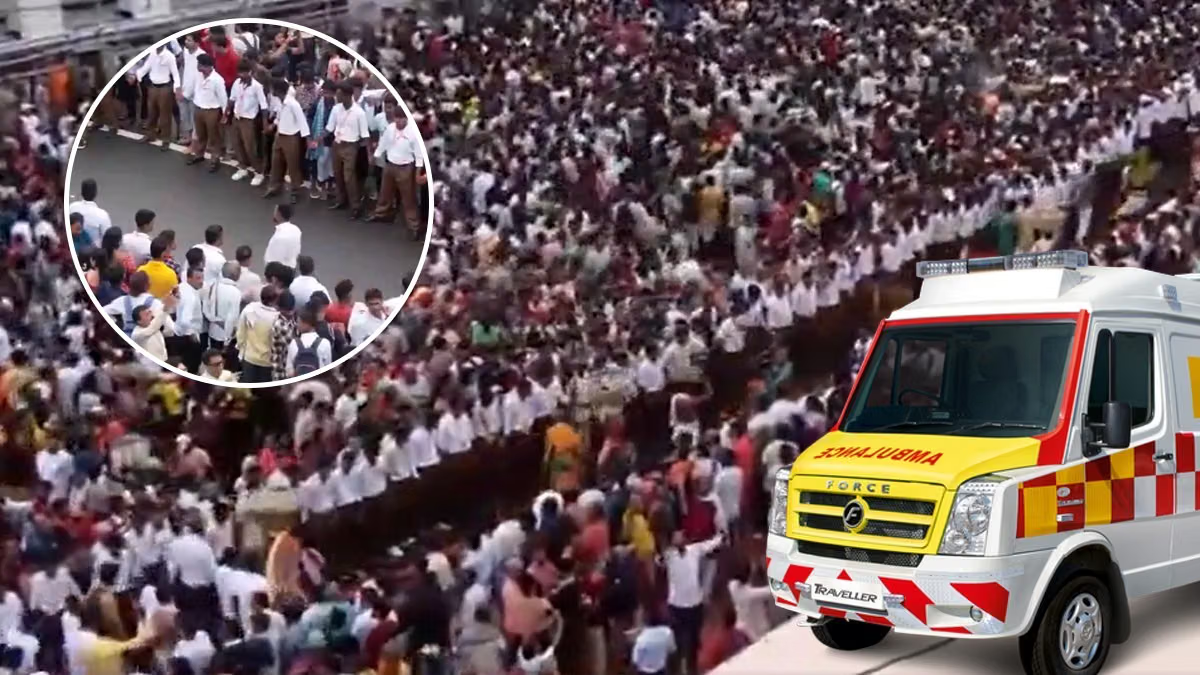
Table of Contents
The Viral Moment: Anatomy of a Spontaneous Rath Yatra Human Chain
The viral video documents what initially seemed like an insurmountable logistical deadlock during the Rath Yatra celebration. As far as the eye could see, a dense ocean of humanity—estimated to comprise hundreds of thousands of pilgrims—was gathered to catch a glimpse of the three grand chariots during this historic Rath Yatra: Nandighosh (Lord Jagannath), Taladhwaj (Lord Balabhadra), and Darpadalan (Goddess Subhadra).
When the distant wail of an ambulance siren pierced the air at the Rath Yatra, the initial assumption among observers was that the vehicle would remain trapped indefinitely due to the sheer density of the Rath Yatra crowd. However, what followed was a highly coordinated, multi-layered rescue response that defined the civic spirit of the Rath Yatra:
- Immediate Mobilization: Stationed volunteers deployed for the Rath Yatra immediately identified the direction of the emergency vehicle within the massive congregation.
- The Chain Link Effect: Rath Yatra volunteers began linking hands, signaling to the surrounding devotees to compress together horizontally and yield space along the Rath Yatra route.
- Orderly Recess: Rather than panicking or pushing forward, the waves of Rath Yatra pilgrims displayed immaculate civic sense, calmly stepping aside onto the flanks of the Grand Road.
- Unobstructed Exit: Within seconds, a wide, sterile path materialized out of the dense Rath Yatra crowd, allowing the ambulance to navigate through the Rath Yatra congregation at high speed without single-file friction or delay.
The Role of Trained Volunteers and Civil Society in Rath Yatra Security
While the coordination appeared beautifully spontaneous, reports indicate that meticulous preparation laid the groundwork for such emergency responses during the annual Rath Yatra. Roughly 1,200 trained volunteers were deployed across key zones of the grand Rath Yatra festival specifically tasked with Rath Yatra crowd management, tracking medical emergencies, and ensuring public safety.
Among these organizations, volunteers from various socio-cultural groups were highly visible on the ground, utilizing pre-planned human-chain drilling techniques to act as human barricades and ensure that the vital Rath Yatra transport pathways remained pliable under crisis.
These volunteers, working in tandem with the Odisha Police, the Special Rescue Unit (SRU) of the Odisha Fire & Emergency Services, and local healthcare coordinators, operated under rigid protocols tailored for the Rath Yatra. The strategic deployment ensured that even when Rath Yatra public address systems were drowned out by devotional chants, conch shells, and the roaring energy of the Rath Yatra festival, visual hand signals and physical human lines could guide emergency services seamlessly through the Rath Yatra metropolis.
A Stark Contrast to Recent Crowd Tragedies
The uplifting nature of the viral ambulance corridor stands in sharp contrast to the underlying vulnerabilities of managing mega-religious events, coming at a time when safety protocols are under strict scrutiny. This year’s Rath Yatra cycle has faced significant logistical hurdles, marred by instances of intense crowd surges that led to casualties and mass hospitalizations.
During the initial Gundicha Yatra opening procession, a severe, localized stampede-like situation near the Marichikote Chowk resulted in two fatalities and over 100 hospitalizations. The intense humidity coupled with an unprecedented crowd surge overwhelmed early responses. Tragically, initial press reports noted that this specific crowd surge occurred when parts of the dense crowd tried to move away suddenly to clear a path for a different emergency vehicle. People fell over one another in the humid conditions, resulting in severe fractures, respiratory distress, and cardiac issues.
Additionally, during the Bahuda Yatra (the return chariot procession), a 57-year-old devotee from Cuttack suffered fatal suffocation and breathlessness while pulling the chariot of Goddess Subhadra, requiring immediate extraction by the Railway Protection Force (RPF) and field volunteers.
The dichotomy of these incidents illustrates the volatile nature of crowd mechanics. While one ambulance movement inadvertently caused a localized surge leading to injuries, the disciplined, volunteer-led human chain successfully prevented a repeat disaster. This underscores how crucial structured, calm coordination is when managing millions of people in constrained urban pathways.

Global Acclaim and Social Media Reactions
The video has triggered an outpouring of emotional and celebratory reactions across various social platforms, including X (formerly Twitter), Instagram, and Facebook. The footage has been shared by public figures, administrative experts, and cultural commentators, who view the event as an educational case study in community-driven crisis management.
“This is the absolute embodiment of civic duty meeting spiritual devotion. To see lakhs of people, entirely consumed by religious fervor, instantly drop everything to save a single human life is nothing short of breathtaking,” commented one widely shared post on X.
Other social media users framed the incident through a philosophical lens, describing the seamless cooperation as “the true spirit of Sanatan Dharma” and “humanity at its absolute peak.” Public health experts also praised the video, noting that Western nations often rely on hard concrete barriers to enforce emergency lanes, whereas the Puri congregation showcased that a deeply rooted cultural fabric of compassion can act as a highly effective, dynamic biological barrier to protect human life.
The Lesson in Civic Responsibility
The ultimate takeaway from the Puri ambulance corridor extends beyond the borders of Odisha. For municipal corporations, state executives, and religious trusts tasked with organizing mega-events globally, the incident demonstrates that top-down police enforcement must always be paired with bottom-up civic engagement.
When dealing with a gathering that defies standard mathematical containment, safety cannot rely solely on steel barricades or police batons. It requires educating the public, building robust networks of localized civil society volunteers, and maintaining an environment where empathy remains the primary operational response to a crisis.
As the historic town of Puri concludes its grand festival cycles, the image of thousands of strangers linking arms to shield and usher an unknown patient to safety will endure as the definitive image of the celebration—a profound proof that even within the most overwhelming chaos, humanity will always find its strongest, most disciplined expression.