
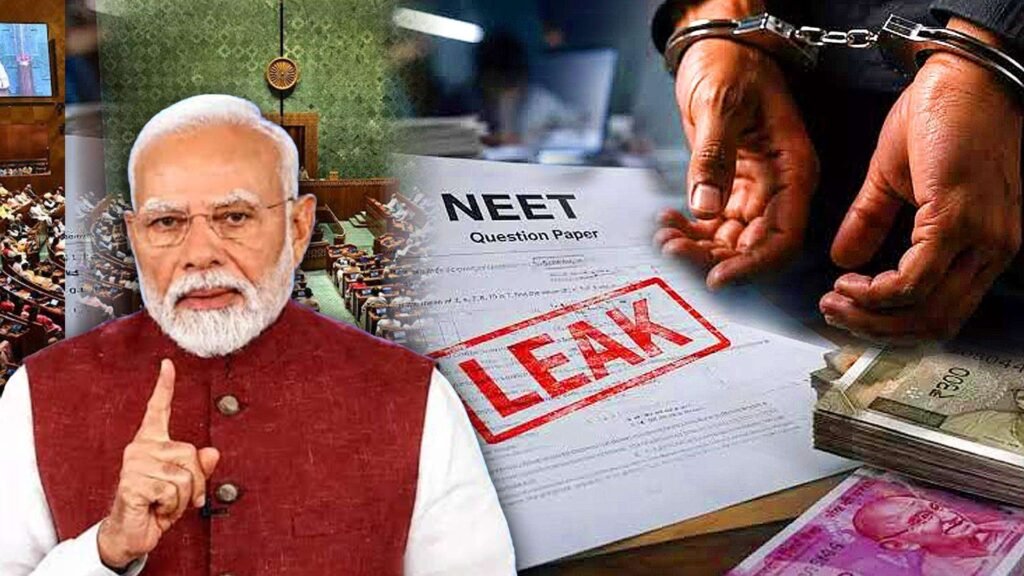
In one of the most significant legislative responses to India’s ongoing examination integrity crisis, the Central Government has introduced the Public Examinations (Prevention of Unfair Means) Amendment Bill, 2026 in the Lok Sabha. The proposed legislation seeks to impose much stricter penalties on individuals, organized groups, examination centres, and institutions involved in question paper leaks and other forms of examination malpractice.
The Bill comes in the wake of the NEET-UG 2026 controversy, which triggered nationwide student protests, political debates, and renewed public concern over the credibility of India’s competitive examination system. If passed by Parliament, the amendment would substantially strengthen the existing Public Examinations (Prevention of Unfair Means) Act, 2024, increasing the maximum punishment to 10 years’ imprisonment and allowing fines of up to ₹10 crore in the most serious cases involving organized examination fraud.
Table of Contents
Government Moves to Strengthen Anti-Paper Leak Law
According to government officials, the amendment aims to close loopholes in the current law and create a stronger deterrent against organized paper leak rackets. The proposed legislation targets not only individuals directly involved in leaking examination papers but also institutions, examination service providers, coaching networks, and criminal syndicates that facilitate unfair practices.
The Union Cabinet recently approved the draft amendment, paving the way for its introduction in Parliament. Officials have stated that the objective is to restore public confidence in national-level examinations conducted by agencies such as the National Testing Agency (NTA), UPSC, SSC, Railway Recruitment Boards, banking recruitment bodies, and other public examination authorities.
What the Amendment Proposes
One of the biggest changes proposed in the Bill is a substantial increase in punishment for organized examination fraud.
Key provisions include:
- Up to 10 years of imprisonment for serious offences involving organized paper leaks and examination fraud.
- Financial penalties that may extend up to ₹10 crore in severe cases involving institutions or organized networks.
- Tougher action against examination centres, agencies, service providers, and institutions found facilitating unfair practices.
- Enhanced accountability for organizations responsible for conducting public examinations.
Fast-Track Courts for Speedy Justice
Recognizing that paper leak investigations often take years to conclude, the proposed amendment also seeks to establish a dedicated system for faster prosecution.
The Bill proposes:
- Designation of fast-track courts in every State and Union Territory.
- Daily hearings for examination malpractice cases wherever possible.
- Completion of investigations within a fixed time frame.
- Time-bound trials aimed at ensuring quicker convictions and stronger deterrence against future offences.
Background: Why the Bill Was Introduced
The proposed legislation comes after widespread protests following alleged irregularities in the NEET-UG 2026 examination.
The controversy sparked demonstrations by students and parents across several states, with demands for accountability, stronger examination security, and reforms within the National Testing Agency. Public concern intensified as multiple reports highlighted recurring incidents of paper leaks and organized cheating in competitive examinations over recent years.
How the Existing Law Will Change
The amendment significantly strengthens the existing 2024 framework.
Compared with the earlier provisions, the proposed law:
- Raises imprisonment for organized examination fraud to 5–10 years.
- Increases financial penalties substantially, with the most serious offences attracting fines of up to ₹10 crore.
- Expands liability to include institutions and examination partners involved in malpractice.
- Introduces stronger procedural mechanisms to improve enforcement and prosecution.
Examinations Likely to Be Covered
The proposed legislation applies to major public examinations conducted by Central authorities, including:
- NEET-UG
- JEE
- CUET
- UPSC examinations
- SSC recruitment examinations
- Banking recruitment examinations
- Railway recruitment examinations
- Other public examinations notified by the Central Government
The aim is to create a uniform legal framework to safeguard the integrity of high-stakes examinations across the country.
Why Paper Leaks Have Become a National Concern
India’s competitive examination system serves millions of candidates every year. Medical admissions, engineering seats, civil services, banking jobs, and government recruitment all depend on fair and transparent examinations.
NEET Paper leaks undermine merit, create opportunities for organized crime, and damage public trust. They also force authorities to cancel examinations, conduct costly re-tests, and delay admissions and recruitment, affecting students, institutions, and employers alike.
Impact on NEET Aspirants and Educational Institutions
If enacted, the amendment is expected to:
- Increase accountability among examination authorities.
- Discourage organized cheating networks.
- Improve confidence in competitive examinations.
- Encourage better security protocols and technological safeguards.
- Protect deserving candidates from unfair competition.
Education experts have argued that stronger laws, combined with administrative reforms and technology-driven security, could help reduce the risk of future examination scandals.
For millions of NEET aspirants, the proposed law could help restore confidence in the admission process.
Technology and Future Reforms for NEET and Other Exams
Alongside stricter legal penalties, the government has indicated that broader reforms are being considered to improve examination security.
These include expanding the use of computer-based testing where feasible, strengthening digital monitoring, improving encryption and logistics for question papers, and tightening oversight of examination centres and service providers. Such measures are intended to complement the proposed legal changes rather than replace them.
Political Significance of the NEET Anti-Paper Leak Bill
The introduction of the Bill marks one of the government’s most visible responses to the ongoing debate over examination integrity. While supporters view the proposal as a strong deterrent against organized cheating, opposition leaders and student groups have emphasized that effective implementation, transparency, and institutional reforms will be equally important.
The legislation is therefore expected to remain a major topic of discussion in Parliament and among education stakeholders in the coming weeks.

What Happens Next?
The Bill has been introduced in the Lok Sabha and must pass both Houses of Parliament before becoming law. If approved, the amended provisions would strengthen the existing legal framework against examination malpractice and provide authorities with broader powers to investigate and prosecute organized paper leak cases.
The Public Examinations (Prevention of Unfair Means) Amendment Bill, 2026 represents a major step in the government’s effort to “restore confidence in the NEET examination system and other public examinations.” By proposing up to 10 years’ imprisonment, fines of up to ₹10 crore, and fast-track judicial mechanisms, the Bill seeks to send a strong message against paper leak syndicates and organized examination fraud.
Although the proposed law promises tougher punishment and faster investigations, its long-term success will depend on effective enforcement, transparent examination management, technological safeguards, and continued institutional reforms. For millions of students preparing for competitive examinations each year, the legislation could become an important milestone in strengthening fairness, accountability, and trust in India’s public examination system.