Ultraviolette Automotive has announced a major expansion of its manufacturing operations with a new production facility in Tamil Nadu, marking an important step in the electric two-wheeler maker’s plans to increase production and introduce a wider range of products.
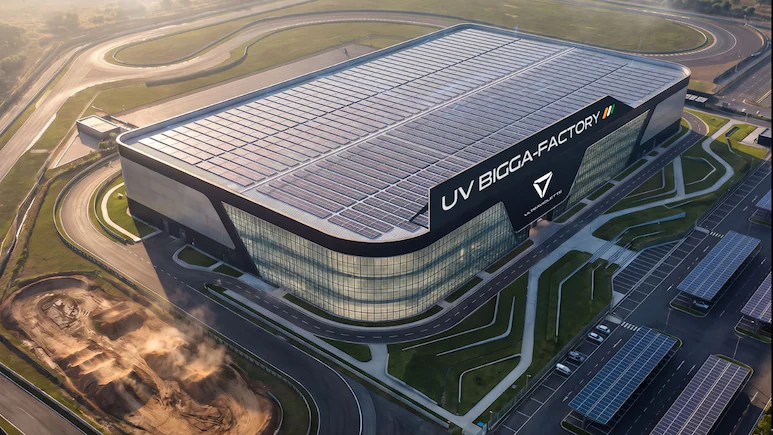
Named BIGGA (Big Global Ambition), the new Ultraviolette manufacturing facility will be located at SIPCOT Industrial Park in Shoolagiri, Hosur. The plant will manufacture the upcoming Ultraviolette Tesseract electric scooter and will also serve as a production base for future motorcycles and scooters.
The facility will initially have an annual production capacity of 2.5 lakh vehicles, with Ultraviolette planning to scale that figure to 5 lakh units annually as market demand increases. The company said the new plant will feature advanced automation, Industry 4.0 manufacturing systems, digital quality-control technologies and a dedicated vehicle test track.
The expansion comes as Ultraviolette prepares to broaden its presence in India’s growing electric two-wheeler market. The company currently has a performance-focused positioning and plans to expand its product portfolio across multiple motorcycle categories as well as electric scooters.
Ultraviolette BIGGA Factory to Be Built in Hosur
The BIGGA Factory will be established at SIPCOT Industrial Park in Shoolagiri, Hosur, Tamil Nadu. The Government of Tamil Nadu will facilitate land allotment for the facility.
Ultraviolette has chosen the location partly because of its proximity to Bengaluru. The company has its research, development and commercial operations in Bengaluru, making Hosur a strategically convenient location for integrating engineering, manufacturing and business operations.
The region also has an established automotive supplier ecosystem. Access to suppliers can be particularly important as Ultraviolette moves towards higher production volumes and develops a larger product portfolio.
By establishing the facility close to its existing engineering base, the company could potentially streamline communication between product development teams and manufacturing operations.
Production Capacity to Start at 2.5 Lakh Units
The new facility will initially be capable of producing 2.5 lakh vehicles per year.
However, the factory has been designed to accommodate future expansion. Ultraviolette plans to increase the production capacity to 5 lakh units annually as demand grows.
This scalable manufacturing strategy is intended to give the company flexibility as it launches new products.
Rather than building a plant exclusively around current demand, Ultraviolette is preparing the BIGGA Factory to support a larger product portfolio over the coming years. The facility will therefore have the capacity to manufacture both scooters and motorcycles.
The eventual production volume will depend on factors including customer demand, new model launches and the company’s expansion across different electric two-wheeler segments.
Tesseract Electric Scooter to Enter Production
The Ultraviolette Tesseract will be one of the key products manufactured at the BIGGA Factory.
According to the company’s announced timeline, the electric scooter is scheduled to enter production at the new facility, with deliveries expected to begin in January 2027.
The Tesseract is positioned as a performance-oriented electric scooter with a strong focus on technology.
It is based on a 100V architecture and will be offered with three battery options: 3.5 kWh, 5.0 kWh and 6.0 kWh.
Ultraviolette claims that the scooter can produce up to 15 kW of peak motor power. The company also claims a 0-60 kmph acceleration time of 2.9 seconds and a top speed of 125 kmph.
The larger battery versions are claimed to deliver an IDC range of up to 261 km.
These specifications are aimed at customers looking for an electric scooter that combines everyday usability with stronger performance than conventional urban-focused electric scooters.
Ultraviolette Tesseract Price and Features
The Tesseract is currently priced from Rs 1.45 lakh, ex-showroom, based on the information provided by Ultraviolette.
The scooter comes equipped with a range of technology and safety features.
One of its most notable systems is radar-based rider assistance technology, including blind-spot detection. The system is intended to help riders monitor surrounding traffic and improve situational awareness.
The scooter also gets dual-channel ABS, which can provide improved braking control, particularly during hard braking or situations where wheel lock-up could occur.
A 7-inch TFT display provides the main digital interface for the rider.
Ultraviolette is also offering front and rear dashcams, allowing riders to record footage while travelling.
Another technology feature is over-the-air update capability. OTA functionality allows compatible software and electronic systems to receive updates remotely.
The Tesseract will also feature 14-inch wheels, under-seat storage and a flat floorboard, combining technology and performance with practical features expected from a scooter.
BIGGA Factory to Use Industry 4.0 Technology
The new factory will rely heavily on advanced manufacturing technologies.
Ultraviolette said the BIGGA Factory will incorporate Industry 4.0 systems, automation and digital quality-control processes.
The facility will use a Manufacturing Execution System (MES) for production monitoring and traceability.
An MES can provide manufacturers with real-time visibility into production processes and help track vehicles and components through different stages of manufacturing. Such systems become increasingly important when production volumes rise and multiple vehicle models are manufactured at the same facility.
Ultraviolette also plans to implement lean manufacturing systems to improve production efficiency and minimise unnecessary processes.
The combination of digital monitoring and lean manufacturing is expected to help the company maintain consistency as production scales.
Collaborative Robots and Automated Assembly
Automation will play a significant role inside the BIGGA Factory.
Ultraviolette plans to deploy collaborative robots, automated assembly systems and vision-based inspection technology.
Collaborative robots are designed to work alongside human employees in selected manufacturing operations. They can assist with repetitive tasks while allowing workers to focus on activities that require greater flexibility and decision-making.
Automated assembly systems will also be used across production processes.
The company expects these technologies to help improve manufacturing consistency, efficiency and quality as output increases.
Vision-based inspection systems will provide another layer of quality control by using automated visual checks during manufacturing.
Digital Quality Control and Traceability
The focus on digital quality control is particularly relevant as Ultraviolette prepares to manufacture vehicles at significantly higher volumes.
The BIGGA Factory’s MES will provide production monitoring and traceability, while digital quality-control systems will help monitor manufacturing processes.
For electric vehicles, production quality involves numerous mechanical, electrical and electronic components. Monitoring these components and their assembly can help manufacturers identify issues more efficiently.
Traceability can also assist in determining where a potential manufacturing problem occurred and which production batches or components may be affected.
Ultraviolette’s approach indicates that the company intends to build quality management directly into the manufacturing process rather than relying solely on end-of-line inspections.
Vehicle Test Track Planned at BIGGA Factory
Another important feature of the facility will be a vehicle test track.
Ultraviolette said the track will be used to evaluate vehicles before they are dispatched from the factory.
Having an integrated test facility can allow the company to conduct final checks on vehicles after production. It can also help streamline the validation process for new models as they enter series production.
The test track will be relevant for both scooters and motorcycles as the company’s product range expands.
For a manufacturer preparing to produce several vehicle categories, the ability to conduct testing close to the production line can provide greater flexibility during both routine manufacturing and future product launches.
Future Ultraviolette Motorcycles Planned Across Multiple Segments
The BIGGA Factory will not be dedicated solely to the Tesseract.
Ultraviolette said the plant will support future motorcycles across Sports, Crossover, Cruiser and Street segments.
This indicates a broader product strategy in which the company intends to address multiple customer requirements rather than remain concentrated in a single performance-oriented motorcycle category.
The addition of scooters further expands the potential customer base.
The planned production capacity of up to 5 lakh vehicles annually could provide the manufacturing infrastructure required to support this wider product strategy.
However, the company’s ability to fully utilise the capacity will depend on the success of its upcoming products and the pace at which demand for electric two-wheelers continues to develop.

Around 2,000 Jobs Expected Initially
The new manufacturing facility is also expected to contribute to employment generation in the region.
Ultraviolette estimates that the BIGGA Factory will create approximately 2,000 jobs initially.
The company expects the number of employees to increase further over the next five years as production expands.
Employment opportunities could cover a range of areas, including production, engineering, quality control, logistics, maintenance and manufacturing technology.
The factory could also generate indirect employment through its supplier network, transportation requirements and other industrial services.
With Hosur already home to a significant automotive manufacturing ecosystem, the project could add further momentum to the region’s position as an important vehicle production hub.
Why the BIGGA Factory Is Important for Ultraviolette
The new plant is strategically important because Ultraviolette is preparing for a substantial expansion of its product range.
The company has developed its brand around electric motorcycles, but the Tesseract will take it into the electric scooter market.
At the same time, the planned Sports, Crossover, Cruiser and Street motorcycle categories suggest that several new products could be introduced in the future.
A scalable factory will be necessary if Ultraviolette wants to support those products at meaningful production volumes.
The move from an initial capacity of 2.5 lakh vehicles to a potential 5 lakh units annually gives the company considerable room to grow without immediately requiring another manufacturing facility.
Tesseract Could Be a Key Test of the Expansion
The Tesseract will be among the first major products to be manufactured under Ultraviolette’s new production strategy.
Its scheduled production start and January 2027 delivery timeline will be closely watched as the company moves towards a broader presence in the electric scooter market.
The scooter’s specifications are designed to distinguish it from conventional electric scooters, with a claimed 15 kW peak output, 2.9-second 0-60 kmph acceleration and 125 kmph top speed.
The larger battery option’s claimed 261 km IDC range and technology features such as radar-based assistance, blind-spot detection, dual-channel ABS, dashcams and OTA updates further strengthen its technology-focused positioning.
At the same time, real-world performance, charging requirements, reliability, after-sales service and consumer acceptance will ultimately determine how successful the model becomes.

Ultraviolette’s Bigger Electric Mobility Ambition
The announcement of the Ultraviolette BIGGA Factory signals that the company is preparing for a much larger role in India’s electric mobility industry.
With an initial capacity of 2.5 lakh vehicles and a potential expansion to 5 lakh units, the facility gives Ultraviolette the manufacturing headroom needed for its upcoming product pipeline.
Its focus on Industry 4.0, automated assembly, collaborative robotics, digital quality control, production traceability and vision-based inspection also shows that the company is aiming to combine scale with modern manufacturing practices.
The Tesseract is expected to enter production at the new plant ahead of deliveries in January 2027. Beyond the scooter, the facility will support future motorcycles and scooters across multiple segments.
The success of the BIGGA Factory, however, will ultimately depend on how effectively Ultraviolette converts its production capacity and technology-led product strategy into sustained market demand.
For now, the Hosur facility represents a major investment in the company’s next phase and reinforces Ultraviolette’s ambition to become a larger player in India’s rapidly evolving electric two-wheeler market.